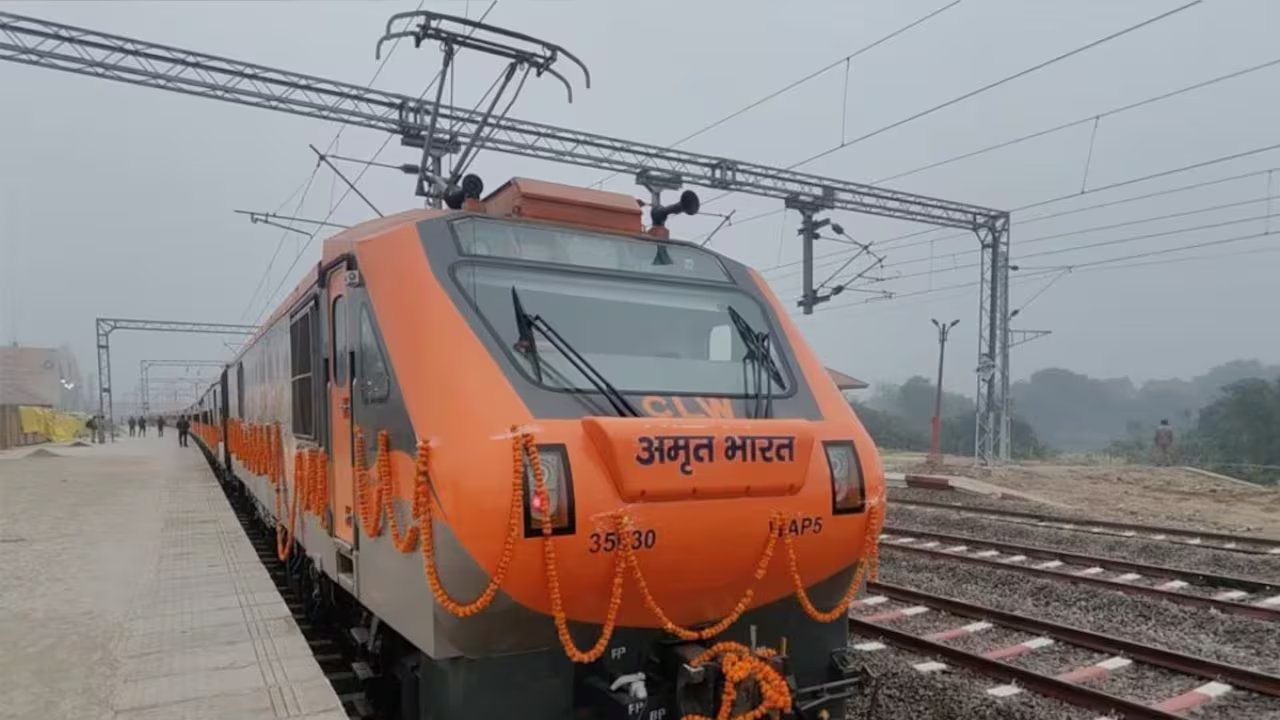
Mumbai has become the latest testing ground for Indian Railways’ efforts to upgrade long-distance passenger mobility, with a new push-pull trainset undergoing high-speed trials on the city’s rail network. The arrival of the Amrit Bharat Express rake for performance testing marks a step towards improving capacity, turnaround time, and operating efficiency on busy intercity corridors that serve millions of migrant and seasonal travellers.
The trials, conducted under the supervision of the national railways’ technical standards authority, are evaluating the train’s performance at speeds of up to 130 kilometres per hour. Railway officials familiar with the process said the objective is to assess braking response, stability, signalling compatibility, and energy efficiency under real operating conditions before wider deployment. Unlike conventional long-distance trains that operate with a single locomotive, the Amrit Bharat rake is built on a push-pull configuration, with locomotives positioned at both ends. This design allows the train to reverse direction without time-consuming shunting, reducing halt times at terminal stations. Transport planners note that such configurations are increasingly relevant for congested nodes like Mumbai, where platform availability and turnaround speed directly affect network reliability.
The Amrit Bharat service has been positioned as a sleeper-class, non-air-conditioned option intended to handle high passenger volumes over long distances. It is aimed particularly at periods of peak demand, such as festivals and large-scale workforce movement between cities and regions. By combining higher operating speeds with simplified onboard amenities, the service seeks to balance affordability with faster end-to-end travel. For Mumbai, which functions as both a major origin and destination for long-distance rail journeys, the trials carry broader urban implications. Rail experts point out that improving intercity rail speeds can ease pressure on road transport and short-haul aviation, both of which carry higher carbon footprints. In the context of climate-conscious urban planning, rail-based mobility remains one of the most energy-efficient modes for mass travel.
The trials also align with Indian Railways’ longer-term push to modernise its rolling stock while extracting greater capacity from existing tracks. Rather than relying solely on new lines, faster and more efficient trains can improve throughput on busy corridors, provided safety benchmarks are met. Industry analysts say this approach is particularly relevant in dense metropolitan regions where land acquisition for new rail infrastructure is complex and costly. From a social perspective, improved long-distance services can make rail travel more predictable and humane for lower- and middle-income passengers who depend on sleeper-class trains. Urban researchers note that reliable, affordable intercity transport supports labour mobility, regional economic integration, and access to employment opportunities.
As testing progresses, railway authorities will evaluate whether the push-pull Amrit Bharat design can be scaled across other routes linking major urban centres. For Mumbai’s rail ecosystem, the outcome could influence how future long-distance services are planned, balancing speed, capacity, and sustainability within an already strained transport network.
Amrit Bharat Push Pull Train Undergoes Speed Testing in Mumbai