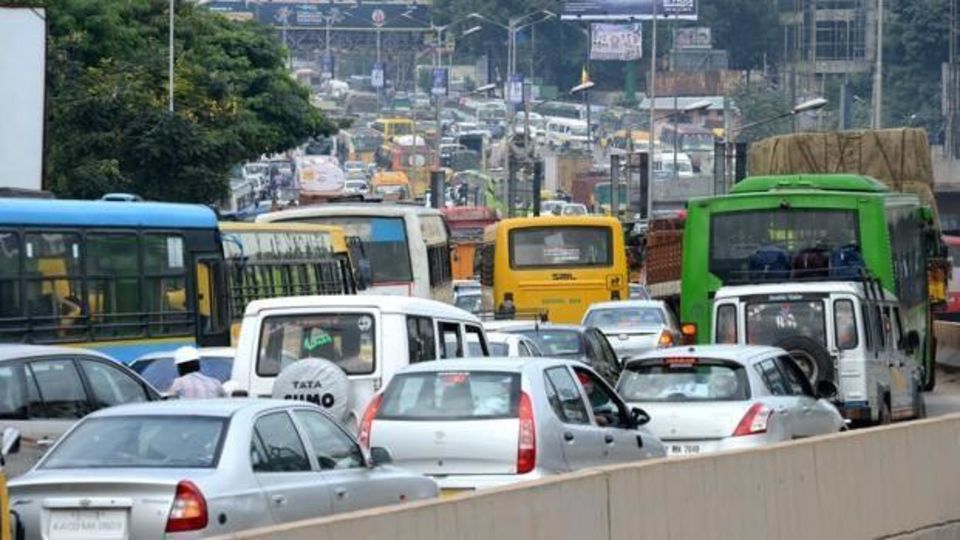
Bengaluru’s daily commute has reached a critical juncture, with new global mobility data placing the city among the most traffic-congested urban centres worldwide in 2025. For a metropolis that anchors India’s technology economy, the findings underline a growing disconnect between economic ambition and the capacity of urban infrastructure to support it. The assessment, drawn from large-scale analysis of commuter travel patterns across hundreds of cities, shows that road users in Bengaluru now spend significantly more time covering shorter distances than in most major global cities. On average, a 10-kilometre journey during peak hours takes well over half an hour, reflecting sustained pressure on the city’s arterial roads and residential corridors alike.
For residents, the impact is measured not only in minutes but in lost productivity and wellbeing. Aggregate estimates indicate that a typical commuter loses nearly an entire working month annually to peak-hour congestion. Urban planners note that such time loss has direct economic consequences, from reduced labour efficiency to increased fuel consumption and rising household transport costs. The congestion indicator calculated as the additional travel time incurred compared to free-flow conditions climbed further in 2025, signalling that incremental road expansions alone are failing to keep pace with demand. Transport experts point out that Bengaluru’s rapid outward growth, combined with high private vehicle ownership and uneven public transport coverage, has intensified traffic loads across both legacy neighbourhoods and newer peripheral zones.
The problem is not uniform across Indian cities. While several large metros have reported marginal improvements in traffic flow due to metro rail expansion, bus fleet modernisation, and junction redesigns, Bengaluru’s gains from mass transit investments have been offset by continued real estate-led sprawl and job concentration in limited corridors. Industry analysts warn that without stronger transit-oriented development norms, congestion could increasingly influence corporate location decisions and real estate valuations. Environmental implications are also becoming harder to ignore. Prolonged idling and slow-moving traffic contribute to higher per-capita transport emissions, complicating the city’s climate resilience goals. Sustainability researchers argue that congestion mitigation must be treated as both a mobility and climate priority, integrating land-use planning with low-emission transport systems.
Urban development officials acknowledge that the challenge now extends beyond road engineering. Solutions under discussion include expanding last-mile public transport, rationalising work-hour peaks, and accelerating mixed-use zoning to shorten commute distances. The effectiveness of these measures will depend on coordinated execution rather than isolated projects. As Bengaluru continues to position itself as a future-ready global city, the state of its streets offers a more immediate test. Whether the city can translate infrastructure investment into measurable improvements in everyday mobility may shape not just commute times, but its long-term economic and environmental competitiveness.