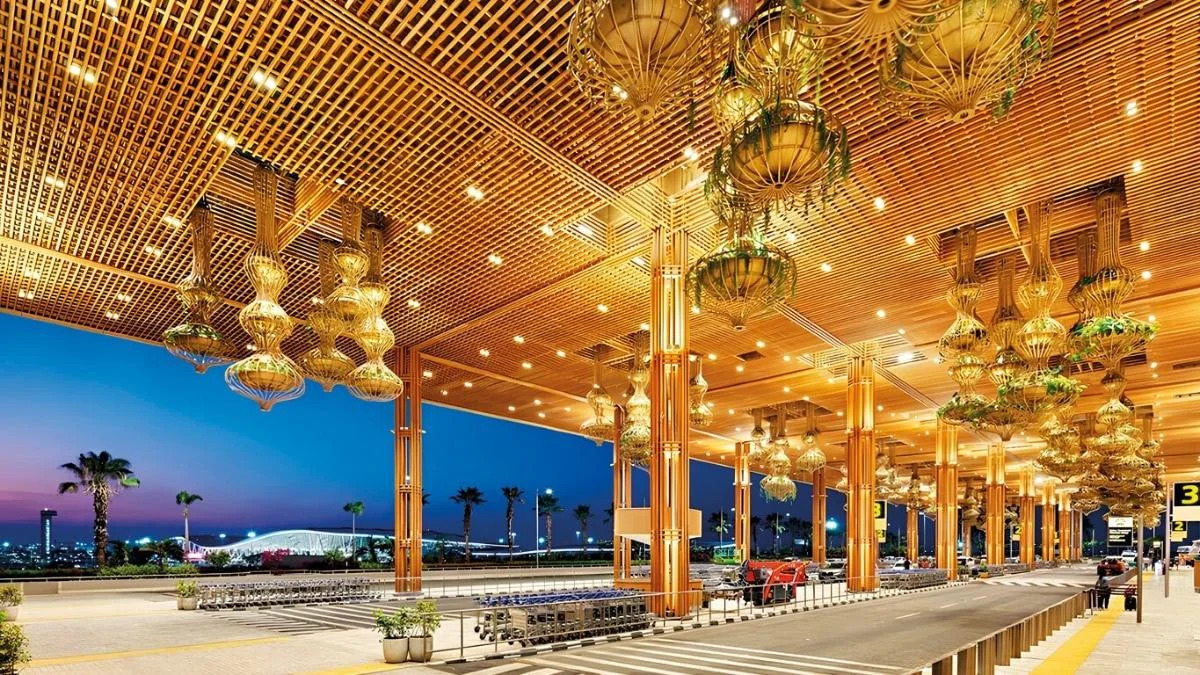
Kempegowda International Airport in Bengaluru has introduced a new passenger lounge at Terminal 2 that signals a broader shift in how Indian airports are rethinking public infrastructure. Designed as a shared social environment rather than a conventional premium waiting area, the space reflects changing expectations around travel, urban mobility and the role of airports as civic places rather than transit utilities. The launch is significant beyond aesthetics. Airports across global cities are increasingly being redesigned as mixed-use public realms that influence how people experience time, stress and connectivity. For Bengaluru a city grappling with congestion, long commutes and uneven access to public spaces the move reflects how transport hubs are stepping in to offer comfort, inclusivity and cultural engagement within constrained urban systems.
Located within Terminal 2, the lounge departs from the formal, enclosed design language of traditional airport lounges. Instead, it adopts an open-plan layout with multiple zones that support varied behaviours from quiet work and informal meetings to dining and collective activity. Urban designers note that such layouts mirror contemporary co-working and civic interiors, responding to a generation that values flexibility and shared experiences over exclusivity. The Gate Z lounge at Bengaluru airport has been designed to accommodate diverse users without segmentation by ticket class or age group. According to airport officials, the objective was to prioritise mindset and usage patterns rather than demographics. Seating arrangements, lighting design and circulation have been planned to reduce visual clutter and allow travellers to self-select how they spend waiting time an approach aligned with people-first urban design principles.
Importantly, the space integrates food and cultural programming as part of its infrastructure. Multiple dining formats operate alongside areas intended for pop-ups, screenings and informal gatherings. Urban planners see this as a recognition that airports are increasingly economic microcosms, supporting local supply chains, creative industries and service employment while shaping the city’s first and last impression. The design also reflects Bengaluru’s wider positioning as a technology-led city. Digital interfaces and intelligent navigation tools have been embedded to improve passenger flow without overwhelming users. Industry experts point out that such low-friction technology is essential in high-density transport environments, particularly as passenger volumes rise and climate resilience demands more efficient building operations.
This initiative follows earlier steps by the airport operator to introduce inclusive infrastructure, including sensory-friendly spaces for neurodivergent travellers and those experiencing anxiety. Together, these interventions indicate a gradual shift towards airports functioning as humane, adaptable public spaces rather than purely commercial assets. As Indian cities expand and air travel becomes more central to economic growth, the Gate Z lounge at Bengaluru airport highlights how design-led infrastructure can improve everyday urban experiences. The challenge ahead will be scaling such models sustainably balancing energy efficiency, accessibility and economic viability as airports evolve into integral components of the urban fabric.