


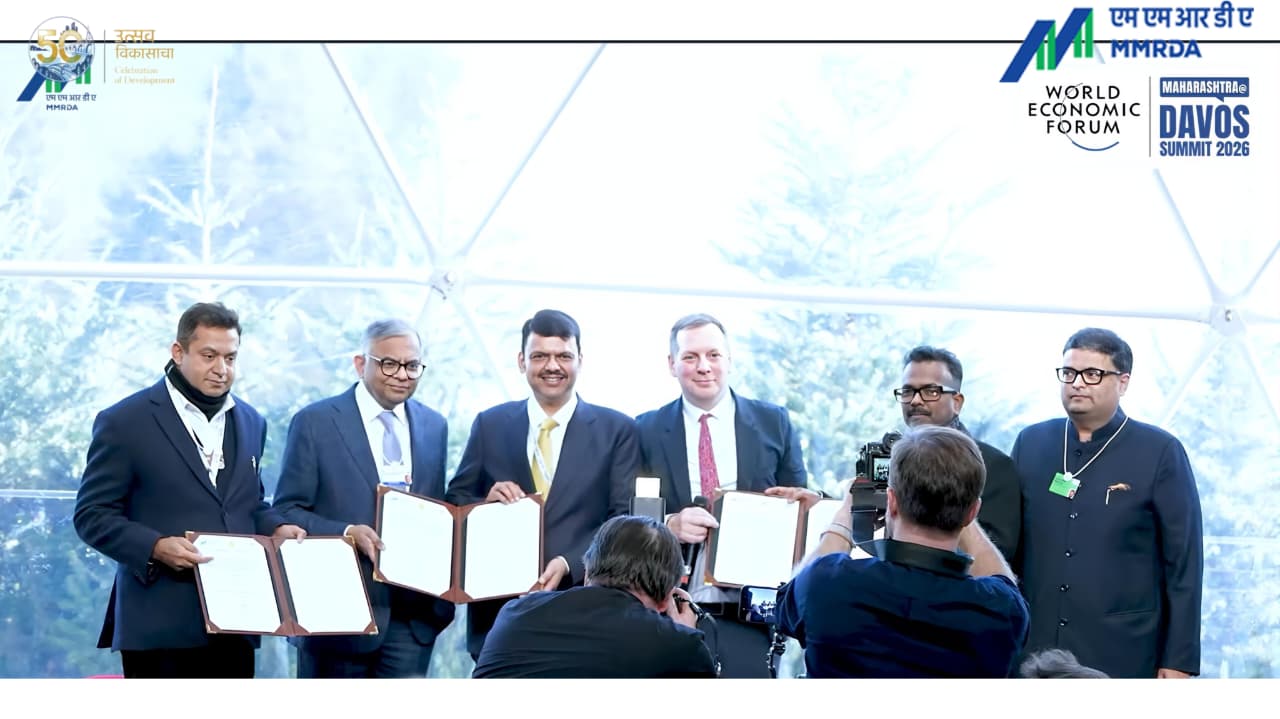
At Davos, MMRDA Bets Big on AI and Sustainable Industry — But the Real Story Lies Beyond the Numbers
Urban Acres Editorial Feature
Mumbai 22, 2026 — On the third day of the World Economic Forum’s Annual Meeting, the Mumbai Metropolitan Region Development Authority (MMRDA) announced two investment agreements worth USD 26 billion, taking its cumulative commitments at Davos 2026 to USD 226.65 billion across 24 Memoranda of Understanding.
On paper, the numbers are extraordinary. They represent the highest investment commitments mobilised by MMRDA in its 51-year history and a sharp increase over the USD 40 billion reported at WEF 2025. Yet, for policymakers, investors, and urban planners, the more relevant question is not how much was signed—but what kind of metropolitan future these agreements are attempting to build.
What Was Signed — And What It Signals
The Day Three announcements comprised two distinct agreements. The first is an USD 11 billion partnership with the Tata Group, centred on artificial intelligence infrastructure, large-scale data centres, and a proposed Innovation City near the Navi Mumbai International Airport. The second is a USD 15 billion industrial development collaboration under the Bharat–Switzerland (B-SWISS-MMR) framework, focused on sustainability-led manufacturing and integrated industrial ecosystems.
Taken together, these MoUs signal a deliberate shift in MMRDA’s outward pitch. Unlike earlier global engagements that foregrounded metro rail, roads, or conventional real estate, the 2026 portfolio emphasises AI, advanced manufacturing, clean energy, logistics, and innovation-led employment.
This change is not incidental. Globally, large pools of capital are moving away from pure infrastructure plays towards ecosystems that combine technology, skills, regulatory clarity, and long-term demand visibility. MMRDA’s Davos strategy appears designed to align with that recalibration.
The Scale Question: Why USD 226.65 Billion Matters
MMRDA has stated that the USD 226.65 billion figure relates entirely to MoUs signed at WEF 2026, spread across 13 investment agreements and 11 strategic partnerships. If realised even partially, this would place the Mumbai Metropolitan Region among the most heavily committed urban economies in the Global South.
However, experienced observers will note that MoUs at Davos are intent statements, not capital inflows. Their value lies in policy alignment, early-stage structuring, and long-term signalling rather than immediate deployment. What is unusual in MMRDA’s case is not just the size of the commitments, but their concentration within a single metropolitan authority, rather than being dispersed across multiple state departments.
This centralisation could reduce coordination risk—but it also places significant execution pressure on one institution.
B-SWISS-MMR: A Test of India’s Industrial Sustainability Claims
The USD 15 billion Bharat–Switzerland collaboration proposes a large industrial enclave spread across roughly 5,000 acres within the Mumbai Metropolitan Region, with a projected employment potential of around 1.5 lakh jobs over a decade.
From an urban-economic standpoint, the project is noteworthy for two reasons. First, it frames sustainability as an organising principle rather than a compliance layer—embedding clean manufacturing, efficient logistics, and knowledge partnerships into the master planning stage. Second, it introduces Swiss industry standards into Indian industrial zoning, a move that could raise both productivity and regulatory expectations.
The challenge, however, will lie in land aggregation, environmental approvals, and inter-agency coordination—areas where large industrial zones in India have historically faced delays. The credibility of B-SWISS-MMR will ultimately depend on whether sustainability remains a design driver or becomes diluted during execution.
The Tata MoU: AI Infrastructure Meets Urban Reality
The USD 11 billion Tata Group agreement focuses on AI data centres, innovation ecosystems, and allied sectors such as renewable energy, storage, and advanced manufacturing. The proposed location near the Navi Mumbai International Airport reflects a global pattern: innovation districts clustering around high-connectivity nodes.
Yet AI infrastructure is capital-intensive, energy-hungry, and highly sensitive to policy stability. Its success will depend less on real estate availability and more on power reliability, data governance frameworks, talent pipelines, and global competitiveness. For MMRDA, this MoU marks an expansion of responsibility—from land and transport to the less familiar terrain of digital-economic facilitation.
Employment Claims and the Urban Productivity Test
MMRDA estimates that the two Day Three agreements could generate approximately 1.5 lakh direct and indirect jobs. While such figures are standard in early-stage announcements, the more substantive issue is the nature and distribution of these jobs.
If the promised employment materialises in high-skill AI, manufacturing, and logistics roles—and if these are spatially integrated with housing, mobility, and social infrastructure—the metropolitan economy stands to gain in productivity. If not, the risk is a familiar one: job clusters disconnected from liveability, intensifying congestion and inequality.
The Execution Lens
MMRDA’s Davos performance has repositioned it from a project-focused development authority to a metropolitan investment aggregator. That transition brings both opportunity and scrutiny.
The coming months will determine whether these MoUs move into phased investment plans, land identification, policy notifications, and financing structures—or remain aspirational statements shaped by the optics of Davos.
The Mumbai Metropolitan Region has successfully captured global attention. The harder task now is converting global intent into ground-level economic transformation. In that sense, the real outcome of Davos will not be measured in billions announced, but in industries built, jobs sustained, and urban systems strengthened over the next decade.
