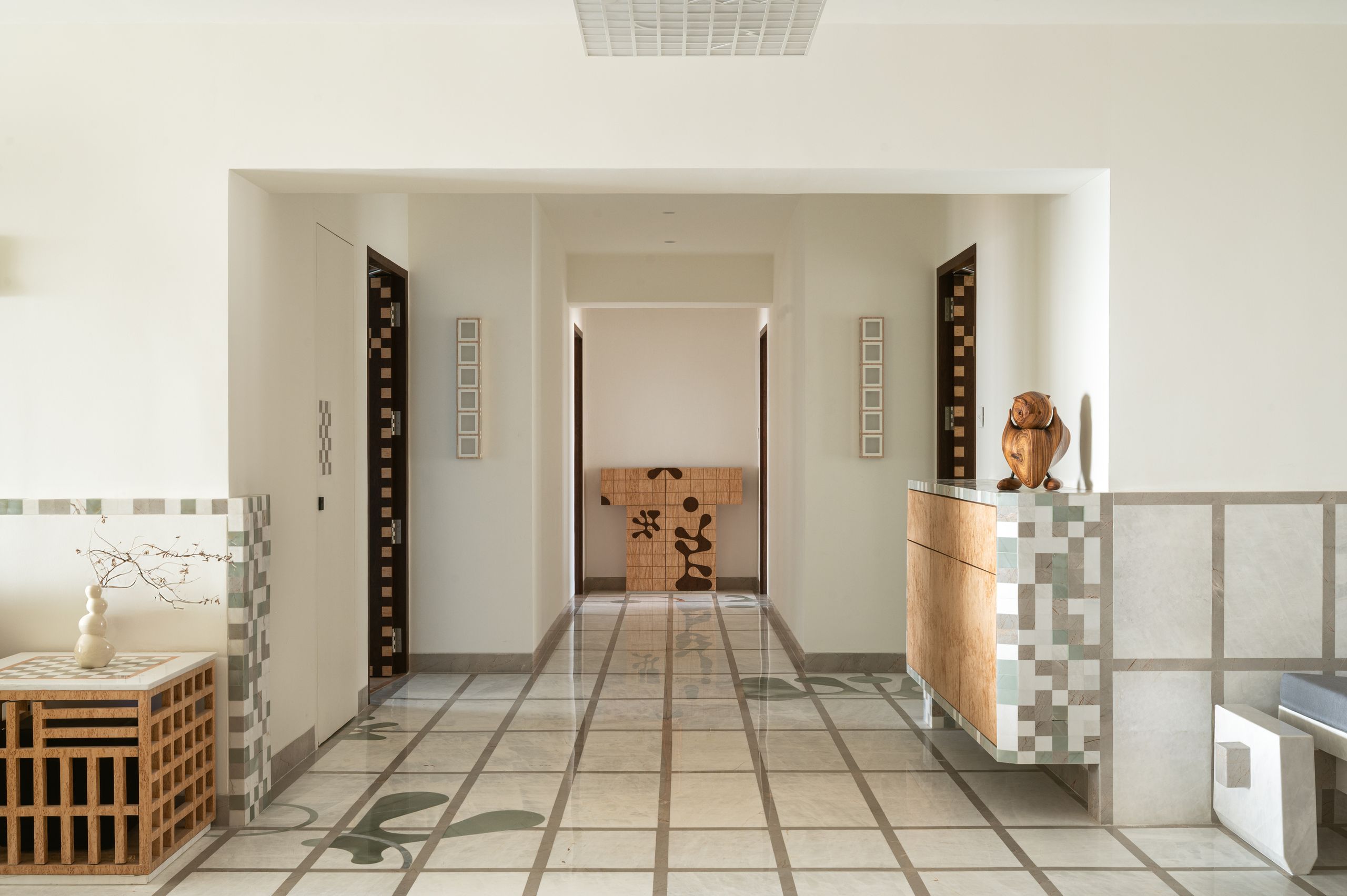
India MuseLAB Apartment Embraces Modern Grid Language
In Mumbai’s coastal Versova neighbourhood, a recently completed high-rise apartment stands out for its bold reinterpretation of spatial structure and interior functionality, demonstrating how contemporary urban homes can balance formal aesthetic ambition with lived-in flexibility. Designed by MuseLAB, the 3,000-square-foot residence harnesses a recurring grid motif as both a visual anchor and an organising principle, transforming what in many projects might be a static pattern into a dynamic scaffold for everyday life.
Across metropolitan India, larger apartments — particularly three-bedroom and bigger configurations — have seen rising demand as buyers prioritise spacious, adaptable living environments, even as overall housing launches cool. Within this market backdrop, MuseLAB’s apartment articulates a design language that marries geometric precision with experiential warmth, reflecting both technical finesse and the growing appetite among homebuyers for interiors that are both expressive and functional. At first glance, the pervasive grid — reminiscent of pixelation in its repetition — might suggest rigidity. Yet throughout the apartment, this network of squares and rectilinear frames becomes a tool for defining and unifying space. It appears in refined marble inlays underfoot, in ceiling details that echo the floor below, and in latticed partitions that articulate transitions between public and private zones. In doing so, it generates a sense of movement and rhythm without diminishing spatial openness or comfort.
Materiality plays a key role in tempering the grid’s graphic intensity. A luminous palette ranging from neutral beiges and pale blues to muted greens softens the geometric language and allows natural light from the Arabian Sea-facing façade to animate surfaces and textures. Strategic use of stone, quartzite and Corian — especially in kitchen and living spaces — anchors the apartment’s tactile richness while maintaining a cohesive spatial narrative. Flexible spatial zoning is another defining trait. The rectilinear living and dining areas accommodate both routine family life and large gatherings, while more intimate corners — such as a study bathed in powder-blue ceilings and a children’s room in vibrant hues — offer distinct sensorial experiences tailored to household needs. Sculptural and bespoke furniture elements contribute further to these layered environments, reinforcing the balance between formality and domestic ease.
This approach resonates with broader trends in Mumbai’s residential sector, where buyers are showing increased interest in design sophistication and adaptable interiors even amid supply shifts. As larger configurations gain share, apartments that blend architectural rigour with human-centric spatial strategies stand to appeal to discerning urban residents seeking both comfort and identity in their homes.
MuseLAB’s project illustrates how a disciplined geometric framework — often associated with corporate or minimalist design — can be reinvented for residential contexts without sacrificing warmth or flexibility. As Indian cities evolve, such interior innovations could influence how developers, designers and homeowners approach spatial efficiency, material expression and lifestyle integration in dense urban settings.