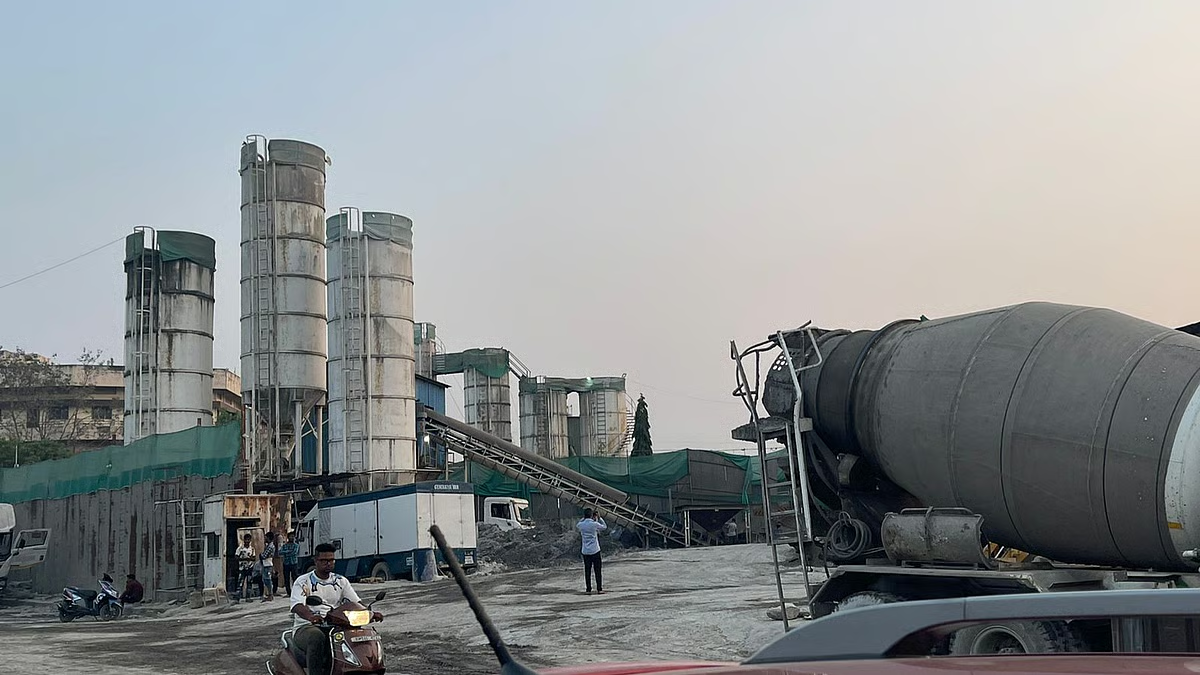
Chandigarh Balances Concrete Expansion With Urban Ecology
Chandigarh’s carefully planned urban identity is entering a new phase as expanding concrete infrastructure reshapes the city’s relationship with nature. Long admired for its tree-lined sectors and open spaces, the city now faces the challenge of accommodating mobility, housing and civic infrastructure without allowing concrete expansion to overwhelm the environmental logic embedded in its original plan. For residents and planners alike, the stakes extend beyond aesthetics to climate resilience and liveability.
Designed as a modernist city with strict zoning and generous green buffers, Chandigarh was structured to ensure that concrete and open space evolved together. Roads were flanked by trees, neighbourhoods embedded within green belts, and public buildings set back from heavy traffic corridors. This balance helped regulate temperatures, manage stormwater and create walkable environments—outcomes increasingly valued as Indian cities confront heat stress and flooding.In recent years, however, the scale and intensity of concrete construction have accelerated. Road widening, parking infrastructure, commercial redevelopment and utility upgrades have increased impervious surfaces across sectors. Urban planners note that while such projects respond to real pressures—rising vehicle ownership, population churn and service demand—the cumulative effect of concrete-heavy interventions risks altering microclimates and drainage patterns.
The material impact of concrete is not merely visual. Unlike permeable landscapes, concrete traps heat and prevents groundwater recharge. Environmental specialists warn that unchecked hardscaping can intensify the urban heat island effect, raising local temperatures and energy demand. In Chandigarh, where summer extremes are becoming more pronounced, this trend has direct implications for public health and energy consumption.Citizen responses reflect growing awareness of this trade-off. Public debates around tree removal, paved public spaces and loss of informal green patches have underscored the tension between infrastructure efficiency and ecological continuity. Urban governance experts argue that these conflicts highlight a planning gap: infrastructure projects often proceed in isolation, without integrating green design as a functional component rather than a compensatory afterthought.
Policy analysts suggest that the solution lies not in halting construction, but in rethinking how concrete is deployed. Techniques such as porous pavements, shaded transit corridors, green medians and reduced surface parking can allow infrastructure to perform without erasing ecological value. Cities that treat green cover as infrastructure—rather than ornamentation—are better positioned to manage climate risks while sustaining growth.Chandigarh’s advantage remains its strong planning framework and institutional memory. Unlike many fast-growing cities, it retains enforceable controls over land use and building form. The challenge now is to update those controls for a climate-constrained future, where the question is not how much concrete a city can build, but how intelligently it can balance concrete with nature.
As Chandigarh evolves, its next planning chapter will be judged on whether it can preserve the principle that once defined it: that urban progress is strongest when concrete and ecology are designed to coexist, not compete.