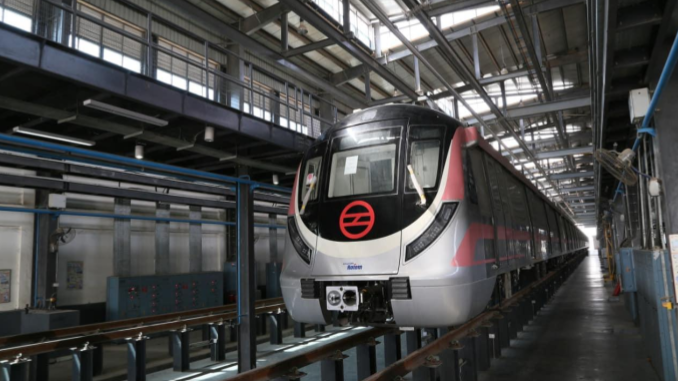
Delhi Metro has moved a step closer to reshaping how transport infrastructure and urban real estate intersect, inviting private participation for commercial development within the Anand Vihar metro complex. The initiative reflects a broader strategy to monetise transit assets while reinforcing the city’s push towards compact, transit-oriented growth. The proposed development focuses on the ground-level footprint of the station, located in one of East Delhi’s most heavily used intermodal hubs. Anand Vihar already integrates metro rail with interstate buses and rail services, making it a strategic site for blending commuter convenience with commercial activity.
Urban infrastructure specialists note that such projects are less about adding retail space and more about rethinking how public transport stations function as urban anchors. By embedding property development within stations, the metro authority aims to generate non-fare revenue that can be reinvested into network expansion, safety upgrades and service quality reducing long-term dependence on public funding. The commercial package has been structured as a time-bound contract, with bidders expected to deliver the initial phase within three months of award. While modest in scale, the project is significant in signalling how metro agencies are gradually transitioning from pure transport operators to integrated urban developers.
For the real estate market, station-linked developments offer a distinct proposition. Industry analysts highlight that retail and service spaces within transit hubs typically outperform standalone commercial assets due to assured footfall, lower marketing costs and predictable demand patterns. In cities like Delhi, where land scarcity and fragmented ownership often stall redevelopment, metro-led property projects provide a rare route to unlocking high-value urban land responsibly.
There is also a sustainability dimension. Transit-oriented commercial spaces reduce the need for long-distance travel by clustering jobs, services and mobility in one location. This model supports lower carbon emissions, reduced congestion and improved air quality priorities that are becoming central to urban planning in Indian megacities.
However, urban planners caution that the success of such developments depends on sensitive design. Over-commercialisation risks undermining passenger movement, safety and inclusivity, particularly for women, senior citizens and persons with disabilities. The emphasis, they argue, must remain on seamless circulation, adequate public amenities and climate-responsive architecture rather than maximising leasable area. Anand Vihar’s context adds further complexity. The surrounding area already experiences high pedestrian density and traffic stress due to overlapping transport systems. Integrating property development into this environment will require careful coordination with municipal agencies to upgrade access roads, drainage, waste management and last-mile connectivity.
Officials involved in the project say detailed planning has been undertaken with these challenges in mind, with the aim of enhancing, not burdening, the station ecosystem. If executed well, the initiative could serve as a template for similar station-area projects across the Delhi Metro network. More broadly, the move reflects how Indian cities are recalibrating the relationship between infrastructure and land value. As public transport networks expand, the question is no longer just how to move people efficiently, but how to ensure that the economic value generated by mobility is captured in ways that support equitable urban growth.
As bids are evaluated over the coming weeks, attention will turn to whether this experiment in transit-linked development can deliver both financial sustainability and a better daily experience for the millions who pass through Delhi’s metro stations every day.
Delhi Metro Invites Bids For Anand Vihar Redevelopment