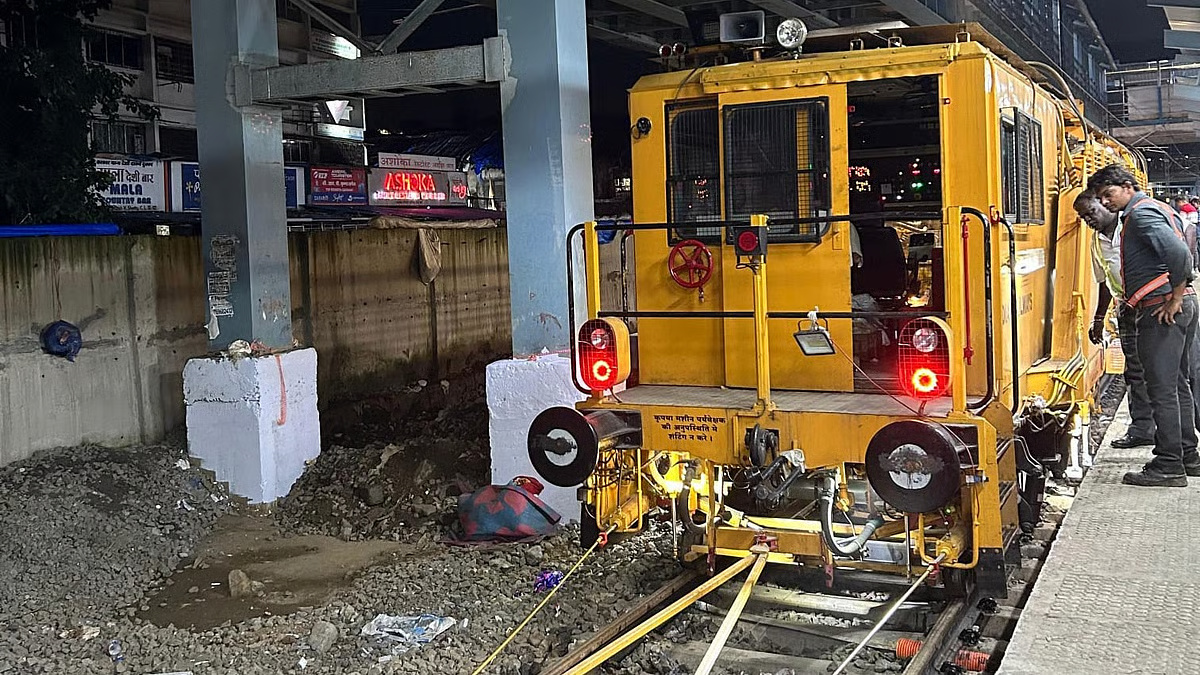
Mumbai’s suburban rail network has crossed a critical capacity threshold with the commissioning of additional rail lines between Kandivali and Borivali, strengthening one of the most heavily used corridors on the Western Railway system. The infrastructure upgrade, cleared for public operations after statutory safety approvals, is expected to reshape how suburban and long-distance trains move through the city’s western suburbs.
The newly operational stretch completes a key phase of a larger corridor expansion between Mumbai Central and Borivali, a route that carries a significant share of daily commuter traffic as well as intercity services. Urban transport experts say the development addresses a long-standing structural constraint in Mumbai’s rail network, where suburban and non-suburban trains often compete for limited track space, affecting punctuality and operational reliability. The section underwent mandatory safety inspections and trial runs before receiving clearance for regular passenger and freight movement. According to officials involved in the process, the authorisation followed extensive testing under real operating conditions, ensuring that the new tracks meet speed, load and safety benchmarks required for one of the world’s busiest suburban rail systems.
Beyond capacity creation, the project reflects the complexity of upgrading infrastructure in a dense, built-up urban environment. Construction was executed within a compressed timeframe, requiring temporary adjustments to existing services and extensive night-time work. Engineers had to navigate tight clearances, live railway operations and surrounding neighbourhoods, underscoring the growing challenge of retrofitting legacy infrastructure in megacities. Signalling and electrical systems were also modernised as part of the expansion. A new generation electronic interlocking system has replaced older technology at a key junction station, enabling digital control of train movements across multiple routes. Transport planners note that such upgrades are essential not only for safety but also for energy efficiency, system resilience and the ability to scale services in the future.
From an operational standpoint, the additional line capacity allows clearer segregation between suburban commuter trains and longer-distance services. This separation is expected to reduce cascading delays, improve timetable adherence and enhance travel predictability for millions of daily users. Economists point out that even marginal improvements in suburban rail reliability can deliver outsized productivity gains in Mumbai, where commuting time directly influences labour participation and household well-being. The rail expansion also carries implications for real estate and urban development along the western corridor. Improved service stability tends to reinforce demand for transit-oriented development, encouraging denser, mixed-use neighbourhoods around stations while supporting lower-carbon mobility choices.
As Mumbai continues to invest in rail, metro and active transport infrastructure, the focus is increasingly shifting from headline project announcements to execution quality and system integration. The commissioning of this corridor signals progress, but urban planners emphasise that sustained investment in maintenance, signalling upgrades and last-mile connectivity will be crucial to ensure that capacity gains translate into a safer, more inclusive and climate-resilient urban transport system.
Western Railway Expands Suburban Rail Corridor