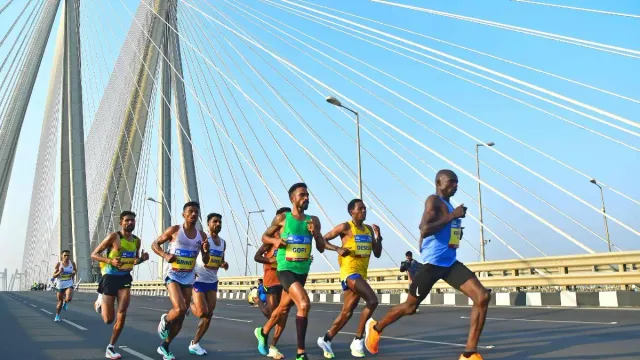
Major thoroughfares including the Coastal Road and the Bandra-Worli Sea Link will be temporarily closed to regular traffic across the city on Sunday as Mumbai hosts the 2026 edition of the Tata Mumbai Marathon, prompting extensive travel diversions and urban mobility adjustments. The closures — scheduled to remain in force for much of the morning and early afternoon — reflect the logistical complexity of staging one of Asia’s largest mass-participation sporting events while balancing the transportation needs of commuters and essential services.
The Mumbai Traffic Police have issued detailed advisories outlining road blocks, alternative routes, and no-entry zones spanning South, Central and parts of Western Mumbai. Key arteries including Marine Drive, Netaji Subhash Chandra Bose Road, Madam Cama Road, Pedder Road, Dr Annie Besant Road, and stretches of Gopalrao Deshmukh Marg will be inaccessible to regular vehicles from approximately 3 am to 2 pm on race day, with exceptions made for emergency and essential service vehicles such as ambulances, fire units, and utility consignments. The marathon route will weave through iconic and high-density urban precincts, beginning near Chhatrapati Shivaji Maharaj Terminus (CSMT) and Azad Maidan, advancing along Marine Drive, Worli Sea Face and the Coastal Road before threading through Bandra and adjoining areas. Race categories ranging from the full 42.195 km distance to the inclusive Dream Run and senior citizens’ run will occur concurrently along segments of this course, drawing an anticipated tens of thousands of participants and spectators.
For commuters, these closures pose practical challenges but also opportunities to rethink mobility choices on event day. With significant swathes of Mumbai’s arterial road network temporarily repurposed for the marathon, public transport options, including local trains and buses, are being positioned as the primary means of travel. The traffic police have advised residents to plan journeys in advance, utilise rail services where feasible, and follow designated diversion signage to minimise congestion and ensure safety. Urban planners note that large-scale events such as the Tata Marathon test the resilience and adaptability of a city’s transport infrastructure. While temporary closures can inconvenience regular commuters, they also showcase how planned disruptions — when combined with robust public transport alternatives — can preserve accessibility and safety for diverse urban users. In many global cities, similar road allocations for major public events are increasingly common as part of strategies to prioritise public space and active mobility. Organisers and civic officials have emphasised that the restrictions are finite and necessary to protect runners and manage pedestrian and vehicular flows effectively.
In addition to traffic curbs, some transit operations are adjusting services to support the event. Select entry and exit gates at metro stations around CSMT and Hutatma Chowk will be temporarily closed during marathon hours to streamline pedestrian movement near start and finish zones, reinforcing the need for early journey planning.
As Mumbai continues to balance its identity as a high-energy metropolis with aspirations for sustainable and inclusive urban mobility, events like the Tata Marathon underline the importance of integrated transport management, real-time communication and civic cooperation. For many residents, race day will be a test of adaptability — and an opportunity to experience the city’s streets in a renewed and people-centric way.