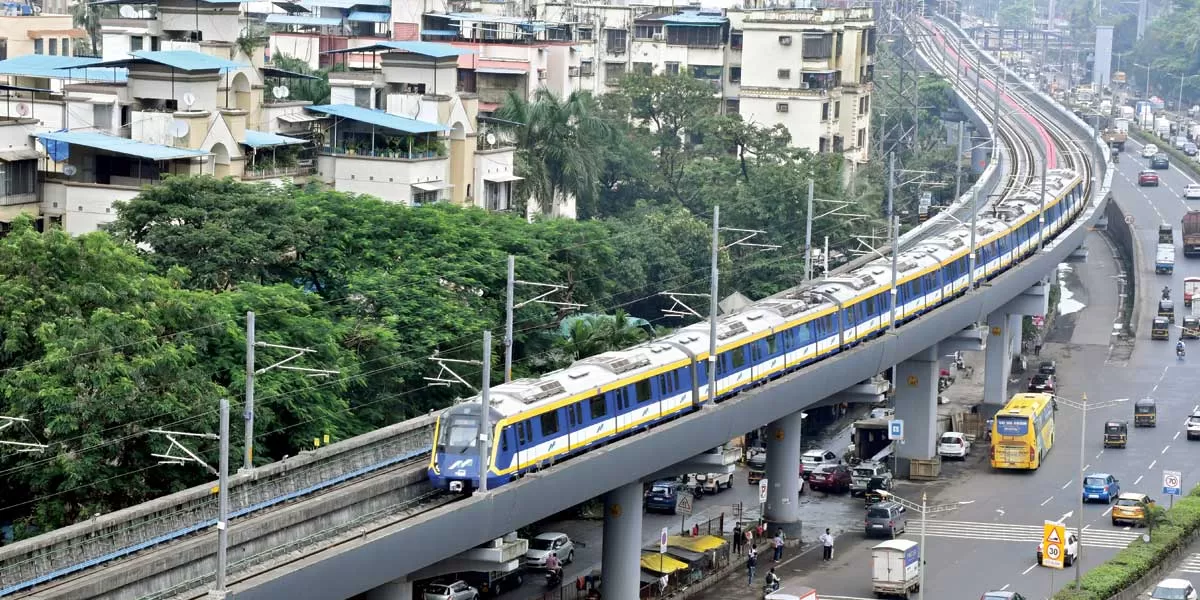
Public transport connectivity between Ahmedabad and Gandhinagar entered a new phase on Thursday as metro services were formally extended to Mahatma Mandir, bringing the state capital’s administrative and convention precinct onto the rapid transit network. The operational launch marks a functional expansion of the Ahmedabad Metro’s northward corridor, with implications for daily commuting patterns, land use planning and regional economic integration.
Early-morning services began running end-to-end from southern Ahmedabad to Mahatma Mandir, traversing key institutional, residential and commercial nodes along the Sabarmati riverfront and the Gandhinagar growth belt. Transport planners view the extension as a critical step in reducing dependence on private vehicles along a corridor that has seen steady traffic growth driven by government offices, educational institutions and emerging office clusters. The route adds a sequence of stations that stitch together Motera, Koteshwar, Knowledge City, Infocity and the Secretariat zone before terminating near Mahatma Mandir. These stops collectively serve stadium infrastructure, universities, IT parks and government complexes, creating a continuous high-capacity transit spine between the two cities. Officials involved in operations indicate that service frequencies and timings have been aligned with peak office hours to support both inbound and outbound commuter flows.
From an urban development perspective, the extension strengthens the Ahmedabad–Gandhinagar twin-city model that has guided planning in the capital region for over a decade. Real estate analysts note that reliable metro access tends to stabilise residential demand in peripheral locations while improving office viability in planned districts such as GIFT City and Knowledge City. The corridor’s integration with existing metro services also enhances last-mile connectivity to older neighbourhoods in Ahmedabad. The move builds on the earlier operational stretch that connected Motera with the Gandhinagar Secretariat, operationalised last year as part of a phased rollout. With Mahatma Mandir now on the map, the metro network directly serves one of the region’s largest convention and public-event venues, which regularly draws visitors from across the state. Improved transit access is expected to ease event-day congestion and lower transport-related emissions during large gatherings.
Urban transport specialists highlight the environmental significance of the extension. Electric metro systems offer a lower-carbon alternative to road-based commuting, particularly in corridors dominated by office travel and institutional trips. Over time, sustained ridership could reduce pressure on arterial roads linking Ahmedabad and Gandhinagar, which are prone to peak-hour bottlenecks.
Looking ahead, the success of the Ahmedabad Metro route extension will depend on feeder services, pedestrian access and integration with bus networks on both ends of the corridor. As the capital region continues to expand northward, planners suggest that consistent service quality and station-area planning will be key to translating infrastructure investment into inclusive, people-first mobility. The Mahatma Mandir extension positions the metro not just as a transport project, but as a structural element shaping how the twin cities grow together.
Ahmedabad Metro Strengthens Daily Link To Gandhinagar