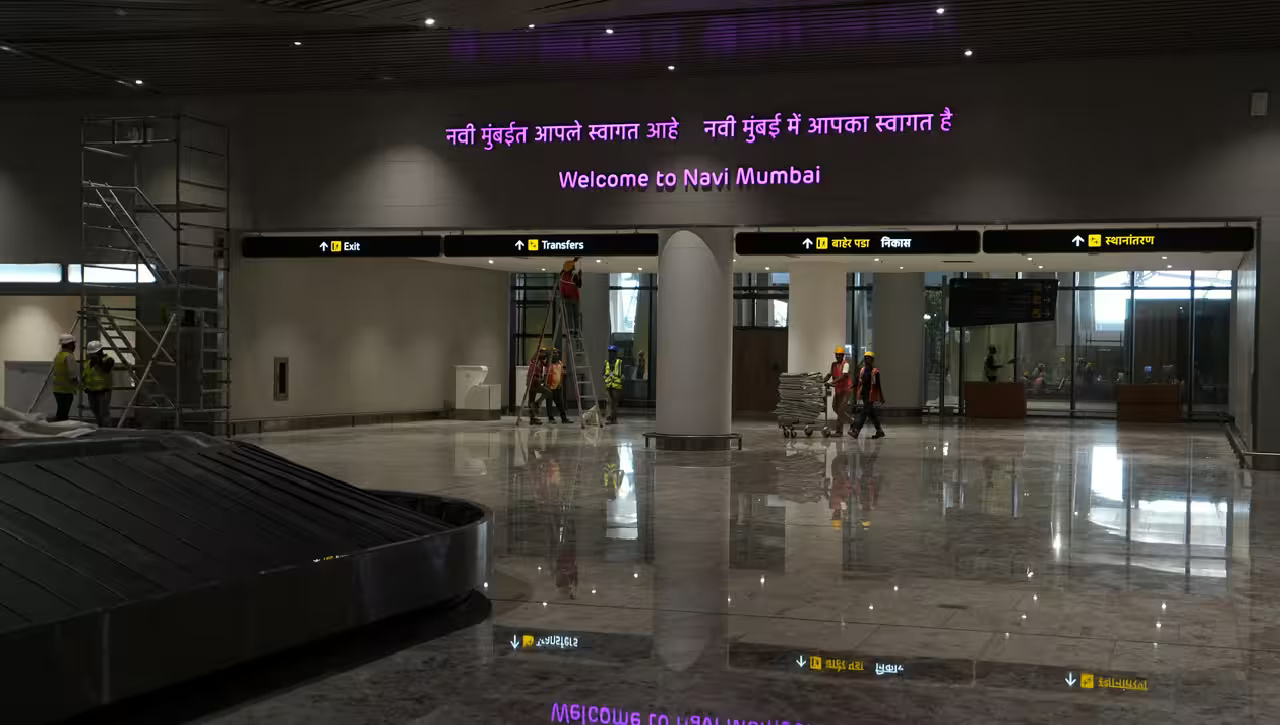
As India’s next major aviation gateway moves closer to operations, Navi Mumbai International Airport has pushed back against claims that mobile services are unavailable at the site, asserting that telecom connectivity is already functional and aligned with global airport standards. The clarification comes amid growing debate between airport operators and telecom service providers over infrastructure models, pricing, and access rights at large public facilities.
Airport officials overseeing the project said the airport has adopted a neutral-host telecom architecture, a system widely used at international airports to ensure consistent coverage, security compliance, and operational reliability. Under this model, a single, integrated in-building telecom network supports multiple service providers, reducing duplication of infrastructure while improving signal quality across both passenger-facing and restricted operational zones. According to airport authorities, the decision was shaped by operational lessons from large transport hubs, where fragmented networks often leave critical areas with weak or inconsistent coverage. Zones such as baggage handling systems, utility corridors, and air traffic control facilities require uninterrupted communication, which planners say is difficult to guarantee when networks are built selectively by individual operators focusing primarily on high-footfall commercial areas.
Responding to concerns raised by telecom operators, the airport operator said mobile connectivity is already live through a government-owned telecom provider, ensuring that essential communication services are available across the premises. Officials emphasised that the issue at hand is not the absence of connectivity, but the framework through which private operators integrate with the airport’s digital backbone. The disagreement has also brought attention to commercial terms associated with airport telecom access. Airport representatives have rejected claims of excessive access fees, stating that proposed charges are comparable with those at other major public-private partnership airports in India. They argue that pricing reflects the cost of deploying and maintaining advanced digital infrastructure in a high-security, mission-critical environment.
Right of Way permissions—legal access required for laying fibre and installing equipment—have emerged as another point of contention. Airport authorities maintain that no operator has been denied access and that ongoing consultations are aimed at resolving technical and commercial concerns without compromising safety or service quality. Telecom companies have approached national regulators seeking clarity, highlighting the broader policy challenge of balancing competition with integrated infrastructure in complex urban assets. Urban infrastructure experts view the dispute as symptomatic of a larger transition in how cities design digital systems for transport hubs. Airports are no longer just transit points but data-intensive urban nodes supporting mobility, logistics, and emergency response. A neutral-host approach, they say, can reduce energy use, visual clutter, and long-term maintenance costs, supporting more climate-resilient and efficient urban development.
As Navi Mumbai International Airport prepares to serve the Mumbai Metropolitan Region’s expanding population and economy, the resolution of telecom integration issues will be closely watched. How stakeholders align on digital infrastructure here could shape standards for future airports, metro systems, and large civic projects across India.
Navi Mumbai Airport Addresses Connectivity Dispute With Telcos