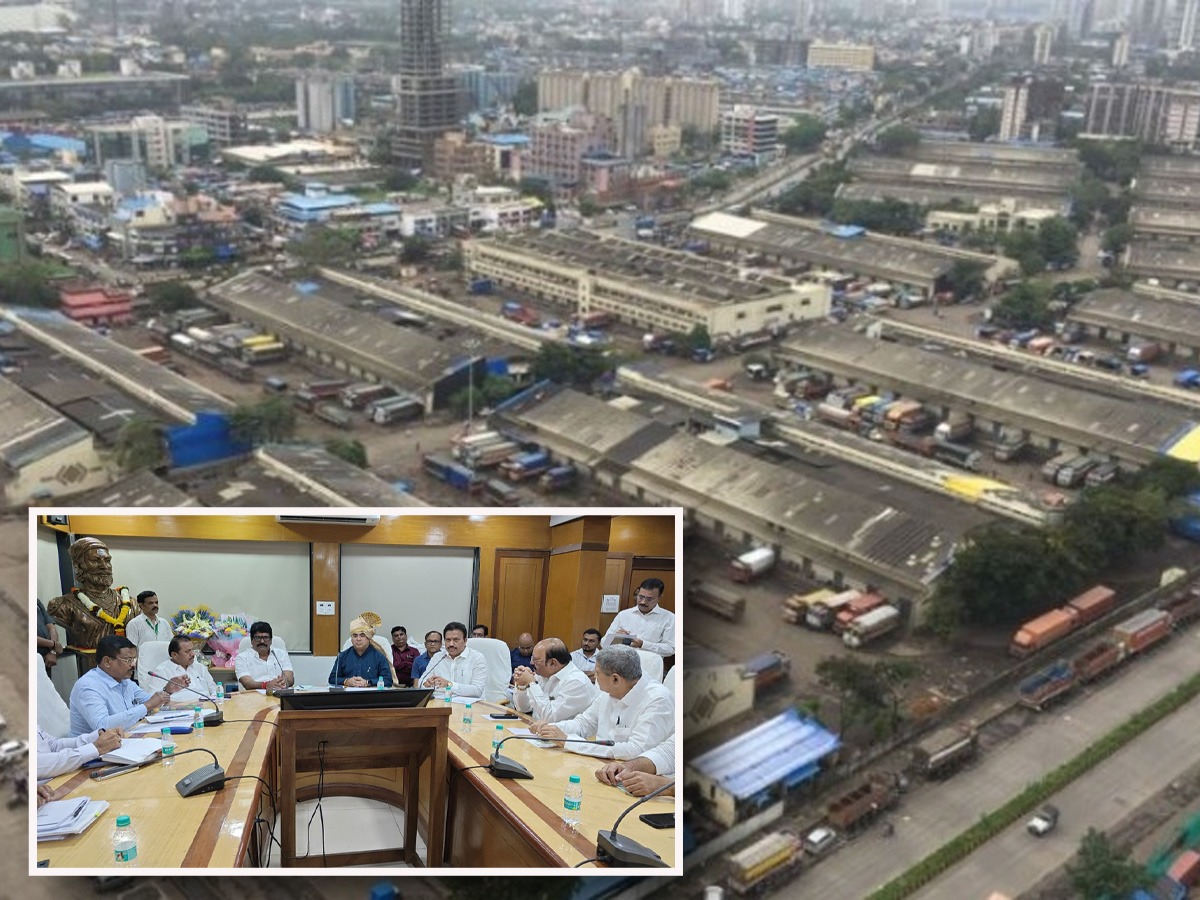
The future of Mumbai’s largest wholesale agricultural market has been clarified, with the state government confirming that the Agricultural Produce Market Committee (APMC) complex in Vashi will remain at its current location and undergo redevelopment rather than relocation. The announcement brings relief to traders, transporters, and supply-chain workers who depend on the market’s proximity to the city and regional transport corridors.
Spread across a vast parcel of land in Navi Mumbai, the Vashi APMC plays a critical role in food security and price stability for the Mumbai Metropolitan Region. Urban economists note that relocating such a facility farther from consumption centres would have increased logistics costs, congestion on peripheral highways, and carbon emissions linked to longer freight movement. Redevelopment, instead, allows the market to modernise while preserving its strategic location. According to senior officials, the proposed Mumbai APMC redevelopment will focus on upgraded trading infrastructure, better internal circulation for freight vehicles, improved storage facilities, and safer working conditions. The aim is to make the decades-old market compatible with contemporary food supply chains while reducing inefficiencies that affect both traders and consumers.
The clarification also comes amid broader planning decisions reshaping Navi Mumbai’s urban and economic landscape. State authorities reiterated that the upcoming international airport in the region will carry a locally significant name, reflecting the role of land-owning communities in enabling the project. Urban planners see this as an attempt to balance large infrastructure development with local sentiment and political legitimacy. Water security and transport connectivity featured prominently in the wider set of announcements. A proposed dam project on the metropolitan periphery is expected to augment long-term water supply for Navi Mumbai, a growing concern as residential, commercial, and industrial developments expand. At the same time, funding has been earmarked for a major junction upgrade at Kalamboli, one of the region’s most complex traffic nodes linking expressways, highways, the port, and the airport.
Infrastructure specialists highlight that congestion at such junctions has economic costs far beyond commuter delays, affecting freight movement to ports and industrial zones. Planned expansion and redesign are expected to ease bottlenecks and support more efficient regional logistics. The government also indicated that work on a long-pending Virar–Alibaug transport corridor is expected to begin soon, alongside deeper integration between Mumbai and Navi Mumbai metro networks. For urban mobility experts, seamless metro connectivity across municipal boundaries is essential to reducing car dependence and supporting compact, transit-oriented growth.
Another policy signal with real estate implications is the proposed conversion of leasehold land to freehold in parts of Navi Mumbai, potentially unlocking property rights and redevelopment potential for long-standing occupants. However, analysts caution that such moves must be paired with planning controls to prevent speculative overbuilding. Taken together, the confirmation of Mumbai APMC redevelopment and parallel infrastructure commitments point to a strategy focused on consolidation rather than displacement. The success of this approach will depend on execution — ensuring that redevelopment strengthens livelihoods, reduces environmental impact, and aligns wholesale trade with the region’s long-term urban resilience goals.
Mumbai APMC Redevelopment Confirmed In Vashi