


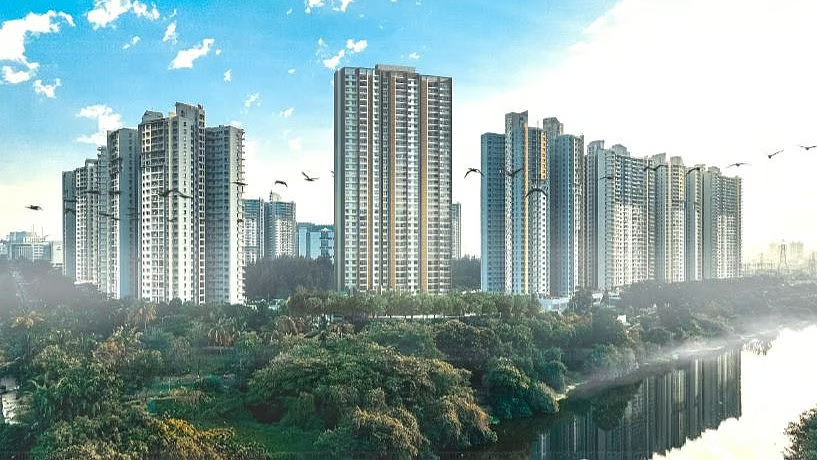
Institutional capital is returning decisively to India’s residential real estate market, with a Rs 340-crore funding infusion backing three large housing developments across Mumbai and Pune. The investment spans projects in Jogeshwari in western Mumbai and Wakad and Mundhwa in Pune, underscoring renewed confidence in urban housing demand even as developers navigate regulatory, financial and rehabilitation challenges.
The funding is structured to support the takeover and revival of stalled or stressed residential assets alongside the completion of an ongoing development. Industry observers note that such capital deployments are increasingly tied to court-supervised resolution mechanisms, reflecting a shift towards more disciplined, transparent pathways for unlocking land value in dense urban centres. In Mumbai, the Jogeshwari project sits near the Jogeshwari-Vikhroli Link Road, a critical east–west connector linking the Western and Eastern Express Highways. Spread over nine acres, the redevelopment affects several hundred households, including long-term residents and previous homebuyers. Urban planners point out that projects of this nature test the city’s ability to balance financial viability with rehabilitation commitments, construction timelines and neighbourhood infrastructure capacity. In Pune, the Wakad and Mundhwa developments together cover over 13 acres in growth corridors shaped by the city’s IT and services economy. Both locations have seen rapid residential expansion over the past decade, driven by employment clusters, arterial road connectivity and proximity to public transport spines. However, experts caution that continued growth must be matched with upgraded drainage, water supply and mobility planning to avoid replicating congestion and climate stress seen in older urban zones.
The Mumbai Pune housing projects reflect a broader recalibration underway in Indian real estate finance. Institutional investors are increasingly selective, favouring mid-sized residential assets with clear legal status, defined exit visibility and end-user demand. According to market analysts, capital is now flowing less on speculative land bets and more on completion-led strategies that prioritise delivery and cash-flow stability. From a civic perspective, such investments carry implications beyond balance sheets. Large-scale residential projects shape travel patterns, energy use and social infrastructure demand for decades. City officials emphasise the importance of integrating climate-responsive design, efficient construction practices and inclusive housing outcomes, particularly in redevelopment zones where existing communities are directly affected. For homebuyers and urban residents, the immediate signal is one of cautious optimism. Revived projects can restore confidence in delayed developments, while fresh funding improves the likelihood of timely delivery.
Yet the longer-term test will lie in whether these Mumbai Pune housing projects contribute to more resilient, liveable neighbourhoods rather than merely adding built-up area. As institutional capital deepens its footprint in India’s cities, the next phase of urban growth will depend on how effectively financial discipline aligns with people-first planning and sustainable infrastructure delivery.
Also Read: Bengaluru Rolls Out Plant Capacity With Waste Rules
Mumbai Pune Housing Projects See Strategic Funding Boost
