


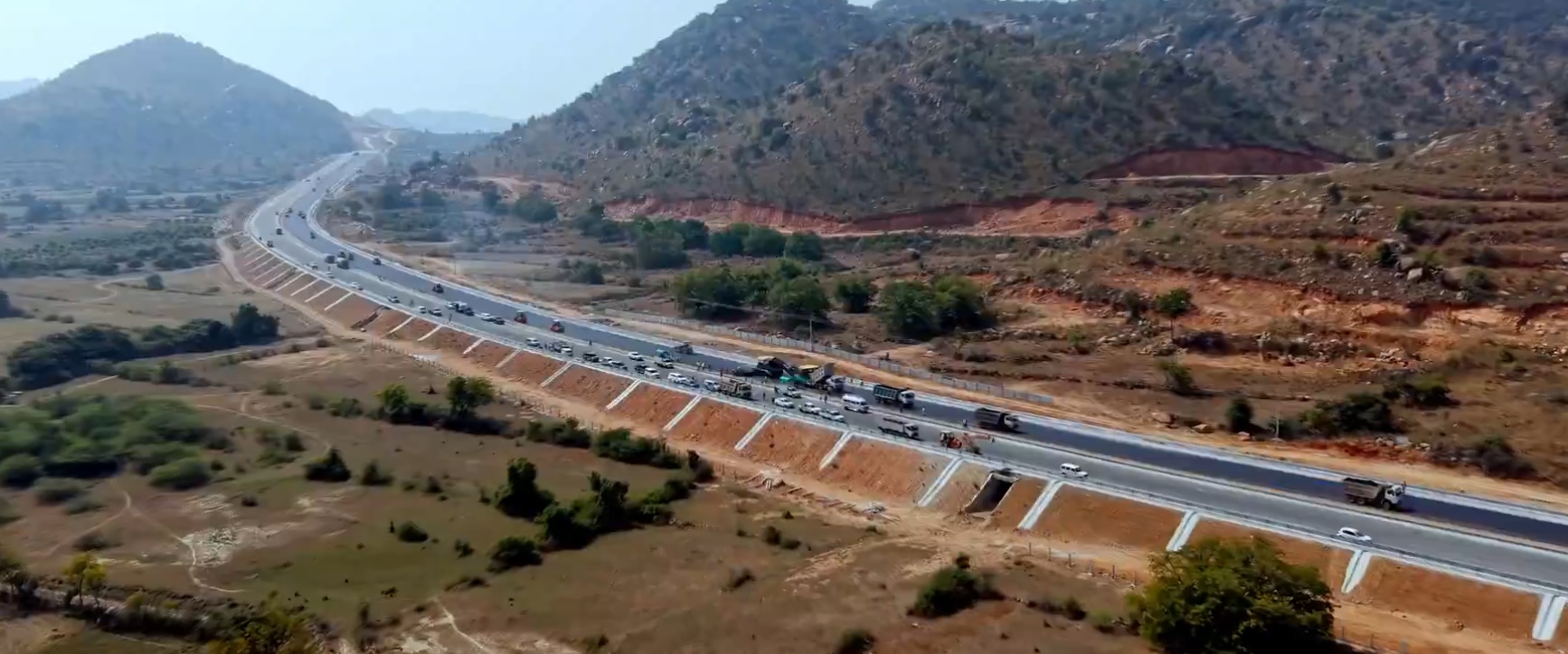
India’s national highway development programme has reached a defining moment with the Bengaluru–Kadapa–Vijayawada Economic Corridor achieving multiple global construction benchmarks, highlighting the scale, speed and technological depth now shaping large transport infrastructure projects. The milestone underscores how corridor-led highway planning is increasingly central to regional economic integration and logistics efficiency.
The access-controlled six-lane corridor, part of National Highway 544G, recorded four globally recognised construction records during ongoing pavement works in Andhra Pradesh. These achievements were registered across different construction packages along the route, reflecting sustained high-output execution rather than isolated activity. Infrastructure specialists say such outcomes signal a shift in India’s highway-building capabilities, where industrial-scale processes are becoming routine rather than exceptional. The record-setting activity involved continuous asphalt paving across extended stretches within compressed timelines, supported by high-capacity machinery, synchronised logistics, and real-time quality monitoring. According to engineers familiar with the project, maintaining consistency across long paving sections is technically demanding due to temperature control, material uniformity, and equipment coordination—factors that are critical for long-term pavement performance and safety.
Beyond engineering metrics, the Bengaluru–Kadapa–Vijayawada Economic Corridor is strategically significant for southern India’s development trajectory. Once operational, the 343-kilometre highway is expected to shorten travel distances by nearly 100 kilometres and reduce end-to-end journey times by several hours. This improvement is likely to enhance freight movement efficiency between Karnataka and Andhra Pradesh while strengthening supply chains serving industrial clusters and ports along the eastern coast. Urban and regional planners note that such corridors play a growing role in decentralising economic activity. By improving access to inland districts and industrial nodes, high-speed highways can stimulate employment, attract manufacturing investments, and ease migration pressures on large cities. The corridor also links key production zones in the Rayalaseema region with coastal markets, supporting more balanced regional growth.
The project’s design incorporates multiple interchanges, wayside amenities, and grade-separated access to improve road safety and user experience. A section of the highway passes through forested terrain, requiring controlled construction practices and environmental management to limit ecological impact. Experts point out that infrastructure resilience increasingly depends on how effectively projects balance speed with environmental stewardship, particularly in climate-sensitive zones. From a sustainability perspective, smoother pavement quality and reduced congestion translate into lower vehicle emissions per kilometre travelled. When combined with reduced idling and shorter travel times, corridor-based highways can contribute to incremental reductions in transport-related carbon output, especially for long-haul freight.
As India accelerates investments in expressways and economic corridors, the achievements on the Bengaluru–Kadapa–Vijayawada route set a new reference point for execution standards. The focus now shifts to timely completion, maintenance planning, and integration with regional development strategies—factors that will ultimately determine the corridor’s long-term impact on mobility, markets and urban expansion.
Also Read : Pune Growth Hub Roadmap Targets Long Term Expansion
