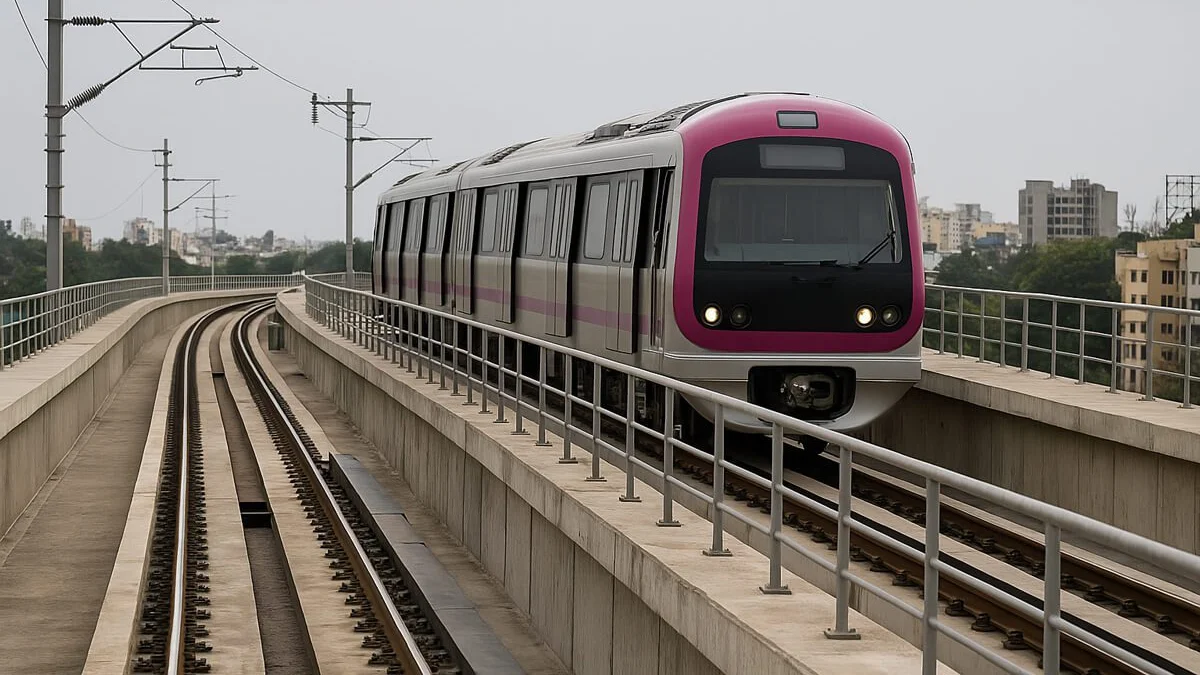
Bengaluru Sees Progress On Metro Pink Line Testing
The Bengaluru Metro Pink Line has crossed a pivotal infrastructure milestone as the Bangalore Metro Rail Corporation Ltd (BMRCL) commenced rolling stock trials on its new 21‑kilometre corridor, signalling a shift from construction to system validation ahead of partial commissioning expected in 2026. The initial prototype trainset was operated on the elevated section between Kalena Agrahara and Tavarekere, a development that could materially improve urban mobility and reduce road congestion across southern and central Bengaluru.
The Pink Line forms one of the core elements of the Namma Metro Phase 2 expansion, envisaged to connect Kalena Agrahara in the south with Nagawara in the north. Of its 21 km span, approximately 7.5 km is elevated — now undergoing systematic tests — while the remaining 13 km runs underground, progressing through advanced tunnelling and civil works towards completion. Rolling stock testing is a critical pre‑commissioning phase where the physical trainsets, supplied by domestic manufacturer Bharat Earth Movers Limited (BEML), are evaluated for traction, braking, structural dynamics and integration with signalling and communications systems. BMRCL officials note this process will span several months and includes regulatory clearances needed before any passenger operations begin. The delivery of additional trainsets through early 2026 will support a staged approach to achieving operational milestones.
Urban mobility experts highlight what this means for Bengaluru’s commuters. Once operational — initially on the elevated stretch expected mid‑2026 and later on the full alignment by year‑end — the Pink Line promises to offer reliable, high‑capacity transit across areas that currently depend heavily on road‑based travel. By diverting traffic to rail, the city could unlock significant reductions in travel time, vehicular emissions and transport‑related energy consumption. These changes align with broader sustainability objectives for climate‑resilient urban transport. Beyond mobility gains, the Pink Line is anticipated to exert upward pressure on real estate values along its route, as frequent, dependable metro access becomes a defining factor in locational desirability. Transit‑oriented development has historically catalysed commercial activity and housing demand across Indian cities, reshaping land use patterns and stimulating employment near major stations. Analysts suggest that early transit connectivity often leads to densification and economic clustering, which could benefit emerging precincts connected by the new corridor.
Yet, challenges remain. Integration with last‑mile solutions — such as feeder buses, cycle lanes and pedestrian access — will be essential to ensure that the network supports truly equitable mobility. Urban planning stakeholders also point to the importance of transparent public communication around testing progress and realistic timelines to manage commuter expectations. As Bengaluru advances towards a future where rapid mass transit becomes core to its urban fabric, the Pink Line’s rolling trials underscore both the technical and civic efforts underway to deliver a more sustainable, accessible and climate‑aware transport ecosystem.