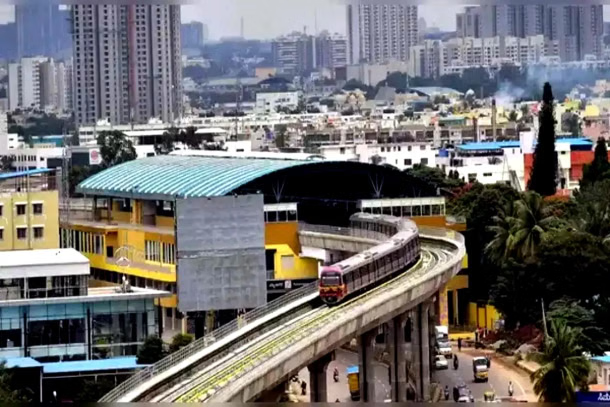
Bengaluru’s long-planned rail link to its international airport is now targeted for completion by the end of 2027, a development that would push the city’s operational Metro network to nearly 175 kilometres. For a city struggling with congestion, rising emissions and uneven access to jobs, the Bengaluru Airport Metro is emerging as a pivotal piece of infrastructure with implications far beyond daily commuting.
Urban transport officials indicate that the airport corridor represents the largest single addition to Bengaluru’s Metro system since construction began over a decade ago. Once operational, the line is expected to significantly reduce travel times between the city core, northern growth corridors and the airport, which handles tens of millions of passengers annually. Planners say the project is critical to easing pressure on arterial roads that are already operating beyond capacity.
The airport line is part of a broader expansion strategy aimed at aligning mass transit with the city’s rapid spatial growth. Work is currently under way on multiple corridors under the third phase of Metro development, while additional routes have reached advanced planning stages and are awaiting statutory approvals.
Feasibility assessments are also in progress for several future corridors, signalling a long-term commitment to rail-based mobility as Bengaluru expands outward.
For residents and businesses, the significance of the Bengaluru Airport Metro lies in predictability and access. Industry experts note that reliable rail connectivity to the airport can influence office location decisions, logistics efficiency and tourism competitiveness. Peripheral areas along the corridor are also expected to see changes in land use, with higher demand for mixed-use developments near stations, reinforcing the need for careful planning to prevent speculative real estate pressures.
Sustainability considerations are increasingly shaping the Metro’s design and operations. Transport authorities say newer corridors are being built with energy-efficient systems, including regenerative braking that feeds power back into the grid during deceleration. Such measures are estimated to reduce operational energy consumption substantially, supporting the city’s broader climate commitments while lowering long-term costs. The airport corridor also highlights the importance of integrated urban planning. Mobility specialists argue that rail alone cannot solve Bengaluru’s transport challenges unless it is supported by seamless last-mile connectivity, pedestrian-friendly station areas and coordinated bus services. Without these elements, the benefits of high-capacity transit risk being unevenly distributed.
Beyond mobility, the expansion reflects a shift in how Indian cities are approaching infrastructure delivery. Regular reviews, phased execution and an emphasis on technology adoption suggest a move towards more accountable project management, even as timelines remain ambitious. As construction advances, attention will increasingly turn to execution quality, neighbourhood impacts and affordability. If delivered as planned, the Bengaluru Airport Metro could redefine how the city moves, while offering a template for balancing growth, sustainability and access in one of India’s fastest-growing urban economies.
Bengaluru transport network nears major milestone