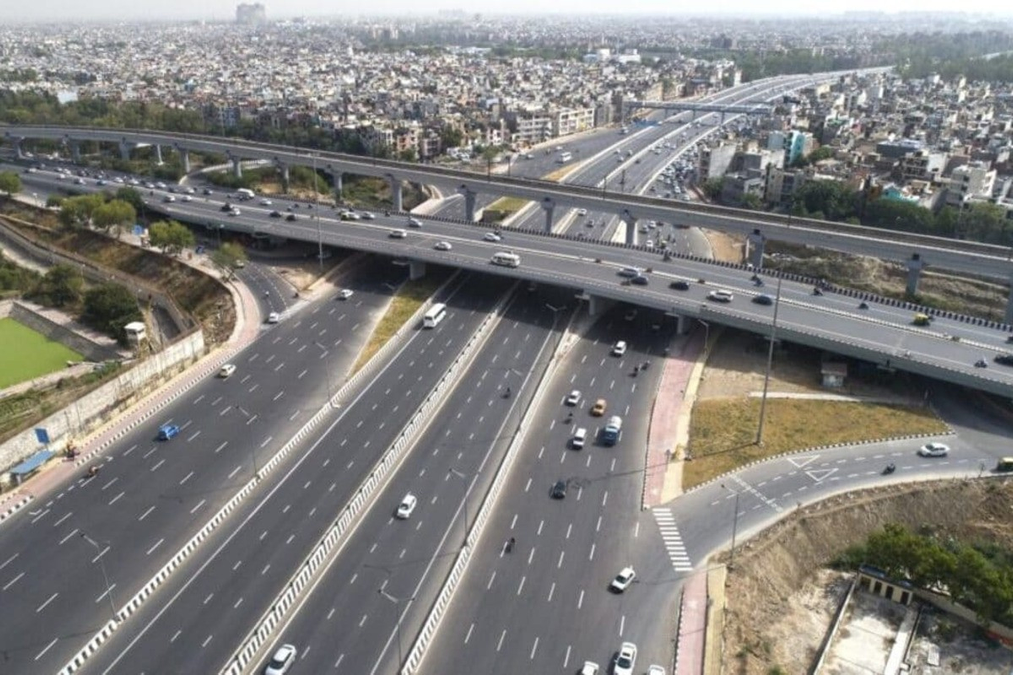
Traffic movement along one of the busiest urban corridors in the National Capital Region is set for a structural reset, as authorities move ahead with two new underpasses on the Noida–Greater Noida Expressway. The projects, planned at key congestion points, are intended to ease daily commuting pressures while testing how fast-growing cities balance infrastructure expansion with environmental responsibility.
The underpasses will come up at two strategic locations that currently act as choke points between residential sectors, industrial zones, and village roads intersecting the expressway. Urban planners say these grade-separated crossings are critical as Noida’s population density and employment hubs continue to expand eastwards, placing sustained pressure on a road network designed for much lower traffic volumes. The Noida–Greater Noida Expressway underpasses will be built using diaphragm wall technology, a construction method commonly used in dense urban areas to minimise surface disruption and enhance structural safety. One underpass is planned near the Jhatta village stretch, connecting multiple residential and industrial sectors that currently rely on signalised crossings. The second will link the Greater Noida Link Road with the expressway near Sultanpur, improving east–west connectivity for both private vehicles and freight traffic.
Together, the two projects represent a public investment of over ₹180 crore, according to officials involved in execution. Authorities estimate that once operational, the underpasses will significantly reduce travel time for residents of more than 20 sectors and several villages, while also supporting smoother access to industrial areas and export-oriented units along the corridor. However, the projects also highlight the environmental trade-offs embedded in urban infrastructure building. Construction will require the removal of 330 trees along the expressway’s green verge. Regulatory clearance has been granted with strict conditions, including the transplantation of a majority of the trees and compensatory plantation at a ten-to-one ratio. Urban forestry experts note that while transplantation helps preserve mature green cover, survival rates vary, making long-term monitoring essential.
Officials overseeing horticulture and environmental compliance say relocated trees are being shifted to designated green belts, where soil preparation and aftercare are intended to improve survival outcomes. Sapling plantation will be carried out alongside and beyond the project sites, reflecting a growing policy emphasis on offsetting carbon and heat impacts from road expansion. For residents and businesses, the Noida–Greater Noida Expressway underpasses are expected to deliver tangible daily benefits shorter commutes, safer crossings, and reduced idling emissions.
Yet mobility specialists caution that underpasses alone cannot solve congestion unless paired with better public transport integration, pedestrian access, and last-mile planning. As Noida continues to urbanise at speed, these projects underline a broader shift in city-making where infrastructure upgrades are no longer judged only by how fast traffic moves, but by how responsibly growth is managed across people, economy, and environment.
Noida Expressway underpasses aim to unclog daily traffic