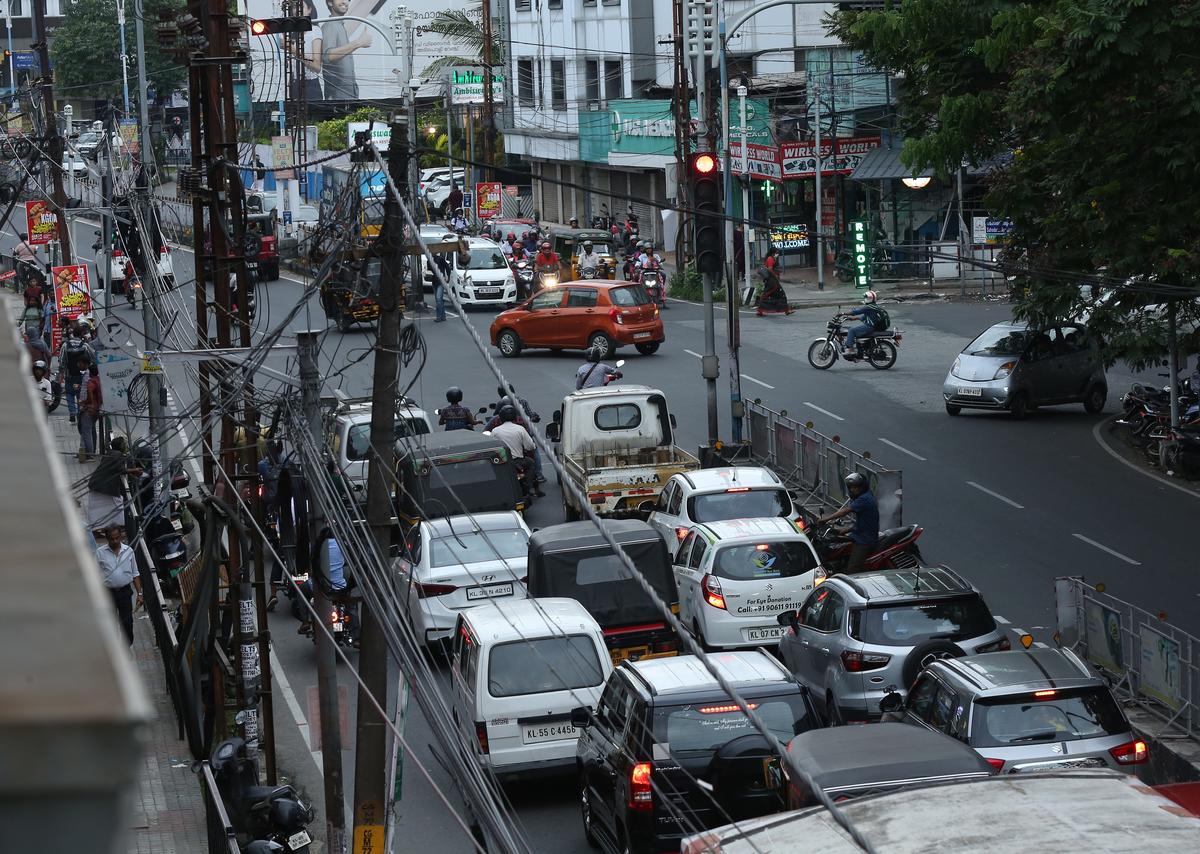
Kochi’s attempt to ease congestion around the Town Hall Metro station by relocating a busy bus stop has run into an unexpected obstacle: commuter behaviour. Nearly a month after authorities redirected bus boarding to a designated shelter near the Reserve Bank of India office, confusion on the ground continues, undermining efforts to streamline traffic flow in one of central Kochi’s most congested transit zones.
The stretch near Town Hall sits at the intersection of multiple urban pressures. Vehicles descending from the Ernakulam North overbridge converge with traffic from Marine Drive and SRM Road, while the Metro station attracts steady footfall throughout the day. To prevent buses halting directly in front of the station a frequent cause of bottlenecks traffic police reinforced the original bus stop location near the RBI office and installed signage to guide commuters. Yet enforcement alone has not delivered results. Transport officials observe that many passengers continue to gather near the Metro entrance, prompting private buses and autorickshaws to stop informally where demand is visible. This behaviour negates the intent of the relocation and recreates congestion along the same stretch authorities aimed to decongest.
Urban mobility experts say the issue highlights a common challenge in Indian cities: infrastructure changes without sufficient last-mile design and public engagement. “People naturally wait where connectivity feels most convenient,” noted an urban planner familiar with Kochi’s transit network. “Unless pedestrian movement, waiting areas, and information systems are intuitive, commuters revert to habit.” The Kochi traffic police maintain that the revised arrangement is operationally sound. During periods of active monitoring, buses generally comply and avoid stopping at the Metro gate. However, once personnel move on, informal boarding resumes. Partial compliance has also created a secondary problem passengers clustering midway between the Metro station and the RBI office, causing buses to stop unpredictably and disrupting traffic again.
The situation has broader implications for Kochi’s sustainable transport goals. The city is investing heavily in Metro rail as a low-emission alternative to private vehicles, but seamless integration with bus networks remains critical. Without clear, user-friendly interchange points, public transport systems struggle to attract consistent ridership and reduce car dependence.Space constraints near the RBI office further complicate matters. Commuters waiting there often spill onto the roadside, raising safety and accessibility concerns, particularly for women, elderly passengers, and people with disabilities. Transport planners point out that relocating a bus stop is not merely a regulatory decision but an urban design exercise requiring adequate shelter, lighting, walkability, and crowd management.
Officials indicate that sustained public awareness campaigns and physical improvements to the designated bus stop area are being considered. Better pedestrian signage, clearer barricading near the Metro entrance, and improved waiting infrastructure could help reinforce the intended traffic pattern. As Kochi continues to expand its public transport network, the Town Hall bus stop episode serves as a reminder that people-first planning is as vital as infrastructure investment. The success of future traffic interventions will depend not just on rules and signage, but on how well city design aligns with everyday commuter behaviour.
Kochi Traffic Plan Tested Near Town Hall