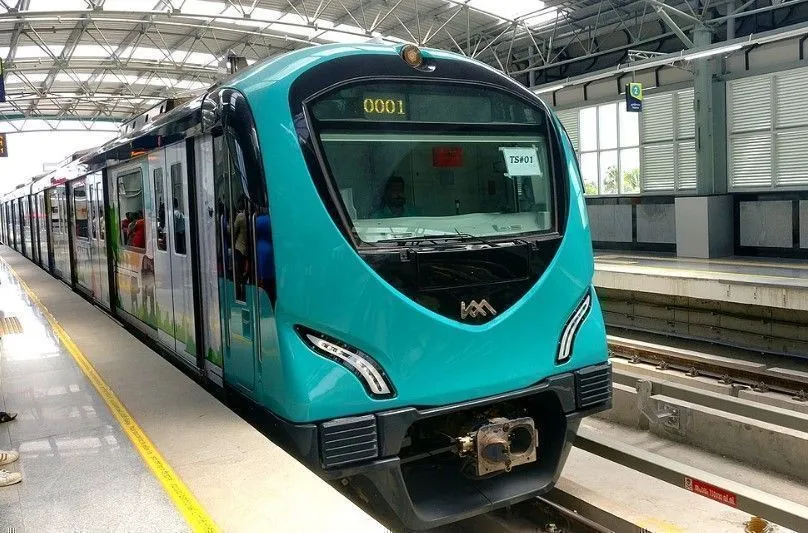
Kochi’s much-anticipated Metro extension towards the Infopark technology corridor is increasingly unlikely to meet its mid-year operational target, raising questions about project financing, construction sequencing, and the city’s wider mobility strategy. The first segment of Phase II of the Kochi Metro, envisioned as a low-carbon mass transit link for one of Kerala’s largest employment hubs, is now confronting visible execution gaps that could delay its June rollout.
Project data reviewed by Urban Acres indicates that while foundation-level activities are largely advanced, progress on superstructure elements remains uneven. Piling across stations and viaduct sections is largely complete, but elevated track construction and pier erection both critical for carrying rails and systems installation are still far from the pace required for commissioning within weeks. Urban transport experts note that Metro projects typically need at least six to eight months after major civil works for signalling, traction, testing, and safety certification.
The Infopark corridor holds strategic importance for Kochi’s urban economy. It is designed to serve tens of thousands of daily commuters employed across technology parks, industrial estates, and institutional campuses. At present, most of this workforce depends on private vehicles or fragmented bus services, contributing to congestion, emissions, and chronic parking stress along arterial roads. The Kochi Metro Infopark extension was positioned as a shift towards more sustainable commuting patterns in a rapidly expanding eastern growth belt.
Funding constraints have emerged as a key risk. Senior officials familiar with the project point to delays in securing external debt, particularly multilateral financing, as a factor slowing procurement and contractor mobilisation. Large urban rail systems depend on predictable capital flows to synchronise civil, electrical, and systems work. Any disruption can cascade into timeline slippages, even when on-ground activity appears visible.
Construction responsibility for Phase II rests with a major infrastructure contractor under a multi-year civil works package. While station structures are rising along several stretches, urban planners caution that partial readiness does not guarantee operational viability. “Metro systems function as integrated networks missing even one systems component can stall the entire corridor,” said an independent transit consultant tracking Indian Metro projects. For Kochi, the delay has implications beyond transport. Real estate absorption around transit corridors, office leasing decisions, and workforce accessibility are closely linked to credible delivery timelines. Developers and employers often factor Metro availability into long-term planning, especially in cities positioning themselves as sustainable technology destinations.
The state government has previously revised the Phase II completion target, reflecting the complexity of building elevated rail in dense urban environments. However, repeated deadline adjustments risk eroding public confidence and reducing the behavioural shift from private vehicles to mass transit a key objective of climate-resilient urban planning. As Kochi balances fiscal constraints with infrastructure ambition, the coming months will test whether coordinated funding decisions, faster systems procurement, and tighter project management can still unlock partial operations. For a city grappling with growth pressures, the success of the Kochi Metro Infopark extension will be a bellwether for how effectively future urban infrastructure is planned, financed, and delivered.
Kochi Metro Infopark Extension Faces Timeline Strain