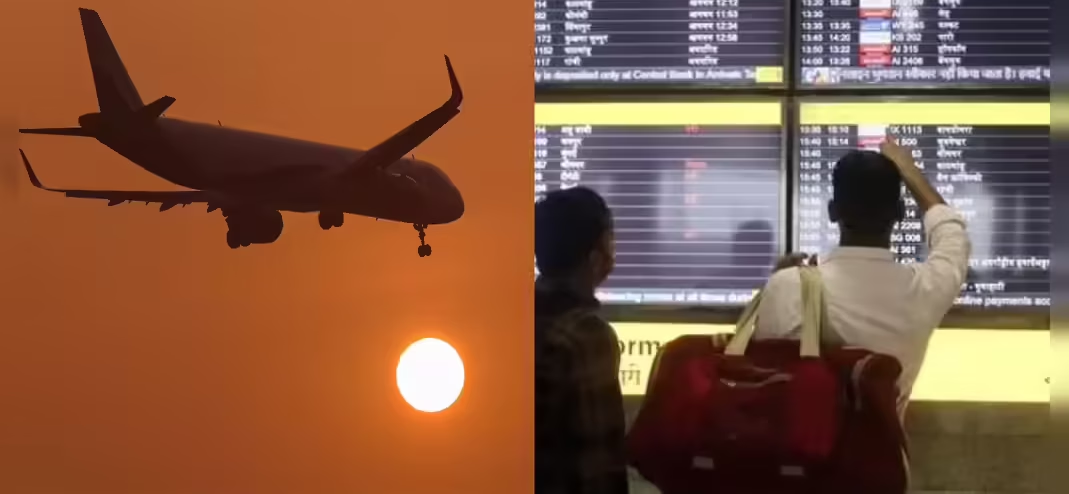
India’s aviation network experienced significant disruption this week as multiple airlines cancelled more than two dozen domestic and international flights across key metropolitan and regional airports. The cancellations, spanning cities such as Delhi, Mumbai, Bengaluru, Chennai, Kolkata and select international routes, highlighted mounting operational stress within a system already stretched by high demand, dense schedules and limited recovery capacity.
The disruptions were not concentrated at a single airport or airline. Instead, they unfolded across several hubs over different time windows, indicating broader network fragility rather than isolated technical issues. Industry analysts note that such distributed cancellations are increasingly common during peak travel periods, when aircraft rotation, crew availability and airspace constraints leave little margin for error. Major business corridors were among the most affected. Flights linking Pune and Bengaluru, Ahmedabad with Delhi and Kolkata, and Kolkata with western and southern markets were withdrawn from schedules, disrupting short-haul routes critical for corporate travel and inter-city commerce. Repeated cancellations on select trunk routes, particularly between Mumbai and Chennai, pointed to ongoing operational constraints rather than one-off disruptions.
The impact extended beyond domestic connectivity. Long-haul services connecting Indian metros with European destinations were also cancelled, affecting international passengers, cargo movements and onward connections. Aviation experts say the grounding of wide-body aircraft on international routes has a cascading effect, as these flights are tightly synchronised with global schedules and limited substitute capacity. Airports in the National Capital Region saw the widest spread of cancellations, covering destinations in the north, east and west of the country alongside an overseas route. As the country’s primary aviation hub, disruptions at Delhi tend to ripple quickly through the national network, affecting secondary cities that rely heavily on hub-and-spoke connectivity.
From a passenger perspective, the consequences were immediate. Travellers faced missed connections, inflated fares on alternative flights and extended ground delays. Business travellers reported compressed schedules and lost productivity, while leisure passengers encountered last-minute itinerary changes during a high-traffic season. Airport operators managed crowding through rebooking counters and extended ground support, but capacity constraints limited swift resolution. The episode also underscores a structural challenge for India’s aviation growth story. Passenger volumes continue to rise sharply, but fleet availability, airport slot saturation and crew resilience have not expanded at the same pace. Aviation planners warn that without greater operational buffers, schedule density can undermine reliability, especially during weather disruptions, maintenance cycles or airspace congestion.
For cities, flight reliability is increasingly tied to economic competitiveness, tourism flows and investor confidence. Urban economists note that dependable air connectivity supports regional development and reduces pressure on surface transport systems, aligning with broader goals of efficient, low-emission mobility. Looking ahead, industry experts suggest that airlines will need stronger contingency planning, more flexible fleet deployment and closer coordination with airport authorities. As India’s aviation sector scales further, resilience rather than sheer capacity may determine whether growth translates into a stable, passenger-friendly network.
India aviation network hit by widespread cancellations