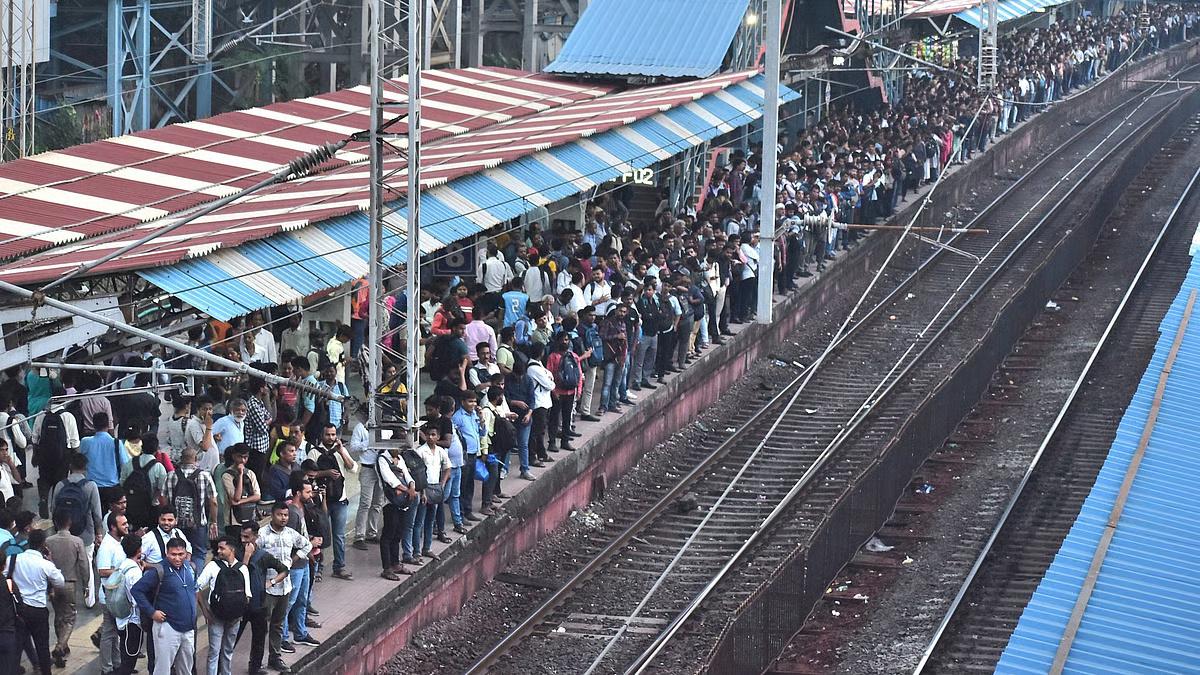
Severe congestion at Andheri station on Mumbai’s Western suburban corridor has once again exposed the fragility of the city’s daily mobility system, after prolonged infrastructure blocks sharply reduced train services. Visuals emerging this week showed dangerously overcrowded platforms and foot overbridges, with commuters forced into unsafe movement patterns. The disruption matters not just as a commuter inconvenience, but as a reminder of how capacity gaps in India’s largest urban rail network directly affect economic productivity, safety, and public confidence.
The pressure at Andheri is being driven by an extended construction block on the Western Railway section between Kandivali and Borivali, where a sixth rail line is under development. The project is intended to separate fast and slow services in the long term, easing congestion on one of India’s most heavily used suburban rail corridors. However, the current execution phase has resulted in widespread service cancellations and altered schedules during peak hours, shifting an already high passenger load onto fewer trains. Transport planners point out that Andheri functions as a critical interchange for office-bound commuters, airport connectivity, and north–south suburban travel. Any disruption at this node has cascading effects across the network, amplifying crowd density at platforms and access points. Reduced frequency, combined with last-minute operational adjustments, has intensified commuter anxiety, particularly during morning and evening peaks when time sensitivity is highest.
Officials associated with suburban rail operations have indicated that several hundred local services are being withdrawn daily during the block period to allow track realignment and signalling upgrades. While such upgrades are necessary to support future capacity and reliability, urban mobility experts argue that the absence of visible crowd management and clear passenger communication increases risk exposure. In a system that moves millions daily, even minor information gaps can trigger unsafe behaviour. From an urban governance perspective, the situation highlights a recurring challenge in Indian cities: executing essential infrastructure upgrades without proportionate investment in temporary mitigation. Crowd marshals, real-time platform information, and predictable service patterns are not merely operational add-ons, but critical safety infrastructure during transition phases. Gender-sensitive design and inclusive access are also affected when platforms become physically inaccessible during extreme congestion.
The Western Railway block underscores a broader policy dilemma facing Mumbai’s transport ecosystem. Rail expansion is vital for reducing road congestion, emissions, and dependence on private vehicles. Yet, without phased planning that prioritises commuter safety and communication, short-term disruptions risk eroding trust in public transport precisely when cities need citizens to rely on it more. As work on the sixth line progresses, attention is likely to shift toward how temporary arrangements are managed over the remaining weeks. For a city striving toward resilient, low-carbon mobility, the lesson from Andheri is clear: infrastructure growth must be matched by people-first operations, especially at the most stressed points of the network.
Mumbai Local Trains Face Severe Andheri Rush