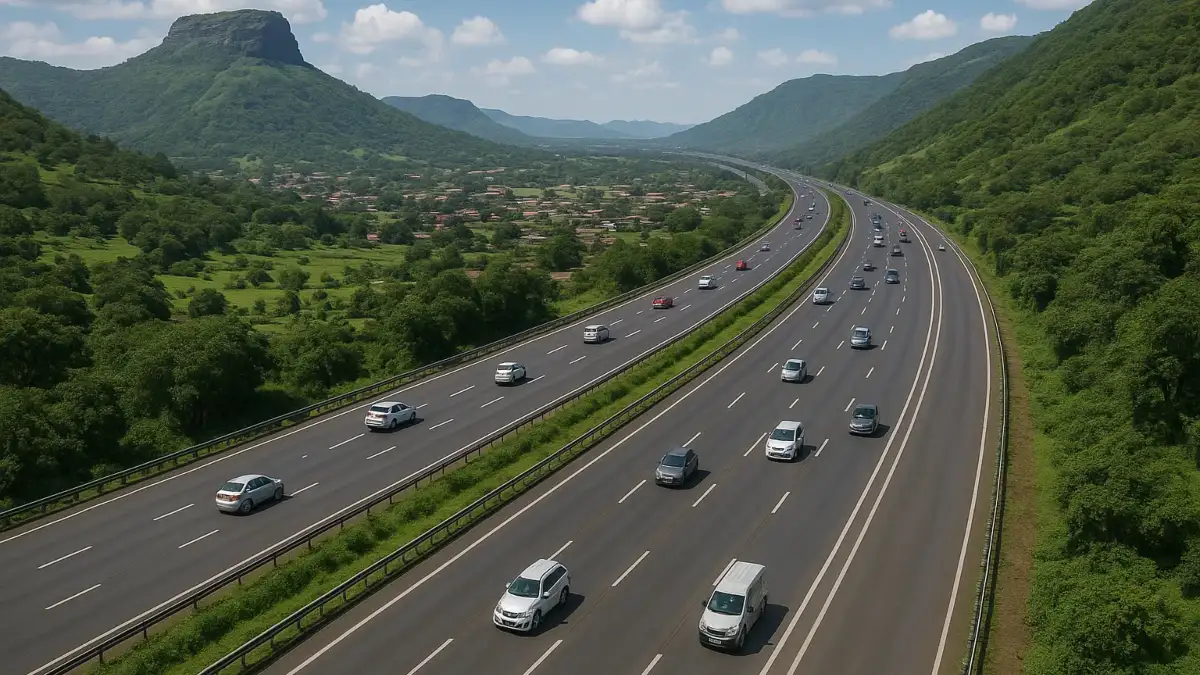
A long-awaited infrastructure upgrade on the Mumbai–Pune expressway is set to open to traffic on May 1, marking a pivotal moment for one of India’s busiest intercity corridors. The completion of the expressway’s missing link near Lonavla is expected to shorten travel time between the two cities by up to half an hour, easing congestion and improving safety on a stretch long regarded as a bottleneck.
The new alignment bypasses the most accident-prone ghat section of the expressway, where sharp curves, steep gradients and weather exposure have historically slowed traffic and increased collision risks. By offering a straighter and more consistent driving experience, the project is designed to improve traffic flow while reducing pressure on the existing mountain road. Infrastructure officials overseeing the project indicate that construction is nearing completion, with final safety checks and finishing works underway. The development includes two long tunnels and a cable-stayed bridge spanning a deep valley in the Western Ghats, representing one of the most technically demanding road engineering efforts undertaken in the state. The bridge, rising more than 180 metres above ground level, has required specialised construction techniques and careful sequencing to manage terrain and wind conditions.
Delays caused by extreme monsoon weather had earlier pushed back timelines, particularly in the ghat section where safety risks limited construction windows. Project planners opted for a cautious approach rather than accelerating work, citing the need to balance deadlines with worker safety and long-term structural integrity. Urban infrastructure experts note that such decisions reflect a broader shift toward risk-aware project execution in climate-sensitive regions. The expressway missing link carries strategic significance beyond travel time savings. The Mumbai–Pune corridor supports a dense economic ecosystem encompassing manufacturing, technology, logistics and real estate. Faster and more reliable connectivity is expected to benefit daily commuters, freight operators and regional supply chains, while also strengthening the integration of satellite towns along the route.
From a sustainability perspective, smoother traffic flow can reduce idling and stop-start driving, contributing marginally to lower vehicular emissions per trip. Transport planners caution, however, that capacity enhancements must be accompanied by demand management and public transport investment to avoid induced traffic over the long term.The project’s cost, estimated at nearly ₹6,700 crore, reflects both its engineering complexity and the challenges of building in ecologically sensitive terrain. Environmental monitoring and slope stabilisation measures have formed a key part of the construction process, given the Western Ghats’ status as a biodiversity hotspot.
For regular users of the expressway, the opening represents a tangible improvement in daily travel experience. For policymakers, it offers a case study in balancing speed, safety and resilience in large-scale road infrastructure. As the new stretch becomes operational, attention will shift to how effectively it integrates with existing traffic patterns and whether it delivers sustained reductions in congestion across peak travel periods.
Maharashtra Expressway Upgrade Nears Completion At Lonavla