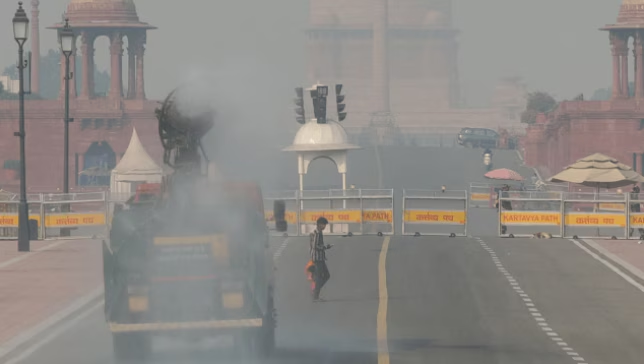
Delhi’s emergency air pollution framework has delivered measurable public health and environmental gains, according to a new multi-agency analysis assessing winter smog episodes across the capital region. The findings indicate that without the Graded Response Action Plan, the city would have endured substantially longer stretches of hazardous air—an outcome with serious consequences for productivity, healthcare systems, and urban liveability.
The assessment, conducted using pollution, meteorological and exposure data over recent winter seasons, shows that the absence of restrictions would have resulted in roughly 60 percent more hours of “severe” air quality. Even more striking, the most toxic “severe-plus” conditions could have persisted for up to three times longer. For a megacity already grappling with climate stress and rapid urbanisation, these avoided pollution hours represent tangible economic and social value. Researchers found that staged interventions under the plan reduced fine particulate matter concentrations by varying margins depending on the severity level. During the most stringent phases, average PM2.5 concentrations fell sharply, easing short-term health risks and lowering cumulative exposure. Public health analysts estimate that these reductions translated into hundreds of avoided premature deaths and thousands of life-years preserved across the region.
The Delhi GRAP effectiveness lies in its graduated structure. Early stages focus on enforcement of existing emission rules, while higher stages restrict construction, freight movement, older vehicles, and selected industrial activities. Though disruptive, these measures are activated only during meteorological conditions that trap pollutants, such as low wind speeds and temperature inversions common in north Indian winters. Urban economists point out that while temporary curbs affect construction schedules, logistics, and commuter routines, the counterfactual cost of inaction would be far higher. Poor air quality reduces labour productivity, increases hospital admissions, and deters investment in dense urban centres. By flattening pollution peaks rather than allowing uncontrolled spikes, the framework provides predictability for businesses and city administrators alike.
The data also reveal year-on-year variation in how often each stage was implemented, reflecting changing weather patterns and emission loads. This variability, experts say, underscores the importance of dynamic, evidence-based governance rather than fixed seasonal bans. It also highlights the need to pair emergency controls with structural reforms such as cleaner transport fleets, dust-free construction practices, and decentralised employment hubs that reduce daily travel demand. From a built-environment perspective, the findings strengthen the case for designing cities that are less vulnerable to episodic shutdowns. Better building envelopes, indoor air filtration, transit-oriented development, and electrified freight corridors can reduce the need for repeated emergency interventions.
As Delhi prepares for future winters, planners and regulators face a clear signal: short-term response systems work, but they cannot substitute long-term urban transformation. Strengthening the Delhi GRAP effectiveness while accelerating clean infrastructure investment may determine whether India’s capital can reconcile economic growth with breathable air.
Delhi GRAP Effectiveness Reduces Extreme Pollution Hours