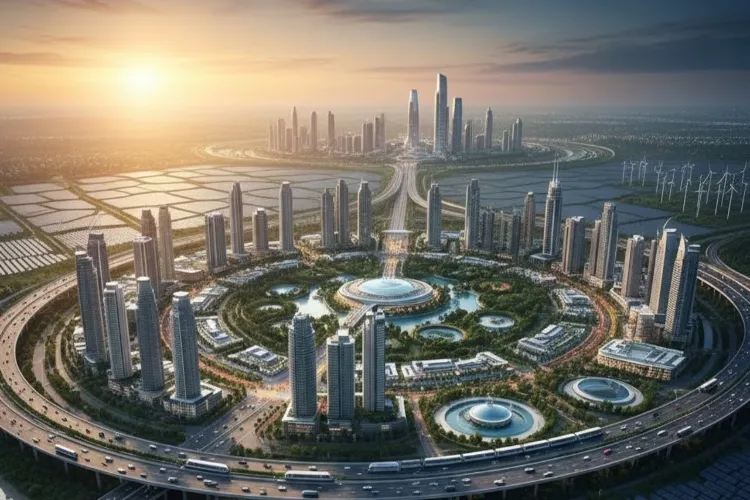
Gujarat has taken a decisive step towards reshaping its urban growth pattern by initiating the planning process for five satellite towns around its largest cities, signalling a shift away from concentrated metropolitan expansion. The state has invited urban planning firms to develop comprehensive master plans for new growth centres near Ahmedabad, Vadodara, Gandhinagar, Surat and Rajkot, aiming to redistribute population, jobs, and infrastructure demand by the end of the decade.
The proposed locations Sanand, Savli, Kalol, Bardoli and Hirasar are already linked economically to their neighbouring cities through industry, logistics or commuting flows. By formalising their development as satellite towns, the state is seeking to convert informal sprawl into planned urban extensions with stronger civic services and local employment capacity. Urban economists say this approach reflects growing recognition that unchecked city expansion strains transport networks, housing supply and public finances.
According to officials overseeing the initiative, the master plans will focus on compact, mixed-use development supported by high-quality public transport. While these towns will not replicate metro rail systems immediately, planners are expected to design transit networks that offer metro-like efficiency through electric buses, dedicated corridors and integrated last-mile connectivity. This is intended to reduce car dependency and curb future emissions as populations grow. Infrastructure proposals under consideration include ring roads to divert freight traffic, advanced water supply and wastewater treatment systems, decentralised solid waste management, and resilient power networks. Urban planners involved in similar projects note that building these systems upfront is significantly more cost-effective than retrofitting them once towns reach scale.
The inclusion of urban forest parks and restored water bodies is also central to the planning brief. Environmental experts argue that integrating green and blue infrastructure early can help satellite towns cope with heat stress, flooding and water scarcity risks that are intensifying across western India. Lakes and green corridors, if protected through zoning, can double as recreational spaces while improving microclimates and biodiversity. From a real estate perspective, the satellite town strategy could reshape development pipelines. Analysts expect demand for affordable and mid-income housing to rise as new employment clusters emerge closer to these locations. Mixed-use zoning, which places offices, retail and housing within walkable distances, is expected to attract private investment while limiting speculative land hoarding.
The initiative also reflects a broader policy push to strengthen Tier-2 and Tier-3 urban centres as engines of economic growth. By creating viable alternatives to overcrowded metros, the state aims to retain skilled workers locally, reduce long-distance commuting, and distribute industrial growth more evenly across regions.
Urban governance specialists caution that success will depend on coordinated execution between state agencies, local bodies and utility providers.
Clear development controls, transparent land-use rules and long-term funding mechanisms will be critical to prevent these towns from becoming dormitory suburbs. As planning tenders move forward, the next phase will test whether Gujarat can translate its satellite town vision into liveable, climate-resilient urban centres offering residents the benefits of city life without the costs of congestion, pollution and overstretched infrastructure.
Gujarat Satellite Towns Plan Targets Balanced Urban Growth