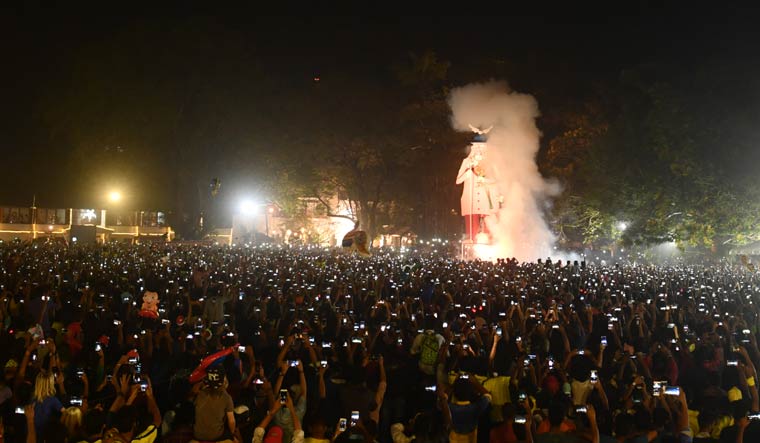
Fort Kochi marked the arrival of the New Year with large-scale public celebrations as thousands of residents and visitors converged on the historic coastal precinct, reinforcing the area’s role as one of Kerala’s most significant civic and cultural gathering spaces. With major events spread across multiple venues, the city witnessed one of its highest seasonal footfalls, placing public infrastructure, safety systems, and urban coordination under close scrutiny.
Celebrations were anchored at two primary locations — the Parade Ground and the Veli Ground — both of which began receiving crowds from early morning onwards. By evening, public movement into Fort Kochi intensified, prompting traffic controls and pedestrian-only access in several stretches to prevent congestion. City authorities deployed layered crowd management strategies, reflecting growing awareness of the risks associated with dense urban gatherings.Organisers implemented structural and safety-related restrictions as part of pre-event planning. One of the most visible measures was limiting the height of ceremonial installations traditionally used to symbolise the transition into the New Year. Officials involved in the planning said the decision was guided by safety audits and emergency response considerations rather than aesthetics, underscoring a shift towards risk-aware event management in heritage districts.
Civic amenities played a central role in sustaining the celebrations. Drinking water points, sanitation facilities, and first-response arrangements were expanded across event zones. For the first time, the city administration introduced a network of bio-toilets at the venues, a move urban planners describe as a small but important step toward reducing environmental stress during mass events in fragile coastal areas.As dusk fell, the Veli Ground emerged as the larger congregation point, drawing sustained crowds well before midnight. Music performances and curated programmes began early in the evening, helping distribute arrivals over time. At the Parade Ground, organisers adopted staggered scheduling to avoid a sudden dispersal of crowds at midnight — a strategy aimed at minimising bottlenecks and public safety risks.
Beyond the main venues, Fort Kochi’s streets transformed into informal cultural corridors. Youth groups assembled across neighbourhood pockets, forming music collectives and street performances that added to the festival’s decentralised character. Urban sociologists note that such spontaneous use of public space reflects Fort Kochi’s unique social fabric, where formal and informal celebrations coexist within walkable urban blocks.The scale of participation also highlighted ongoing challenges. Waste management, last-mile mobility, and emergency access remain pressure points during high-density events. However, officials involved in the planning said lessons from this year’s arrangements would feed into future frameworks for managing festivals in historic city zones.
As Indian cities increasingly rely on public events to drive tourism and local economies, Fort Kochi’s New Year celebrations offer a case study in balancing cultural vibrancy with safety, sustainability, and inclusive access to shared urban spaces.