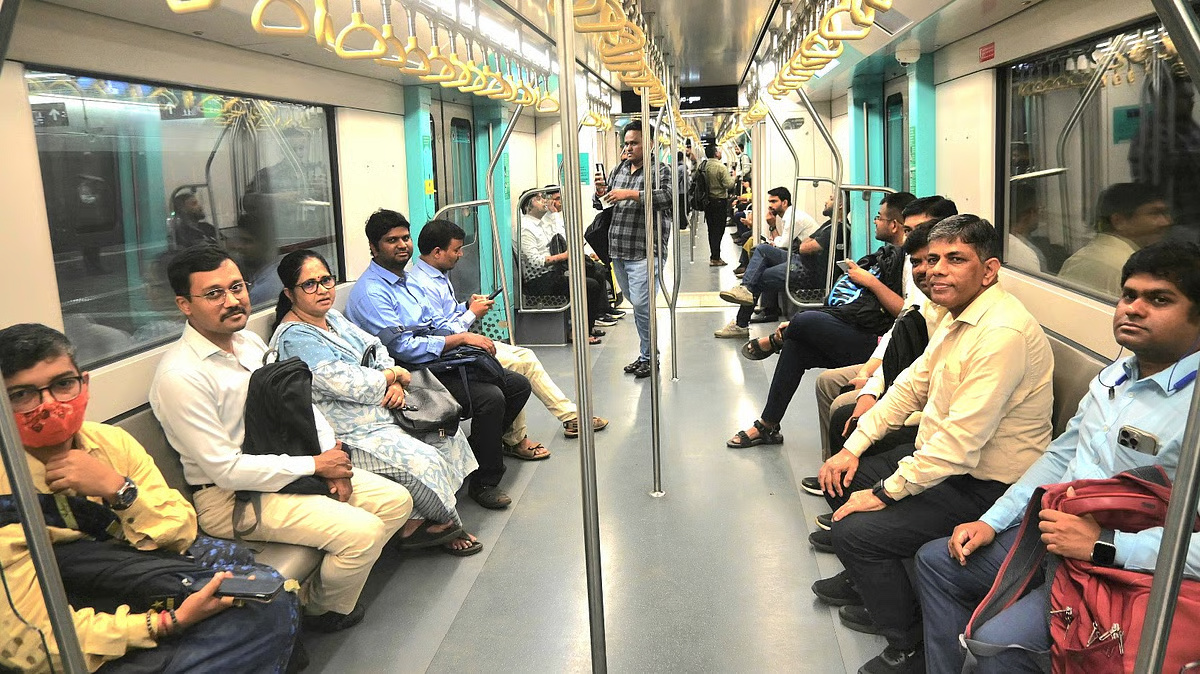
Mumbai’s experiment with extended public transport operations on New Year’s Eve has delivered a clear signal to urban planners: demand for safe, reliable late-night mobility is no longer niche but mainstream. Special overnight operations across two Metro corridors recorded significantly higher ridership than regular days, reinforcing the role of rapid transit in managing large-scale civic movement during major citywide events.
On the western suburban corridor, additional services operated well past midnight into the early hours of January 1, carrying close to half a million passengers over the extended operating window. Transport officials tracking system data said usage comfortably exceeded the line’s recent daily average, despite the services being concentrated largely during non-peak leisure hours rather than routine work travel. The underground north–south Metro corridor also reported strong usage through the night. Ridership figures compiled across the evening and early morning hours indicated that demand remained robust even during a period when office commuters—who typically dominate weekday patronage—were largely absent due to year-end holidays. Urban mobility specialists see this as an important behavioural marker, suggesting that metros are increasingly being viewed as a preferred option for social, recreational, and late-night travel.
The success of late night Metro services has wider implications for Mumbai’s transport planning. Traditionally, the city’s night-time mobility has relied heavily on private vehicles, app-based taxis, and limited bus services. During festivals and major celebrations, this imbalance often leads to traffic congestion, safety risks, and higher emissions. Extended metro operations, by contrast, offer a lower-carbon alternative capable of moving large volumes of people efficiently and predictably. Industry experts note that the New Year’s Eve data strengthens the case for periodic late-night operations beyond exceptional occasions. While running services overnight involves higher staffing and energy costs, these must be weighed against broader public benefits such as reduced drink-driving incidents, lower congestion, and improved access for shift workers in hospitality, healthcare, logistics, and emergency services.
From an inclusion perspective, reliable late night Metro services also address a long-standing urban equity gap. Women, young workers, and lower-income commuters often face disproportionate safety and cost barriers when travelling after dark. A visible, well-managed mass transit system can help normalise night-time mobility while improving perceptions of safety in public spaces. Urban planners caution, however, that sustained night operations would require coordination across policing, station-area lighting, last-mile connectivity, and neighbourhood-level services. Without these supporting systems, the full social and environmental benefits of extended metro hours may not be realised.
For now, the New Year response offers policymakers a data-backed reference point. As Mumbai continues to expand its Metro network across the metropolitan region, integrating late night Metro services into long-term operations could play a meaningful role in shaping a more resilient, people-first, and climate-conscious urban transport ecosystem. The coming months will determine whether this demand is treated as a one-off festive surge—or as evidence of a permanent shift in how the city moves after dark.
Mumbai Metro Sees Record New Year Ridership