Chennai Housing Market Records Strongest Sales Growth
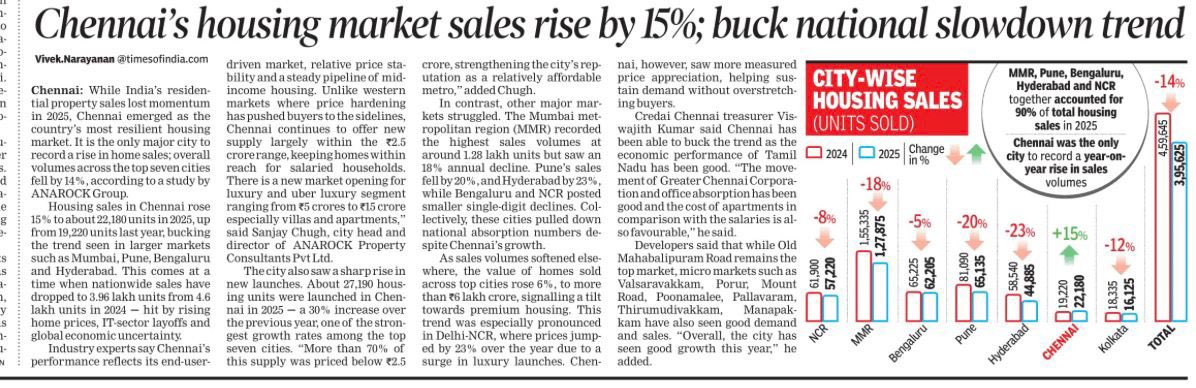
Chennai’s residential property sector emerged as a bright spot in an otherwise cooling Indian housing market, recording a 15% increase in home sales in 2025. While major metros including Mumbai, Pune, Bengaluru, and Hyderabad saw total sales volumes drop, the Tamil Nadu capital bucked the national trend, reflecting a resilient, end-user-driven market. Analysts note that the city’s ability to maintain affordable pricing and steady new launches has kept buyer sentiment strong despite broader economic uncertainty.
According to market estimates, approximately 22,180 units were sold in Chennai last year, up from 19,220 in 2024. In contrast, sales across India’s seven largest cities collectively declined by 14%, with total nationwide absorption falling from 4.6 lakh units to 3.96 lakh units. Experts attribute Chennai’s relative stability to consistent pricing, a robust mid-income segment, and a growing pipeline of housing options priced below ₹2.5 crore, keeping homes accessible for salaried professionals.The city also witnessed a surge in new launches, with 27,190 residential units introduced in 2025 — a 30% increase from the previous year. More than 70% of this supply was concentrated in the sub-₹2.5 crore range, reinforcing Chennai’s position as one of India’s more affordable metros. Meanwhile, premium and luxury housing segments, ranging from ₹5 crore to ₹15 crore, saw emerging demand for villas and high-end apartments, signalling diversification of the market without displacing the core buyer base.
Other major metros struggled to sustain sales. The Mumbai metropolitan region, despite recording the highest absolute sales at 1.28 lakh units, experienced an 18% decline. Pune and Hyderabad reported sharper falls of 20% and 23%, respectively, while Bengaluru and Delhi-NCR posted moderate single-digit reductions. Luxury launches in Delhi-NCR drove a 23% price rise, highlighting a national tilt towards premium housing. Chennai, in contrast, maintained measured appreciation, preventing affordability pressures from deterring buyers.
Urban economists and housing planners highlight Chennai’s performance as a case study in balanced urban development. Steady office absorption, ongoing infrastructure projects, and strategically located micro-markets — including Old Mahabalipuram Road, Porur, Pallavaram, Mount Road, and Thirumudivakkam — have supported demand growth. By aligning housing supply with income levels and maintaining connectivity across the city, developers and municipal authorities have created conditions that encourage sustainable urban growth while managing speculative pressure.
Looking forward, Chennai’s housing market is likely to continue its resilience, provided developers maintain affordability and expand housing options across mid-income and emerging micro-markets. Urban planners see the model as indicative of how metro cities can balance real estate growth with inclusivity, economic opportunity, and long-term climate-conscious planning.