Bengaluru prepares citywide traffic plan for New Year
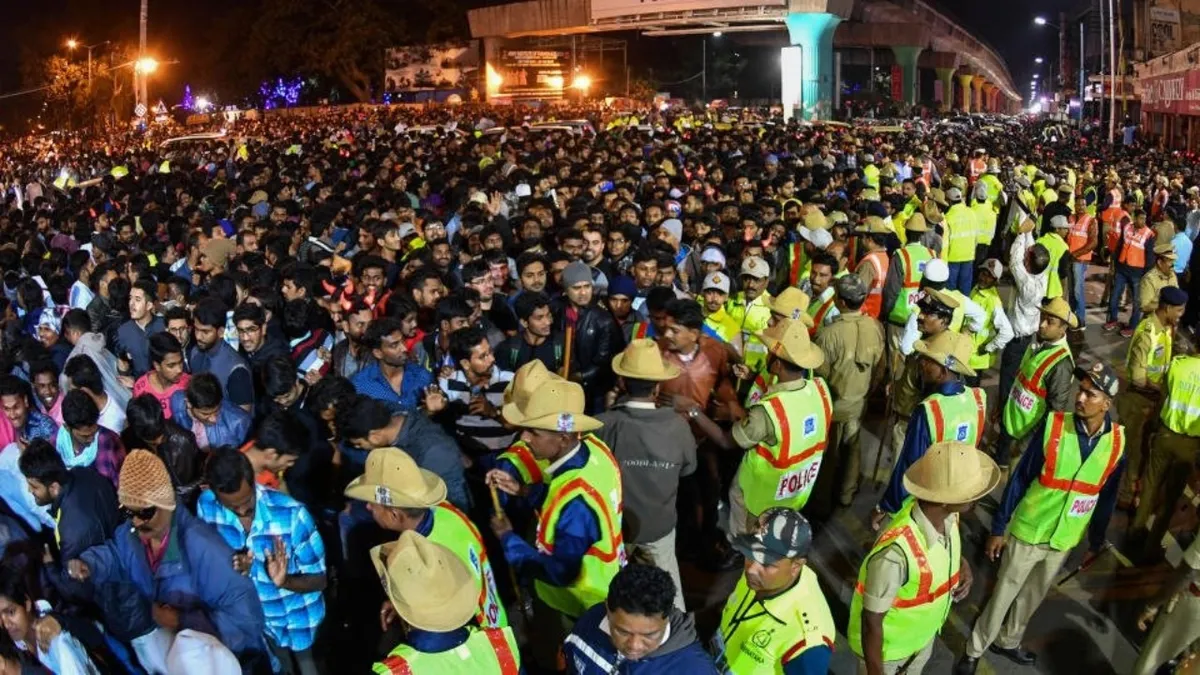
Bengaluru is bracing for one of the largest New Year’s Eve gatherings in recent years, with officials preparing extensive traffic management, crowd control, and transit measures to manage over a million revelers across the city. Key urban zones including M.G. Road, Brigade Road, Indiranagar, Koramangala, and major mall precincts are being prioritised for monitoring, reflecting the city’s push for safer, more organised public festivities amid growing population density.
The state government has mobilised roughly 20,000 police personnel, integrating traditional deployment with technology-driven monitoring, including the city’s first Heat Map system to track crowd density in real time. Urban planners highlight that such measures are increasingly necessary to balance public celebration with safety, given Bengaluru’s dense urban fabric and rising vehicular pressure.Traffic restrictions will be in place across several high-footfall corridors from 8 pm to 3 am, with supplementary parking bans starting at 4 pm. In central hubs like M.G. Road and Brigade Road, pedestrians will have one-way access along defined stretches, while private vehicles will be diverted at critical junctions including Cubbon Road and Trinity Circle. Peripheral parking options at locations such as UB City, Garuda Mall, and Shivajinagar BMTC complex aim to reduce congestion within the core zones.
In residential and commercial neighbourhoods, including Indiranagar and Koramangala, authorities have restricted on-street parking and introduced route diversions to mitigate bottlenecks. Similarly, near major retail and entertainment destinations like Orion Mall and Mall of Asia, selected arterial roads will remain closed to through traffic, reflecting a city-wide strategy to pre-empt gridlock while maintaining pedestrian safety.Complementing road measures, Bengaluru Metro Rail Corporation Limited (BMRCL) has extended services across the Purple, Green, and Yellow Lines until early hours of January 1, 2026. Trains will operate at frequent intervals, though select stations, such as M.G. Road Metro, will close temporarily to manage crowd movement. Token sales and digital ticketing have been adapted to encourage contactless boarding, highlighting the city’s push for technology-integrated urban transport.Additionally, the Bangalore Metropolitan Transport Corporation (BMTC) has scheduled special bus services connecting central celebration zones with peripheral neighbourhoods, offering last-mile connectivity and reducing reliance on private vehicles. Enforcement strategies are bolstered by drone surveillance, traffic wardens, and 166 sobriety checkpoints, underlining a multi-layered approach to public safety.
Urban safety experts suggest that these measures reflect a maturing city infrastructure approach, where traffic management, public transport, and crowd monitoring converge to support climate-conscious, inclusive urban mobility. As Bengaluru navigates the challenges of dense celebrations, the focus remains on maintaining order, ensuring accessibility, and enhancing citizen confidence in public spaces during major events.