


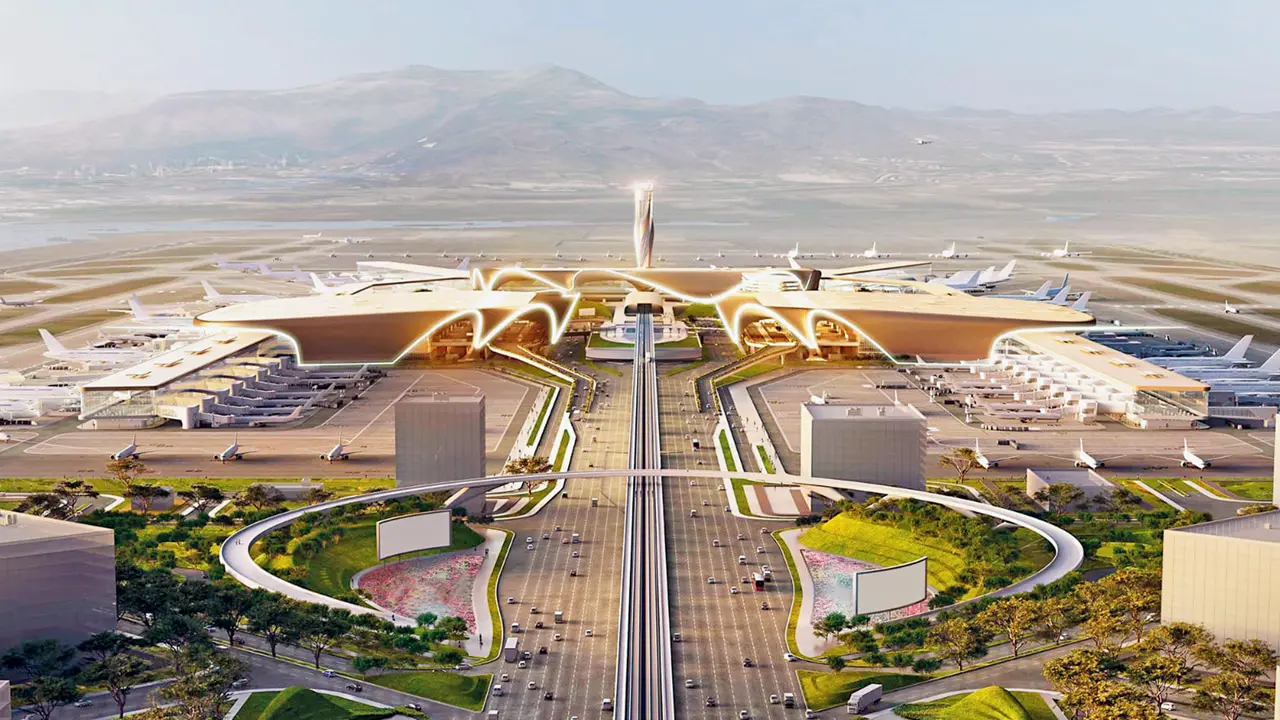
Commercial operations at the Navi Mumbai International Airport began on 25 December, marking a decisive shift in the spatial and economic geography of the Mumbai region. With scheduled domestic flights commencing from day one, the long-awaited aviation hub is expected to reshape mobility patterns while accelerating real estate development across Navi Mumbai and adjoining districts of the Mumbai and Pune metropolitan regions.
Industry executives and urban planners describe the first flight as more than a transport milestone. The airport is widely seen as a catalyst that strengthens Navi Mumbai’s role as a counterweight to congested South Mumbai and Bandra Kurla Complex, while opening new development corridors along established road and rail networks. Airlines have already deployed connections to major Indian cities, signalling confidence in sustained passenger demand and future capacity expansion. Property markets appear to have priced in this optimism well before the inaugural landing. Residential values in Panvel and nearby nodes have risen sharply over the past four years, outpacing many established parts of Navi Mumbai. Market data shared by real estate consultants indicate that while core Navi Mumbai remains costlier in absolute terms, price appreciation has been stronger in emerging micro-markets closer to the airport influence zone. Analysts attribute this to speculative land aggregation, infrastructure-led demand and expectations of employment generation linked to aviation and logistics. An industry expert noted that the airport forms part of a wider infrastructure stack, including metro rail, expressways, suburban rail upgrades and planned water transport. Together, these projects are gradually compressing travel times between housing clusters and employment centres, reshaping daily commuting choices. Locations such as Panvel, Ulwe, Kharghar and Taloja are witnessing a rise in integrated residential projects, with developers positioning them as self-sufficient neighbourhoods rather than dormitory suburbs.
Affordability remains a defining feature of the airport’s immediate hinterland. Despite recent price growth, several pockets around Navi Mumbai International Airport still offer homes below the Rs 1 crore threshold, a rarity within the broader Mumbai Metropolitan Region. Smaller apartments in Ulwe and Taloja continue to attract first-time buyers and aviation-linked professionals, while Kharghar caters to end-users seeking better social infrastructure, albeit at higher entry prices. Urban economists caution, however, that infrastructure-led growth must be carefully managed. Rapid appreciation can strain local ecosystems, water resources and transport capacity if not matched with sustainable planning norms. Officials involved in regional planning argue that the airport’s long-term success will depend on transit-oriented development, mixed-income housing supply and low-carbon mobility solutions that reduce private vehicle dependence.
As Navi Mumbai International Airport settles into regular operations, its real impact will unfold over the next decade. Beyond boosting real estate values, the project has the potential to support a more balanced metropolitan form one that redistributes jobs, shortens commutes and encourages inclusive urban growth across the extended MMR.
Also Read: VIP Industries Appoints Sameer Wanchoo As Chief Marketing Officer To Strengthen Mumbai Operations
