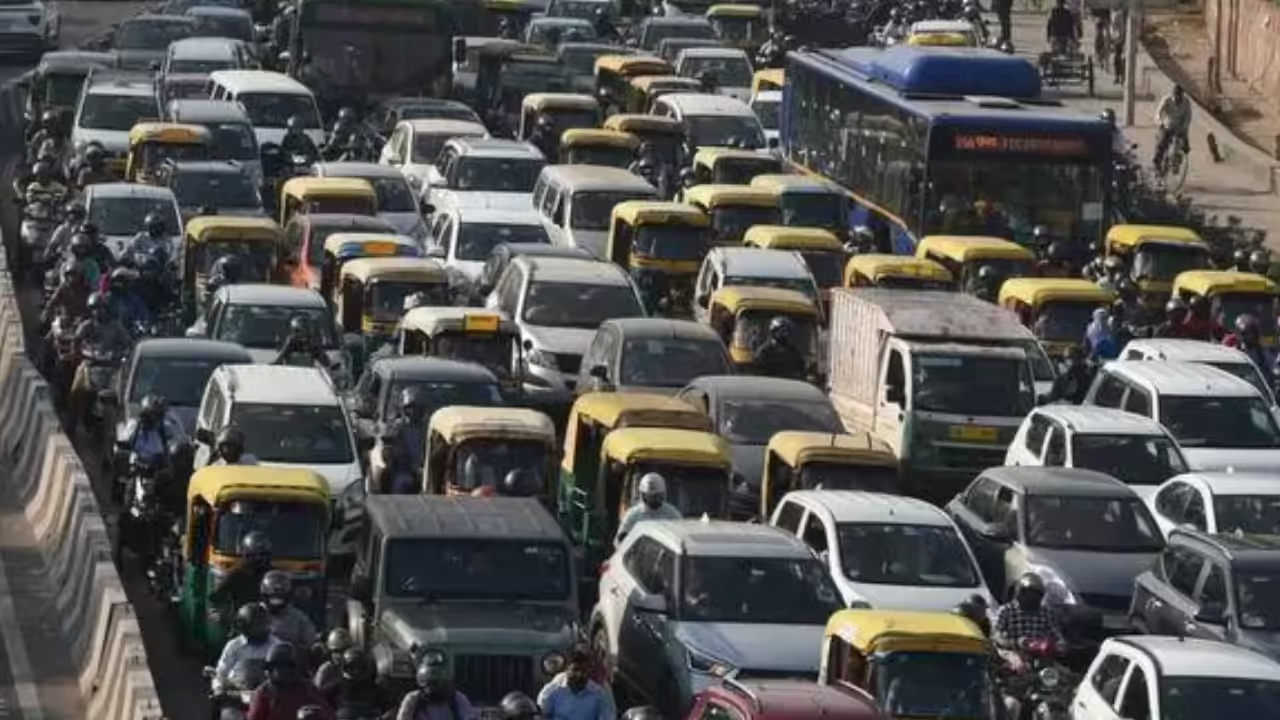
The Delhi government has approved a ₹759 crore package of long-pending road infrastructure projects aimed at easing chronic congestion across South Delhi, signalling a renewed push to address mobility bottlenecks in one of the capital’s most densely travelled corridors. Cleared by the Expenditure Finance Committee, the projects include flyover expansions and a major stormwater drainage upgrade along the Mehrauli–Badarpur Road, a stretch notorious for traffic snarls and monsoon flooding.
The programme, to be executed by the Public Works Department, focuses on strengthening a critical north–south corridor linking residential neighbourhoods, business districts and key intercity routes to Gurgaon and Faridabad. Urban planners view the decision as overdue, noting that stalled approvals and fragmented planning have compounded congestion and environmental stress in South Delhi for years. At the heart of the plan is the widening of the Savitri Cinema flyover, a key junction handling daily commuter traffic between South and Central Delhi. The existing structure will be doubled to accommodate rising vehicle volumes, easing peak-hour bottlenecks that routinely spill over into surrounding residential streets. Industry experts say the expansion could significantly cut travel times if construction timelines are tightly managed.
The second component involves doubling the Kalkaji flyover, commonly referred to as the Modi Mill flyover, and integrating it seamlessly with the Savitri Cinema structure. Once linked, the two flyovers will form a continuous elevated corridor, enabling uninterrupted traffic flow across a highly congested stretch. According to transport analysts, such continuity is essential for reducing stop-start driving patterns that increase fuel consumption and emissions. Equally critical is the stormwater drainage project planned along the Mehrauli–Badarpur Road. The corridor experiences severe waterlogging during monsoon months, disrupting traffic and accelerating road damage. The upgraded drainage system is expected to improve climate resilience, protect public investment in road infrastructure and ensure year-round reliability for commuters.
A senior government official said the projects had remained stuck due to years of administrative indecision but would now move swiftly into the tendering phase. “With financial approvals secured, execution is the priority,” the official noted, adding that coordination across agencies would be central to timely delivery.
Once completed, the upgraded corridor from the Modi Mill flyover to the IIT Gate intersection will feature three lanes in each direction, smoother traffic movement and improved road safety
Urban policy specialists argue that while flyovers alone cannot solve Delhi’s congestion, targeted upgrades on critical corridors can deliver immediate relief when paired with better drainage, pedestrian safety and public transport planning.
As Delhi grapples with air pollution, climate risks and unequal access to mobility, the success of these projects will depend not just on speed, but on whether they form part of a broader shift towards inclusive, resilient and lower-carbon urban infrastructure.
Delhi Fast Tracks ₹759 Crore South Delhi Traffic Decongestion Infrastructure Projects Major