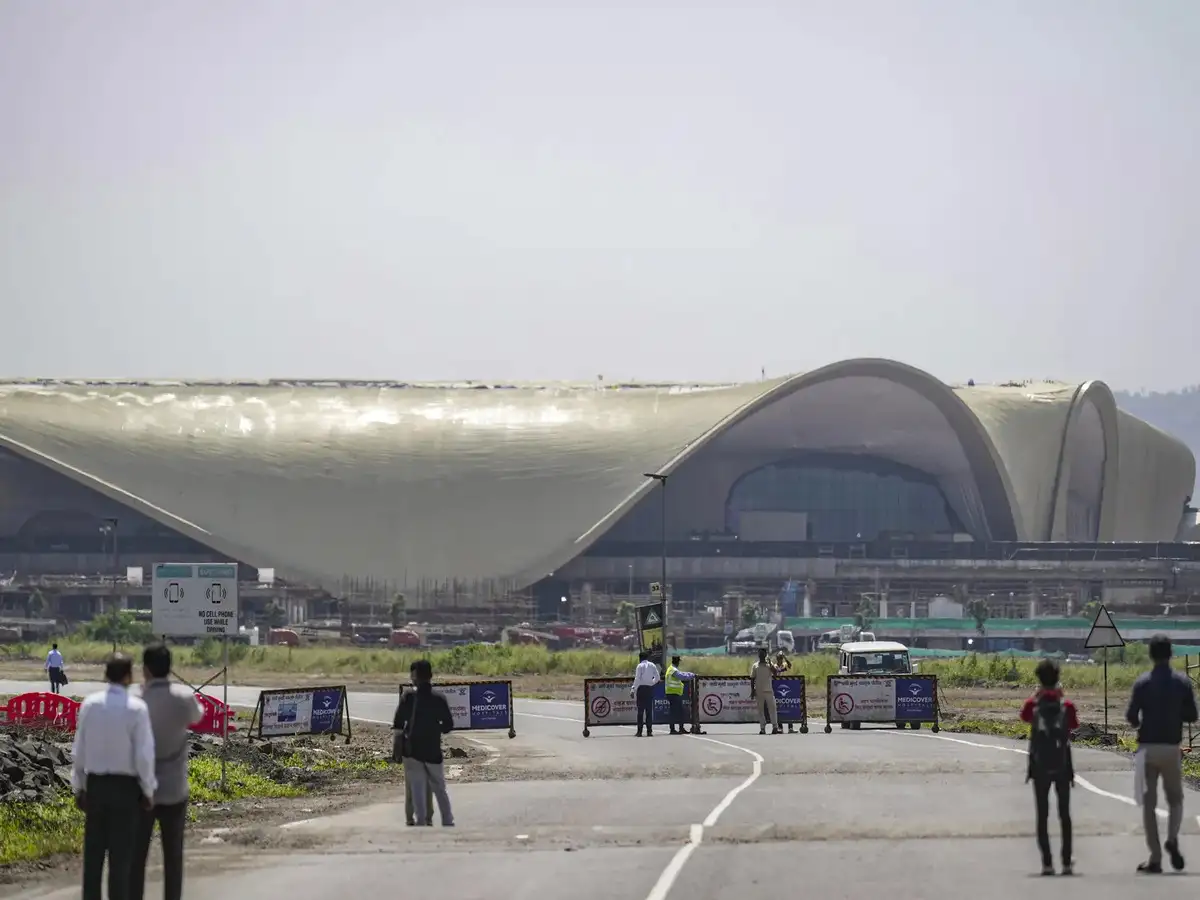
When the Navi Mumbai International Airport (NMIA) opens its doors this week, the Mumbai Metropolitan Region (MMR) will formally join a small global club of urban regions operating two major airports simultaneously. The long-anticipated facility marks a critical expansion of aviation capacity for India’s financial capital, but its debut also underlines a familiar urban challenge: large infrastructure arriving ahead of mass transit connectivity.
At launch, NMIA will be accessible exclusively by road, with passengers relying on private vehicles, taxis and buses to reach the terminal. Officials involved in the project describe the airport as a deliberately decentralised transport node, planned to draw passengers and cargo from multiple directions rather than depend on a single corridor. Traffic modelling, they say, has accounted for flows from South Mumbai, the eastern suburbs, Navi Mumbai, Thane, extended MMR towns and key economic corridors towards Pune, Nashik and the Konkan coast. In the short term, access will hinge on arterial road infrastructure. The Sion–Panvel Highway, Palm Beach Road and national highway links around Kalamboli will form the primary approach routes. South Mumbai connectivity will improve via the Mumbai Trans Harbour Link, although onward travel will remain circuitous until the Ulwe Coastal Road becomes operational, a project now expected only towards the end of 2026.
Suburban rail connectivity exists, but remains limited. The nearest railway station is over three kilometres from the terminal and sees relatively few daily services. While shuttle buses and last-mile links are planned, officials acknowledge that rail will initially serve airport staff more than passengers. Urban transport experts point out that without seamless rail access, airport-bound road traffic risks adding pressure to already congested corridors during peak hours. Medium- and long-term mobility plans are more ambitious. Authorities have proposed a dedicated airport express metro linking NMIA with Mumbai’s primary international airport, integrating with multiple existing and under-construction metro lines. Separately, an extension of the Navi Mumbai Metro is planned to directly serve the airport, alongside additional metro corridors intended to connect eastern growth nodes and industrial zones.
There is also renewed interest in water-based transport. Plans are under discussion for passenger and cargo services via nearby creeks, reflecting a broader push to diversify urban mobility while reducing carbon intensity. Maritime agencies are assisting with feasibility and route planning, drawing on experience from other Indian cities experimenting with water transit. Urban planners view NMIA as more than an aviation project. Its success, they argue, will depend on how quickly multimodal access materialises and whether transport planning prioritises public, low-emission options over private vehicles. As cities across India expand critical infrastructure, NMIA offers a test case for aligning growth with sustainability, equity and long-term urban resilience.
Navi Mumbai Airport Opens With Road Only Access As Rail Links Await