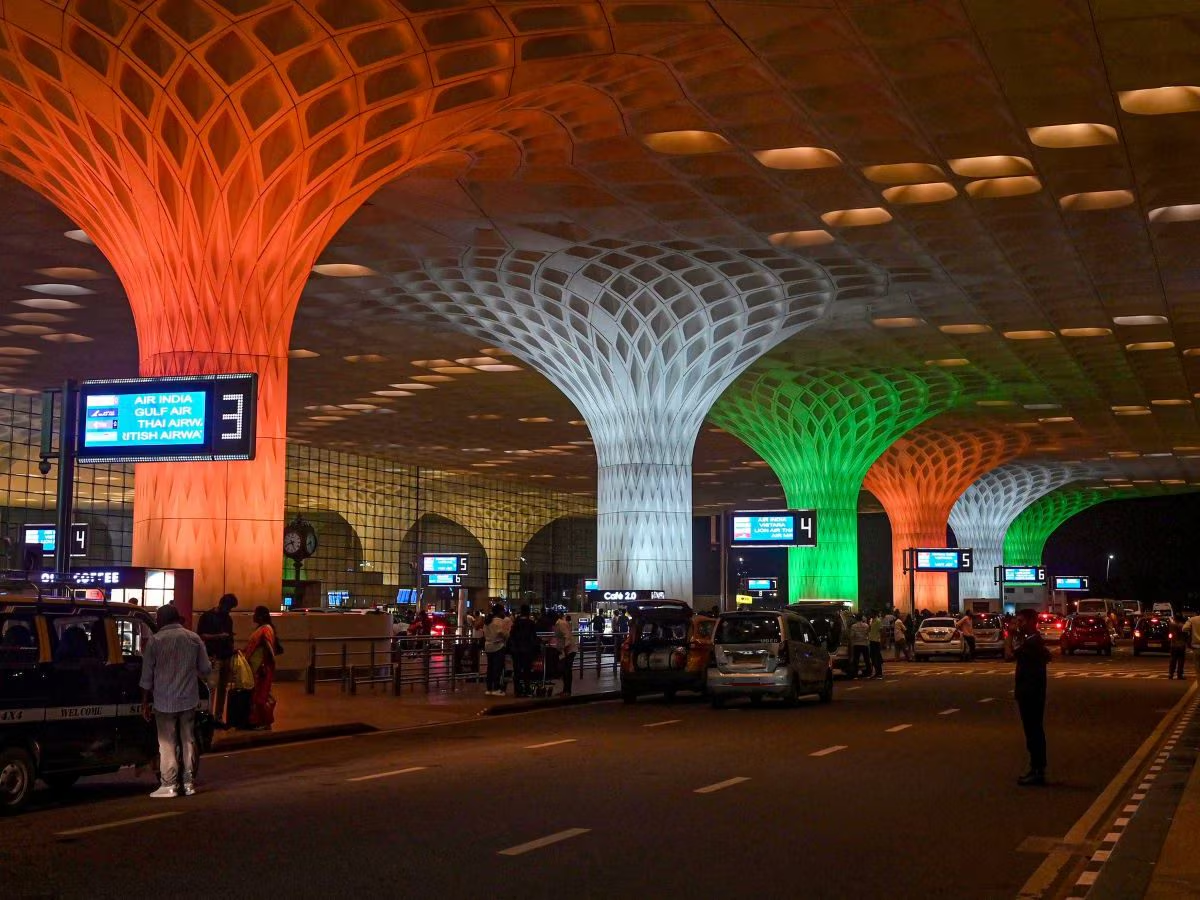
Mumbai’s primary airport is preparing for a quiet but consequential transformation that could reshape how one of the world’s most congested aviation hubs grows without laying a single slab of new concrete. Chhatrapati Shivaji Maharaj International Airport is set to increase aircraft movements by deploying advanced, precision-based air traffic control systems that rely on machine-enabled decision support rather than traditional estimation-driven methods.
The initiative, led by the national airport operator, aims to unlock additional landing capacity on the airport’s single operational runway by the end of 2028, according to officials familiar with the plan. The move comes at a critical juncture for India’s commercial capital. With passenger volumes crossing 55 million annually and aircraft movements exceeding 330,000, Mumbai airport operates at near-saturation levels for large parts of the day. Unlike most global hubs, it manages both arrivals and departures on a single mixed-use runway, leaving little margin for operational inefficiency.
Rather than pursuing physical expansion an increasingly difficult proposition in land-constrained Mumbai the authorities are turning to intelligent approach management systems built around time-based aircraft separation. These systems calculate precise landing sequences in real time, accounting for aircraft performance, wake turbulence and prevailing weather conditions. An aviation official involved in the project said the shift would allow controllers to move from reactive traffic handling to predictive flow management. “The objective is to reduce variability, smoothen peak-hour operations and safely bring movements closer to the runway’s true capacity,” the official said.
At present, Mumbai handles around 44 to 46 aircraft movements per hour. Minor disruptions often cascade into delays, increasing controller workload and fuel burn for airlines. By optimising arrival spacing and reducing unnecessary airborne holding, the new system is expected to improve punctuality while lowering emissions an increasingly important consideration for climate-conscious urban infrastructure. The initiative also reflects broader changes underway in the Mumbai metropolitan aviation ecosystem. The new air traffic framework will eventually manage approach operations for both the existing airport and the upcoming Navi Mumbai airport through a shared control environment, allowing coordinated use of regional airspace.
Industry experts say this integration is crucial for sustainable aviation growth. “Airports can no longer expand endlessly. Efficiency, digital coordination and environmental performance are now central to capacity planning,” said an aviation infrastructure specialist. Significant groundwork has already been laid, including upgraded surveillance systems, digital pilot–controller communications and advanced arrival and departure management tools. The proposed intelligent approach layer will sit atop these systems, creating a unified and data-driven air traffic environment. As India’s air travel demand is projected to grow steadily over the next two decades, Mumbai’s experiment could become a template for other dense urban airports. By prioritising smarter systems over physical sprawl, the city is signalling how critical infrastructure can expand responsibly balancing economic growth, operational safety and environmental accountability in an increasingly crowded urban sky.
Mumbai Airport To Enable More Landings On Single Runway Using Precision Technology