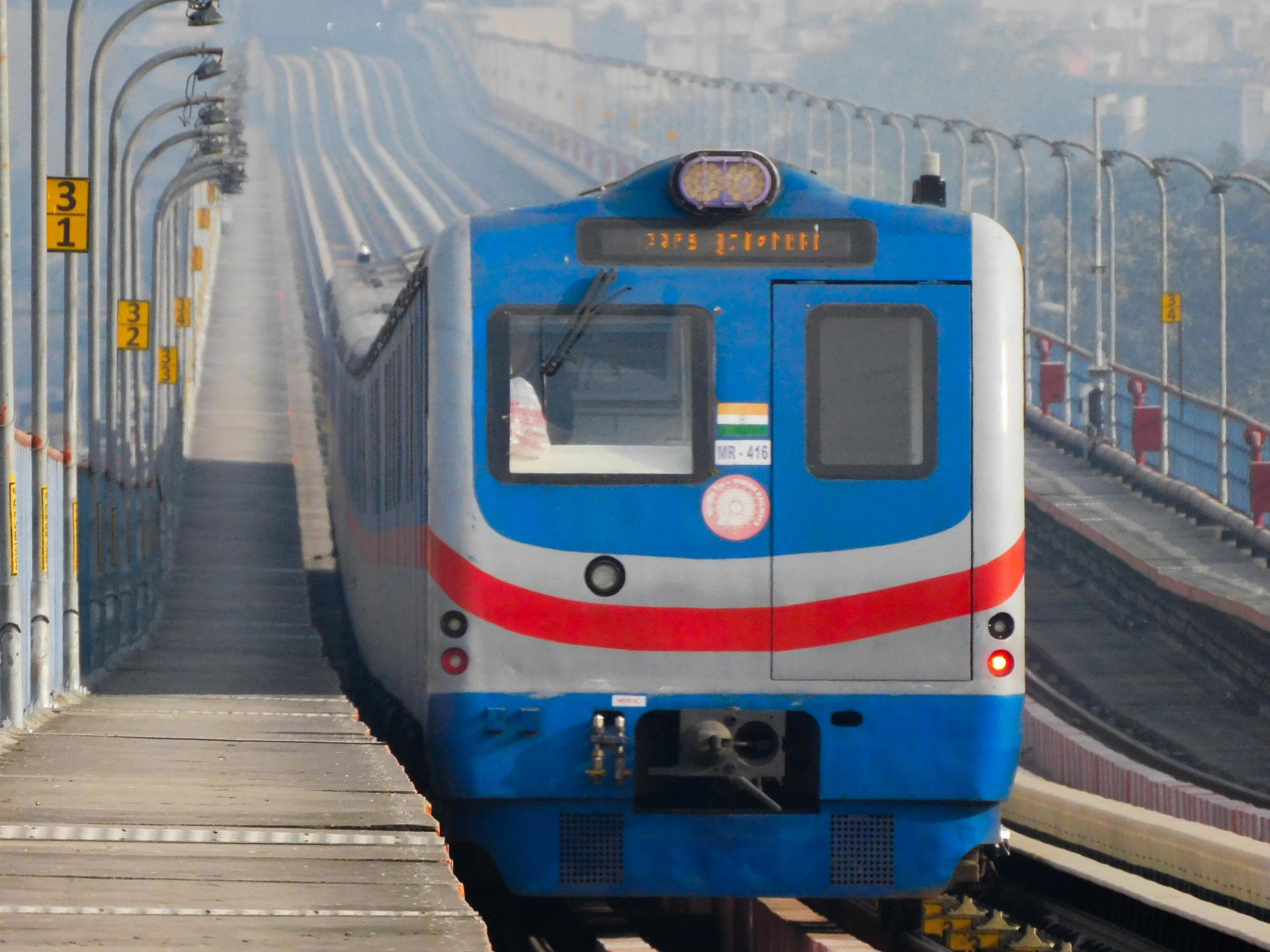
Kolkata, India’s cultural and economic hub in the east, is witnessing a transformative phase in urban mobility as its metro network expands to meet rising commuter demand. Established as the country’s first metro rail system, Kolkata Metro now spans over 74 km across multiple corridors, integrating advanced technology and modern infrastructure to address traffic congestion and support sustainable transport.
The concept of metro rail in Kolkata dates back to the early 20th century, but it was formally pursued in the 1960s when traffic growth outpaced road capacity. The Metropolitan Transport Project (MTP) laid the groundwork for a master plan connecting key city sectors through multiple corridors, with the North–South line taking priority due to heavy commuter volumes. The first operational stretch, a 3.4 km section between Esplanade and Bhowanipore, launched in 1984, establishing a precedent for urban rail in India.
Today, the Kolkata Metro comprises several lines, including the Blue Line from Dakshineswar to Kavi Subhash, the Green Line connecting Salt Lake Sector V to Howrah Maidan, and the Orange, Yellow, and Purple lines expanding connectivity across the city. Notably, the Green Line incorporates India’s first underwater metro section, linking Howrah Maidan to Esplanade. Extensions such as the Nopara–Jai Hind Bimanbandar Yellow Line and Orange Line expansions highlight ongoing efforts to improve accessibility to peripheral neighbourhoods and emerging business hubs. Despite these advances, challenges remain. Older infrastructure faces maintenance issues, with incidents such as structural cracks at Kavi Subhas station necessitating reconstruction. Legacy technology continues to restrict operational efficiency, and financial losses are reported to have increased to ₹224.7 crore as of January 2025. Delays in expansion projects have further contributed to rising costs, highlighting the need for robust planning and funding mechanisms.
Nevertheless, ridership trends are encouraging. Daily passenger counts surpassed 8.69 lakh in late 2025, reflecting growing public reliance on the metro. The Blue and Green lines remain particularly busy, while newer lines gradually attract commuters, contributing to traffic decongestion and improved urban mobility. Non-fare revenue streams have also grown, signalling a diversification strategy to enhance financial sustainability. Industry experts note that the Kolkata Metro’s continued expansion and modernisation will be central to creating a low-carbon, inclusive, and sustainable transport system. With projected network growth exceeding 130 km by 2027, these developments are positioned to reinforce Kolkata’s role as a forward-looking, resilient urban centre.
Kolkata Metro Expansion Strengthens Sustainable Urban Connectivity Across Rapidly Growing City Today