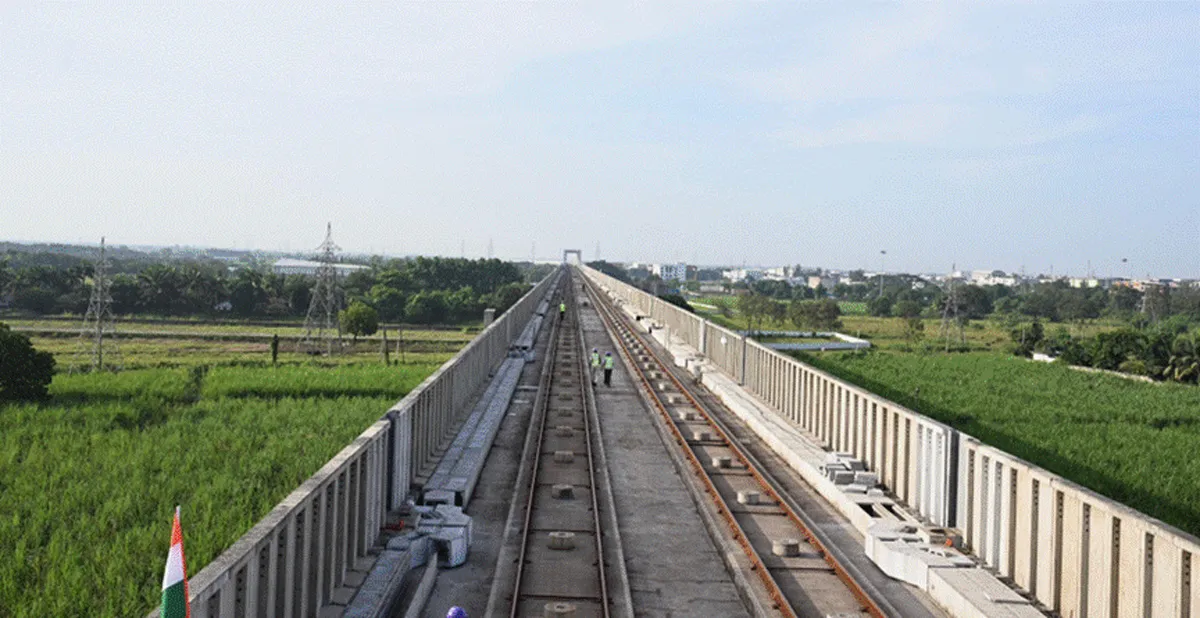
Mumbai–Ahmedabad: India’s inaugural high-speed rail corridor, the Mumbai–Ahmedabad High-Speed Rail (MAHSR) project, has marked significant construction milestones as of early December 2025, signalling rapid progress in civil engineering, tunnelling, and system installation across Maharashtra and Gujarat. The National High Speed Rail Corporation Limited (NHSRCL) reports that multiple work fronts are advancing simultaneously, highlighting India’s entry into high-speed rail operations.
Civil works remain the backbone of the project, with 330 km of viaduct and 408 km of piers completed along the 508-km corridor. These elevated structures are essential for maintaining the precise geometry required for Shinkansen-style trains operating at 320 kmph. Additionally, bridge construction has reached critical milestones, including 17 river bridges, 11 steel bridges, and five pre-stressed concrete bridges completed. A 130-metre span of a planned 230-metre steel bridge has also been installed, reflecting some of the most challenging engineering tasks on the route.Noise mitigation has been prioritised along urban and suburban stretches, with over 4.7 lakh noise barriers covering 235 km of the alignment, ensuring compliance with international Shinkansen standards. Track infrastructure is progressing steadily, with 260 km of reinforced concrete track bed, 3,700 overhead electrification masts, and 85 km of electrification completed. These installations will support vibration-free slab tracks, optimising train performance and long-term maintenance efficiency.
Tunnelling remains a complex segment of MAHSR, particularly in Palghar and undersea sections. Seven mountain tunnels are under excavation, and the BKC–Shilphata underground tunnel, spanning 21 km and including India’s first undersea segment, has seen 5 km excavated using the New Austrian Tunnelling Method (NATM). These tunnels will house some of the deepest stations, with BKC functioning as the central underground terminal.Operational facilities are being developed in parallel, with depots under construction in Surat and Ahmedabad to manage Shinkansen E5-type train sets. Station construction is progressing rapidly, with Gujarat’s stations nearing completion and Maharashtra’s elevated stations, including BKC, advancing with structural and base slab work.Early delays related to land acquisition and environmental clearances in Maharashtra have been resolved, enabling accelerated construction.
“With civil works, systems, and tunnelling progressing concurrently, the corridor is on track to redefine India’s high-speed transport landscape,” an NHSRCL official said. Once operational, the Mumbai–Ahmedabad bullet train will cut travel times to approximately two hours, significantly boosting regional economic activity, tourism, and connectivity between Maharashtra and Gujarat. The project exemplifies an integrated urban and transport planning approach, supporting sustainable mobility while reducing reliance on conventional road and air travel.
Mumbai Ahmedabad Bullet Train Project Advances Rapidly With Viaduct Bridges Tunnels Stations Completed