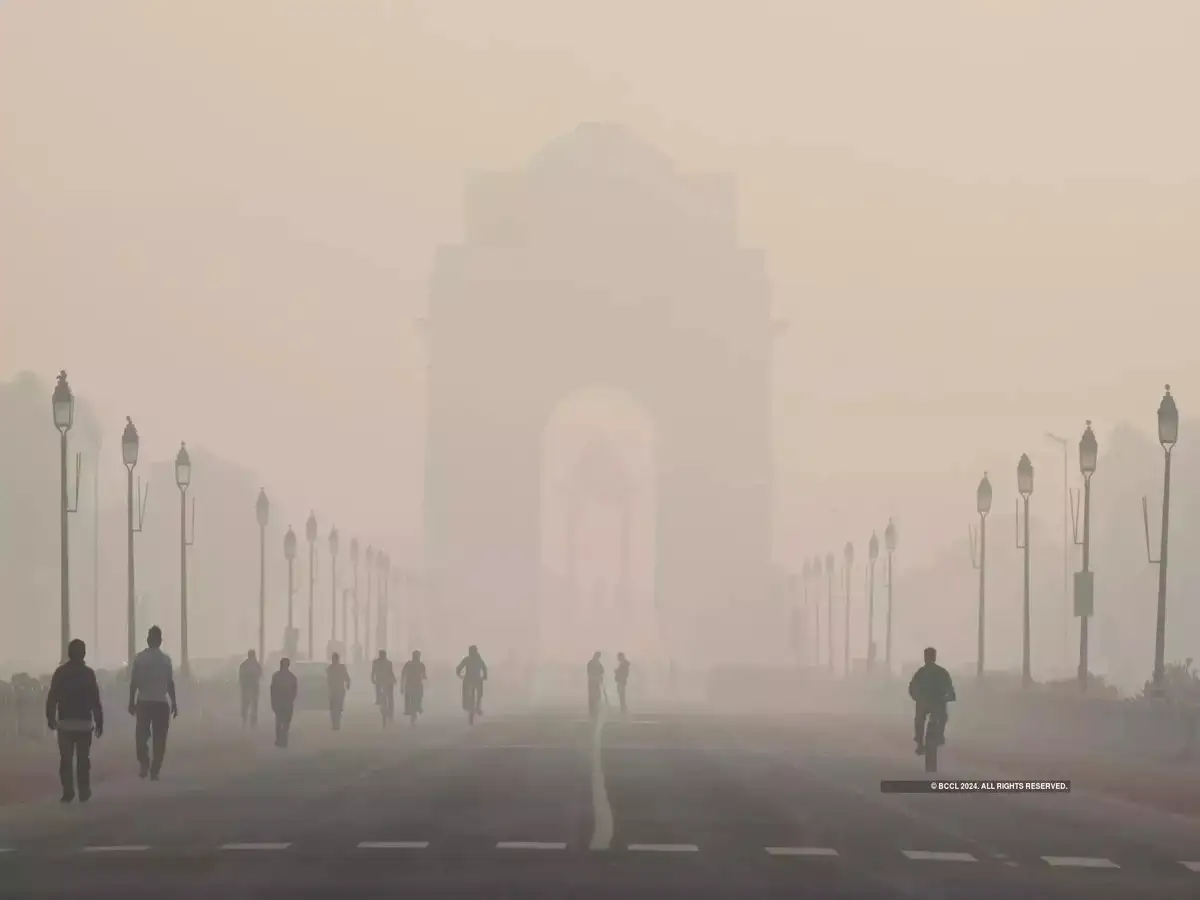
Delhi woke up to another day of hazardous winter air on Friday, with the city’s air quality remaining firmly in the “very poor” category even as a cold wave took hold. The combination of dense pollution, falling temperatures and stagnant winds continues to heighten public health concerns in a region already struggling with long-term air-quality instability.
According to data from the national air-quality monitoring network, Delhi recorded an Air Quality Index (AQI) reading of 323 at 9 a.m., placing it in the higher end of the “very poor” band. More than 30 monitoring stations across the capital showed similarly alarming levels, with the northern industrial belt reporting some of the worst pollution concentrations. An official familiar with the real-time monitoring process said the sustained decline highlights “persistent emissions, slower atmospheric dispersion and an early winter inversion layer”.
The weekly data points to a sharp fluctuation in Delhi’s air quality, underscoring how quickly conditions deteriorate when meteorological support weakens. After recording a relatively lower AQI of 279 at the start of the week, levels rose consistently, touching 372 on Tuesday, inching close to the “severe” threshold. Experts note that this volatility complicates the city’s ability to plan responsive mitigation, especially during high-pressure winter phases when pollution tends to remain trapped close to the surface.
Alongside the pollution spike, the India Meteorological Department has forecast a cold wave across the capital. The minimum temperature dipped to 5.6°C, nearly four degrees below normal, accompanied by relative humidity reaching 100%. The cold, still air has further prevented particulate matter from dispersing a combination urban planners describe as among the toughest for city health systems and mobility networks.Environmental specialists argue that Delhi’s recurring winter pattern reflects the urgent need for long-term reductions in emissions, backed by aggressive monitoring of construction dust, industrial activity and mobility-related pollution. They add that while seasonal interventions such as emergency restrictions or smog towers bring temporary relief, sustainable gains demand regional coordination, cleaner transport systems and redesigned urban spaces that promote low-carbon behaviour.
Public health researchers warn that prolonged exposure to “very poor” air disproportionately affects vulnerable communities, especially outdoor workers, children and the elderly. They stress that accessible public information, cleaner public transport and resilient neighbourhood design must become central to Delhi’s urban strategy if the city is to move toward an inclusive and sustainable future.While the maximum temperature is expected to hover around 22°C later in the day, the overall outlook suggests no immediate relief from the pollution cycle. For now, Delhi’s residents remain caught between hazardous air and an intensifying winter, as the city once again confronts the complex intersection of climate, urbanisation and public health.
Delhi Air Quality Remains Very Poor As Forecasters Warn Of Intensifying Cold Wave