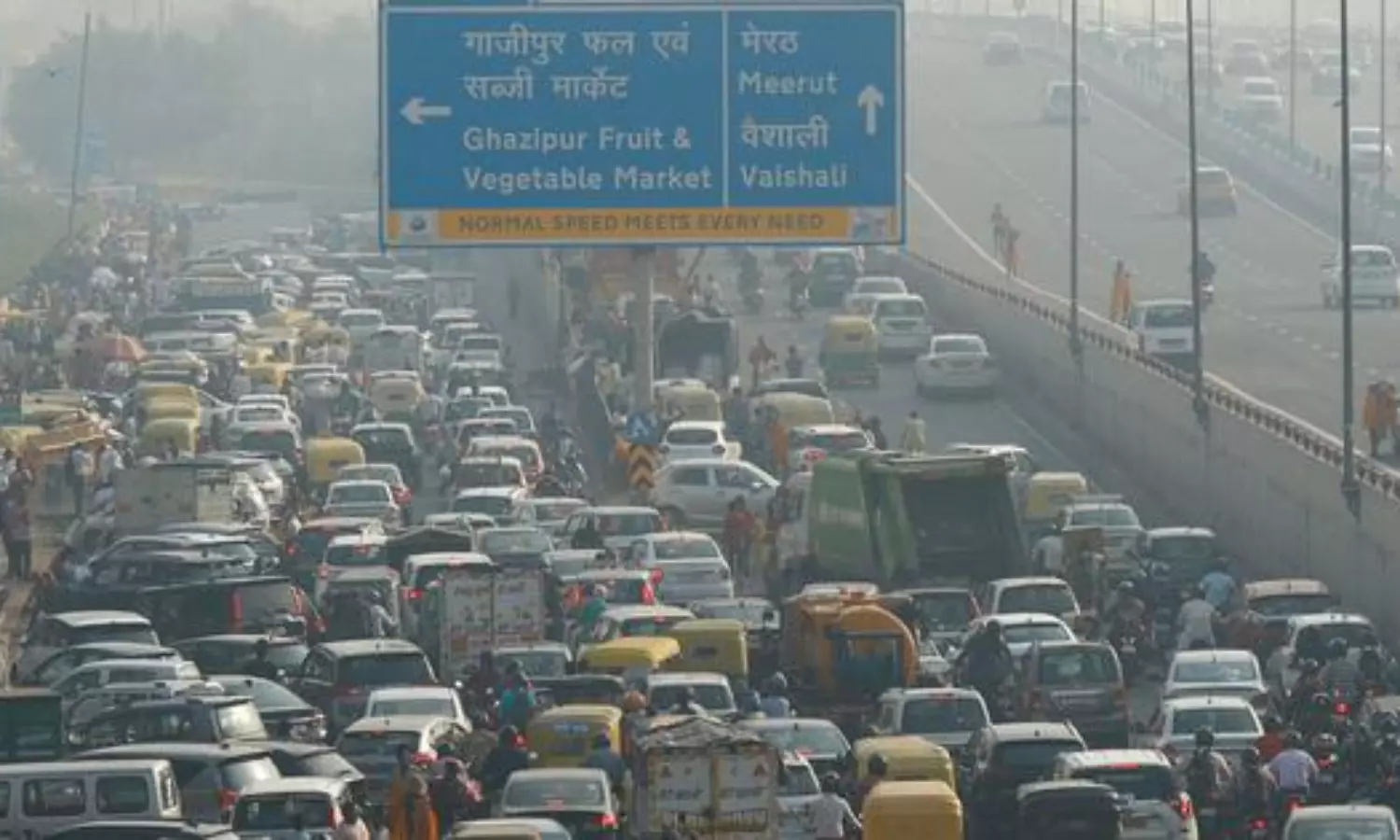
Delhi’s early winter pollution patterns are once again being shaped by the city’s saturated roads, with new analysis showing that particulate matter spikes are closely aligned with daily traffic peaks. A review of air quality data across Delhi-NCR indicates that the morning and evening rush hours are driving the sharpest surges in PM2.5, nitrogen dioxide, and carbon monoxide a combination that becomes more hazardous when trapped under shallow winter boundary layers.
The assessment, prepared by a leading environmental research institution, highlights that PM2.5 levels rose and declined almost in step with nitrogen dioxide concentrations during commuter-heavy hours. According to analysts involved in the study, this synchronisation is a clear indication that vehicular emissions are reinforcing daily pollution peaks far more strongly than previously assumed. Carbon monoxide, a toxic pollutant strongly linked to incomplete combustion, displayed even sharper and quicker spikes at roadside stations.
Across the 59-day observation window beginning in early October, nearly two dozen monitoring stations reported carbon monoxide exceedances on more than 30 days. Locations such as Dwarka Sector 8, Jahangirpuri, and the Delhi University North Campus emerged as the most persistent hotspots, with exceedance days ranging from 50 to 55. An official familiar with the findings noted that these breaches underline the chronic intensity of traffic-linked emissions in densely populated neighbourhoods.
The region-wide assessment also examined broader winter pollution trends. While peak pollution episodes were lower this year due to a decrease in crop-burning activity in neighbouring states, the average pollution load remained largely unchanged. Data suggests that Delhi’s annual PM2.5 levels have plateaued at elevated levels since 2022, undermining the earlier post-2018 gains when particulate concentrations had steadily declined. Experts warn that this stagnation indicates the city is now grappling with entrenched, year-round pollution that is no longer driven primarily by seasonal fire events.
Neighbouring NCR towns fared no better. Several smaller cities recorded longer and more intense smog build-ups, with one town experiencing a continuous ten-day pollution episode in mid-November. Urban planners argue that such synchronised deterioration across the airshed shows the limits of isolated city-level interventions and points to the need for coordinated regional planning.The study proposes a multi-pronged approach, emphasising time-bound electrification of vehicles, retirement of older fleets, and expansion of integrated public transport. It also calls for improving walking and cycling networks, introducing congestion charges, and enforcing parking caps to curb personal vehicle use.
For industry, the recommendations include shifting to affordable clean fuels and strengthening waste-management systems to prevent burning.Experts underline that mitigating winter spikes requires attention to the city’s core mobility systems rather than just seasonal measures such as dust control. Long-term resilience, they argue, will depend on cleaner transport options, equitable access to public mobility, and region-wide emissions governance all essential for creating healthier, more inclusive and low-carbon cities.
Delhi Pollution Spikes Rise As Traffic Emissions Mirror Daily Rush Hours