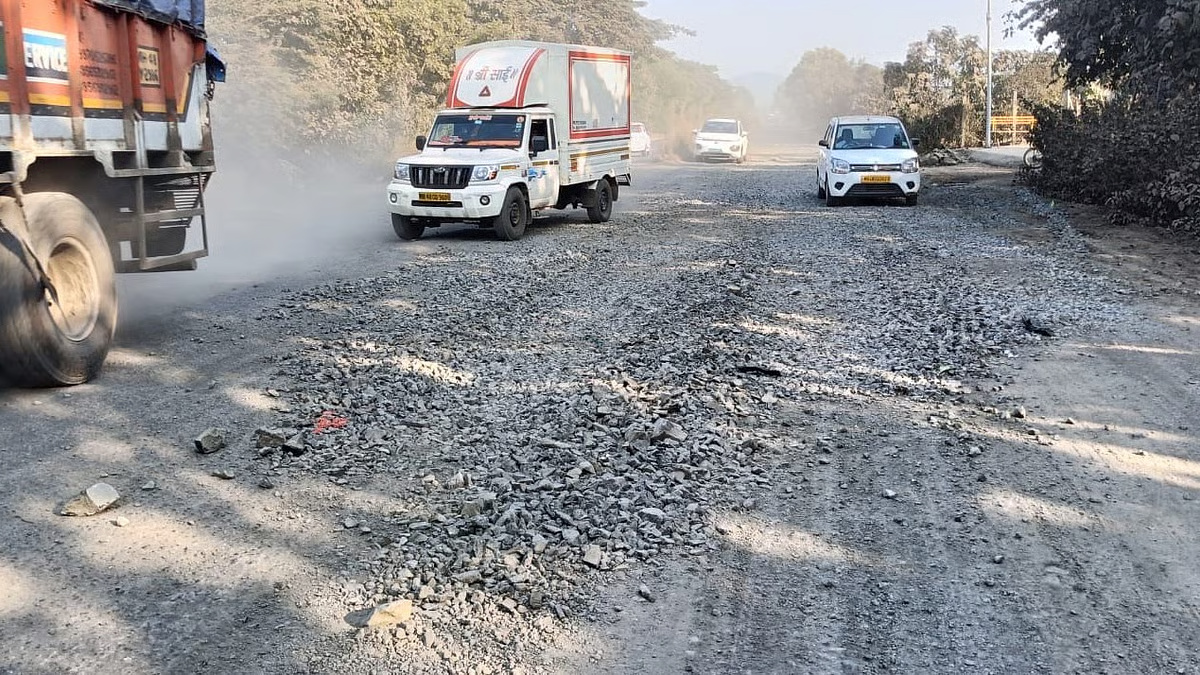
Residents across Wada taluka have raised serious concerns over the poor repair work being carried out on the Wada–Manor Highway, a key connector linking several industrial and rural settlements in Palghar district to the Mumbai–Ahmedabad National Highway. Commuters say the temporary patchwork undertaken in recent days has worsened driving conditions rather than improving them, raising questions about contractor accountability and infrastructure oversight.
The 22-kilometre stretch between Kanchad and Manor serves thousands of daily users, including goods carriers, buses, and two-wheelers travelling towards Boisar, Talasari, and parts of Gujarat. Despite its strategic economic relevance, residents report that repair crews have been relying on loose stones, gravel, and construction debris instead of standard road-building materials. According to locals, this approach has resulted in skidding hazards and low visibility due to dust, particularly endangering two-wheeler riders during night-time travel. Officials said the Public Works Department (PWD) recently initiated stop-gap maintenance on damaged portions while awaiting progress on a larger concreting project. The state has sanctioned approximately ₹776 crore for the holistic upgradation of the Bhiwandi–Wada–Manor route, with a portion already paid towards the Wada–Bhiwandi segment. However, residents argue that the interim repair efforts indicate poor monitoring and inadequate adherence to safety norms.
Several social activists noted that large potholes at Kanchad, Vaghote, and Ambhai Khind remain unaddressed using proper asphalt-based treatment. Instead, they allege contractors have placed coarse construction waste that has already dispersed across the road. “This is not repair work; it is a safety risk,” said one activist, urging the PWD to conduct a technical audit. Urban policy analysts observe that the situation reflects broader challenges in regional road governance, where short-term fixes undermine long-term network reliability. Poor-quality works particularly disadvantage low-income rural commuters who rely on two-wheelers and do not have the option of alternate routes. As cities and districts increasingly interlink through economic corridors, experts say rural highway standards must align with principles of safety, equity, and climate resilience.
The current condition of the Wada–Manor highway also carries environmental implications. Dust dispersion from loose debris contributes to local air pollution, affecting vulnerable groups such as schoolchildren and daily wage workers. Better-quality materials and mechanised rollers would minimise particulate emissions while improving ride quality, experts said. Residents have demanded stricter oversight, transparent inspections, and penalties for non-compliance. Many emphasise that resilient, well-engineered roads form an essential part of equitable regional development, especially as Maharashtra works to strengthen logistics networks and climate-ready infrastructure. Officials said the concerns will be reviewed, but commuters insist that corrective action cannot be delayed further.
Maharashtra Residents Slam Hazardous Poor-Quality Repair Work On Key Wada–Manor Highway