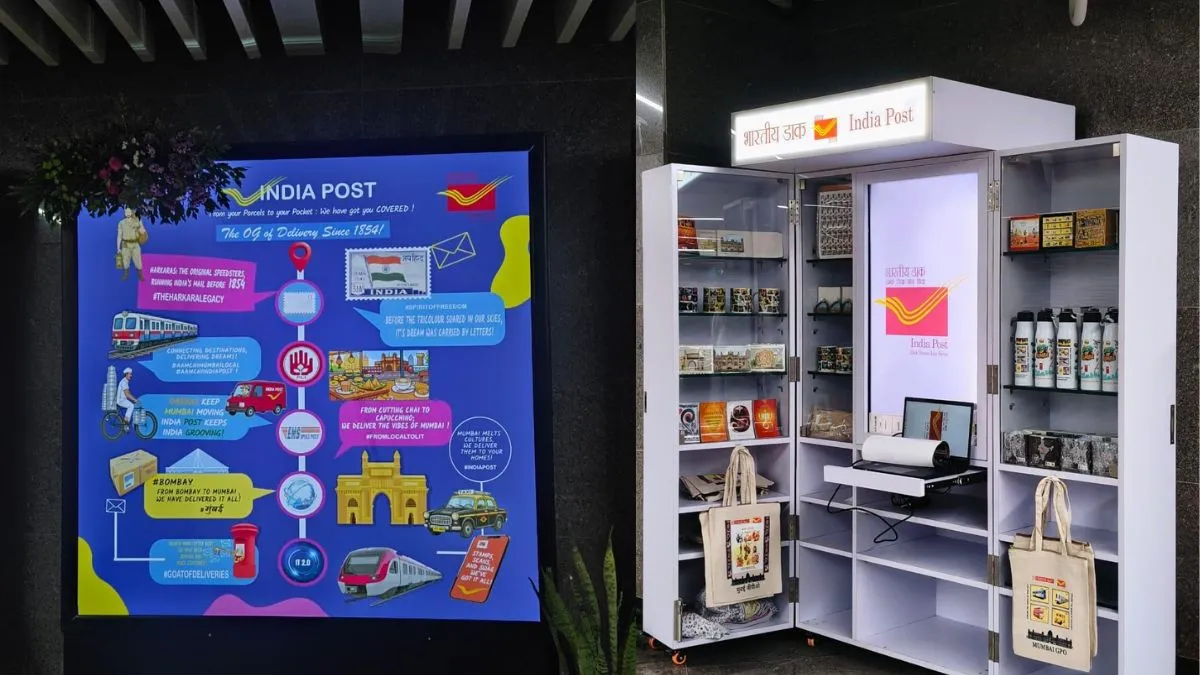
Mumbai’s expanding metro network has added a new commuter-facing service with India Post and the metro operator jointly opening a dedicated postal desk at the Chhatrapati Shivaji Maharaj Terminals on the Aqua Line. The initiative aims to make essential public services more accessible in high-footfall transport hubs while strengthening the role of metro stations as community-oriented urban spaces rather than just transit points.
Located near Entry and Exit Gates A2 and A3, the new desk offers a selection of postal services, visitor information, and collectible products designed to familiarise commuters with the modern capabilities of India Post. Officials from both organisations said the collaboration reflects a shared intention to enhance commuter convenience and broaden the utility of metro stations, especially for residents who rely on public transport for daily errands. As part of the project, the station now features a series of visually curated installations depicting the evolution of India Post—from its historical roots to its contemporary digital services. According to officials, the displays are intended to educate passengers while making the station environment more vibrant and culturally grounded. Urban designers note that such installations often help humanise large transport infrastructures, making them more inviting and reducing the monotony of long-distance commutes.
The service desk itself offers a range of small-format products, including themed coasters, water bottles, tote bags and augmented reality postcards, which are expected to draw interest from younger commuters. A “My Stamp” facility has also been introduced, allowing visitors to create personalised postage stamps using their own photographs—an offering that has gained popularity in other public venues. In addition to promotional services, the counter provides information on core postal offerings and supports Aadhaar updates, enabling commuters to complete essential documentation tasks without travelling to a separate government office. For many daily travellers, especially those with limited time between work and household responsibilities, such integrated services reduce friction and promote more inclusive access to civic functions.
Urban mobility experts say these collaborative models demonstrate how public transport infrastructure can support broader social needs. By embedding public services within high-density metro stations, cities can reduce citizen travel time, strengthen last-mile convenience and encourage greater use of sustainable mobility options. An official familiar with the project noted that “metro systems are increasingly becoming platforms for citizen services, not only mobility corridors.” India Post has indicated that similar service desks will be established at three more metro stations—BKC, SEEPZ and Cuffe Parade—in the next phase. These locations are expected to attract a mix of office-goers, students and airport-bound travellers, enabling wider public engagement with postal services in a modern, accessible format.
The initiative aligns with Mumbai’s broader push to build inclusive, people-centred transport ecosystems that integrate commerce, public services and cultural expression. As India’s urban centres grow more complex, experts argue that such multi-use station models can help create equitable, low-carbon and community-oriented cities where essential services sit closer to the everyday journeys of residents.
MMRCL Collaborates With India Post To Open Dedicated Service Desk For Aqua Line Commuters