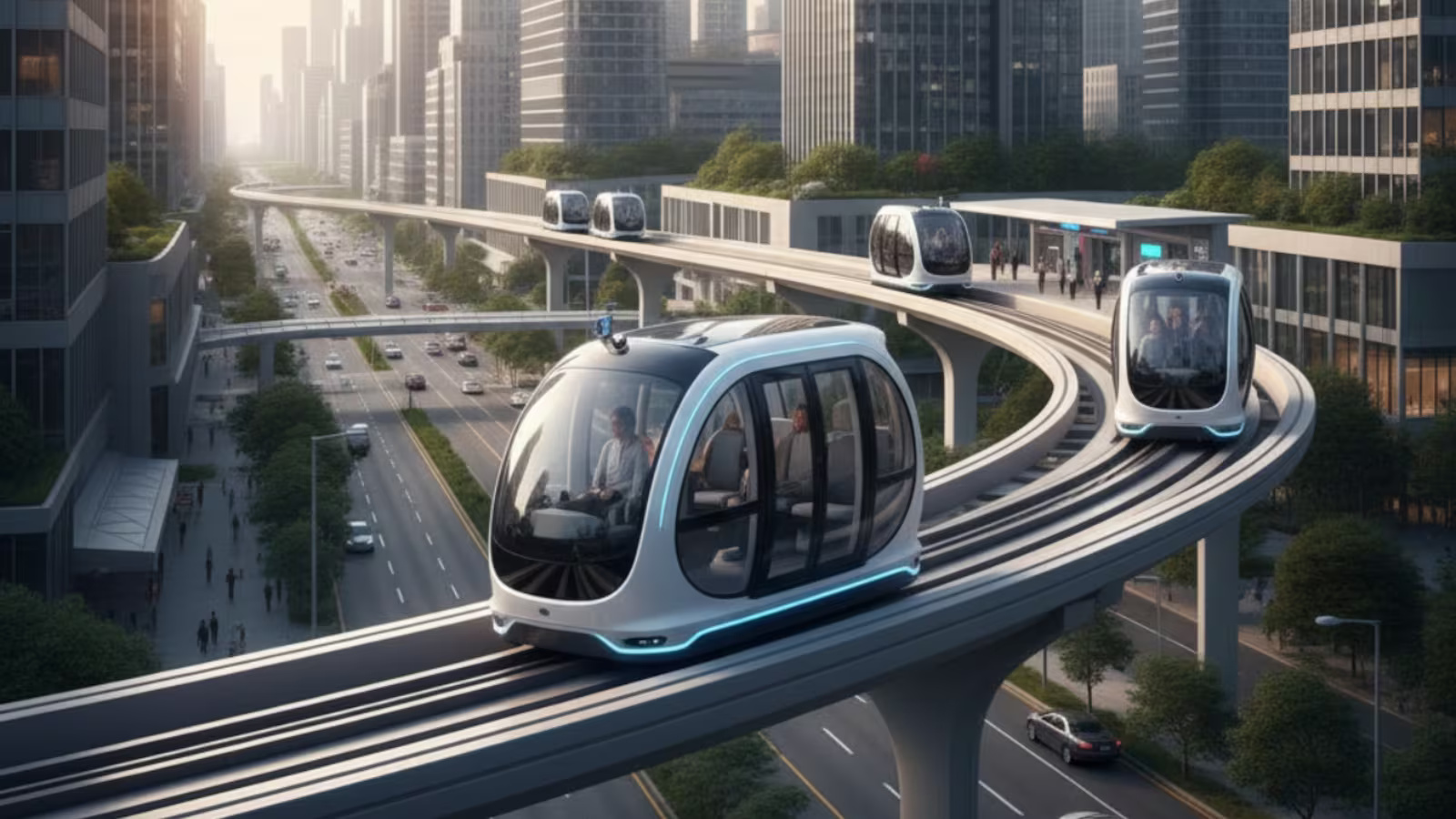
Mumbai is taking a significant step towards next-generation urban mobility with the state government directing the Mumbai Metropolitan Region Development Authority to initiate feasibility studies for the country’s first pod taxi network. The proposed system aims to connect Thane, Navi Mumbai, and Mira Bhayandar—three rapidly expanding parts of the metropolitan region facing persistent congestion and growing travel demand. The move signals a broader shift towards cleaner, energy-efficient mobility suited to high-density Indian cities.
According to officials, the state’s interest in pod taxis stems from the growing strain on road infrastructure and the need for transport options that are quicker to deploy, economical to operate, and environmentally sustainable. A senior government representative noted that the network could support mobility around emerging economic corridors, including areas expected to witness sharp growth once the bullet train terminal and new judicial infrastructure become operational. The pod taxi model, widely known as Personal Rapid Transit, operates using small driverless electric pods that run on elevated guideways. Each unit typically accommodates three to six passengers and can travel directly between origin and destination stations without intermediate stops. This point-to-point feature, combined with its elevated structure, helps decongest busy roads while avoiding large-scale land acquisition—a recurring hurdle in conventional mass transit expansion across metropolitan India.
Authorities believe the system could complement existing and upcoming metro and bus networks by handling last-mile and short-distance journeys more efficiently. Industry experts say pod taxis also offer ecological benefits, producing zero tailpipe emissions and significantly lower noise levels than conventional road transport. Given the focus on building net-zero, inclusive, and accessible mobility networks, the technology aligns with the state’s long-term sustainability goals. Globally, pod taxis have seen limited but successful applications in controlled urban districts in Abu Dhabi, London, South Korea, and Japan. These systems are typically used in business districts, airport campuses, or high-footfall corridors—contexts similar to several emerging clusters in Mumbai Metropolitan Region. However, experts emphasise that India’s higher density, complex street networks, and varying commuter patterns would require careful customisation.
Public sentiment around the proposal has been positive, especially among daily commuters navigating long travel times and inconsistent connectivity. Residents believe a pod taxi system could improve last-mile access, reduce pollution, and offer safer, predictable travel. If the feasibility studies return favourable results, the network could become a pilot model for other Indian cities exploring compact, low-carbon mobility systems that prioritise speed, accessibility, and urban resilience. As Mumbai continues to expand its transport ecosystem, officials say pod taxis may offer a flexible, future-ready layer within a broader integrated mobility framework—one capable of supporting both economic growth and sustainable urban living.
Mumbai Set To Launch Pod Taxi Network After Government Approves Detailed Study