


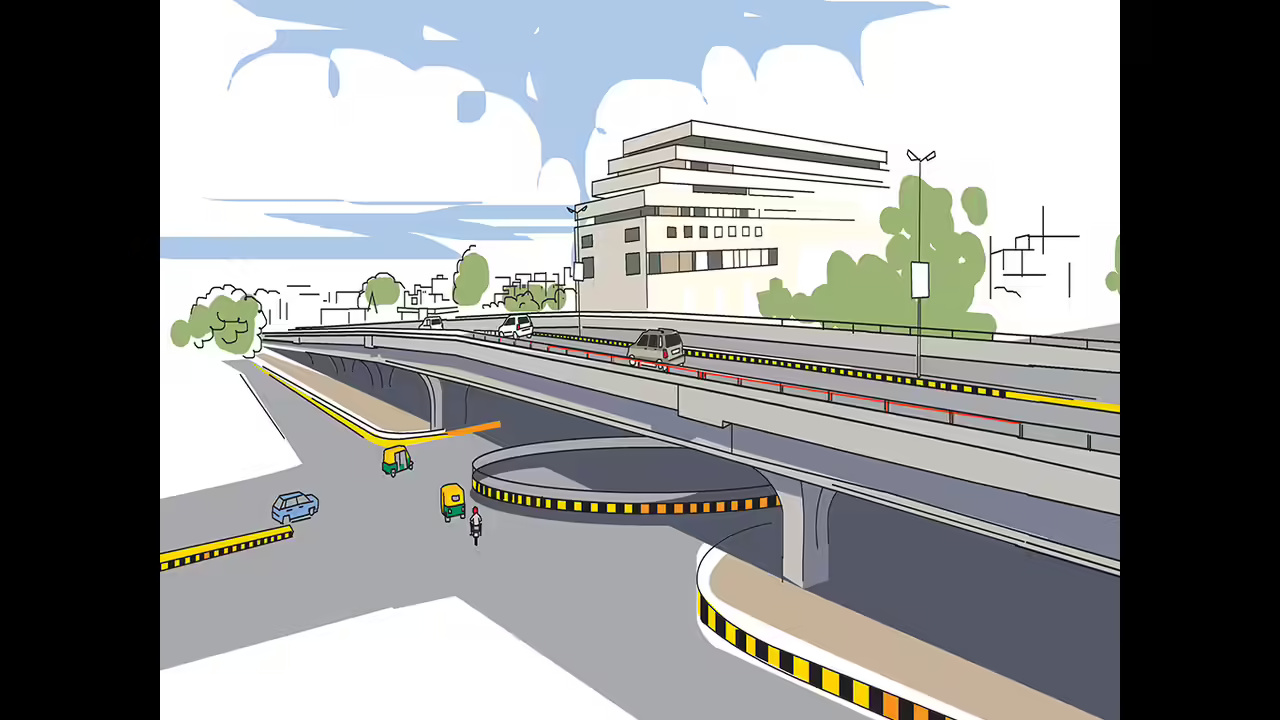
Pune’s long-delayed Warje bridge project is expected to see its first lane operational by February, offering partial relief to thousands of daily commuters affected by persistent congestion along the city’s western corridor. The update comes as civic authorities face growing criticism over inadequate traffic planning, deteriorating road infrastructure and worsening mobility conditions that have become a daily challenge for residents.
The bridge, located near the busy Warje–Navale stretch, has been under construction for several months as part of a broader plan to strengthen connectivity across the rapidly expanding suburbs. According to officials, one carriageway is nearing completion and the entire structure is scheduled to be opened by May, provided ongoing works proceed without further interruptions. The project is considered crucial for improving travel flow between the city centre and neighbouring residential clusters that have grown rapidly over the past decade. During a recent site inspection, public representatives expressed concern over the slow progress and the broader systemic issues contributing to Pune’s recurring gridlock. They observed that the western belt has become particularly vulnerable to traffic build-up due to limited road capacity, insufficient enforcement and delays in completing alternative routes. One representative described the situation as “extremely serious”, noting that residents are increasingly fatigued by long travel times and inconsistent civic responses.
Urban mobility experts say the Warje bridge has the potential to ease pressure on existing junctions, but caution that a single project will not solve the structural inefficiencies in the city’s transport network. They emphasise the need for integrated mobility planning that prioritises sustainable modes such as public transport, non-motorised pathways and climate-resilient road systems. Several planners highlighted that without such measures, Pune risks locking itself into higher carbon emissions and unequal access to mobility as more private vehicles crowd the roads. Residents living near the Warje–Navale corridor say congestion peaks during morning and evening hours, with bottlenecks created by narrow lanes, heavy commercial traffic and inadequate diversion management at construction spots. Some citizens argue that while infrastructure expansion is necessary, temporary mobility solutions and safety measures during construction phases are often neglected. According to officials, discussions are underway to improve traffic marshaling, streamline signal timings and deploy additional personnel until the bridge opens fully.
The project has also drawn attention to the broader challenge of urban governance in fast-growing Indian cities. Analysts point out that Pune’s rapid urbanisation has outpaced its mobility infrastructure, creating stress on public services such as waste management, water supply and traffic regulation. Strengthening coordination between agencies, they say, is essential for ensuring that new infrastructure is delivered on time and managed efficiently once operational. As the February deadline approaches, civic authorities have been urged to prioritise remaining works and communicate progress transparently. While the opening of one lane may provide short-term relief, planners argue that Pune’s long-term mobility resilience will depend on sustained investments in equitable, low-carbon and commuter-friendly urban design. The full commissioning of the Warje bridge by May will serve as an important test case for the city’s commitment to building infrastructure that keeps pace with its growing population.
Also Read : Railways Permits Mcdonalds, Kfc Haldirams, To Operate At Stations Under Premium Category
