


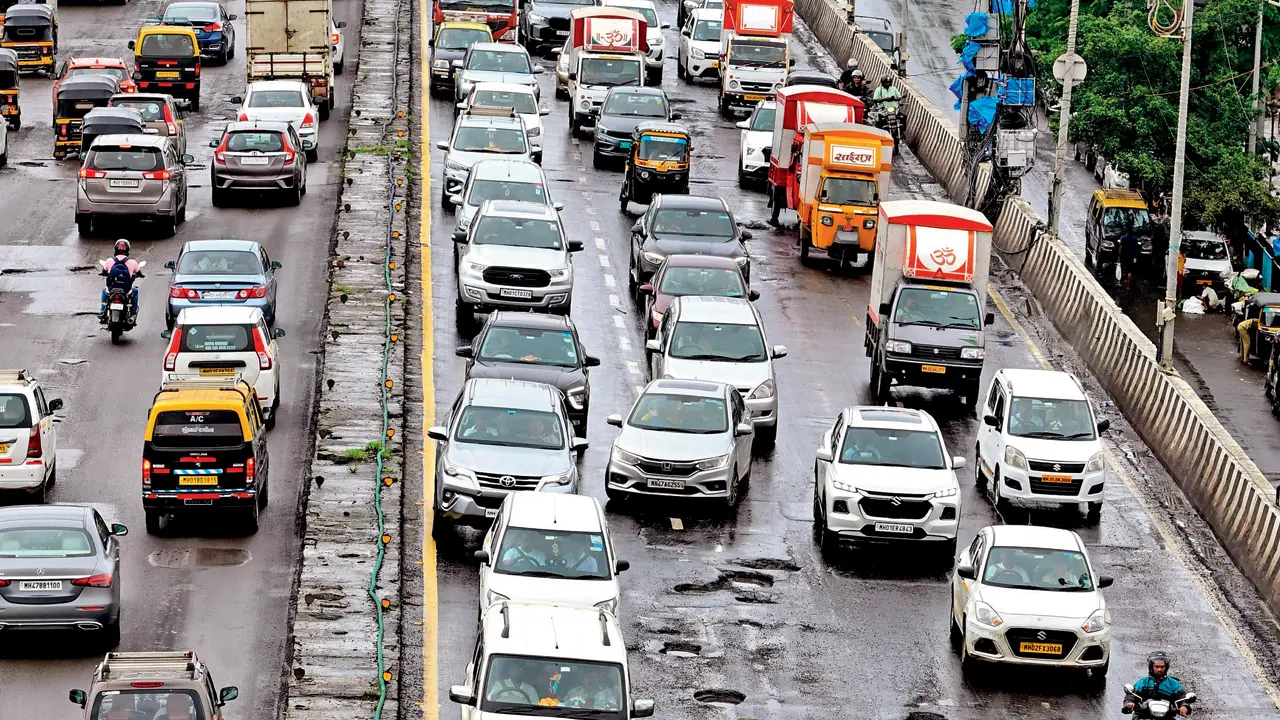
Mumbai’s civic administration has moved to resurface four key flyovers managed by the Maharashtra State Road Development Corporation (MSRDC) after a turbulent monsoon season that saw widespread public frustration over pothole-ridden elevated roads. The decision, confirmed by senior officials, is aimed at preventing another cycle of congestion, safety hazards, and patchwork repairs before the next rainy season sets in.
The Brihanmumbai Municipal Corporation (BMC) will undertake the resurfacing of the Vakola, Aarey, Sanjay Gandhi National Park, and Vikhroli flyovers in the first phase, covering nearly four kilometres of elevated road. These structures sit on crucial east–west and north–south corridors and routinely carry dense traffic volumes, making their condition critical for urban mobility. An official said the city cannot afford another year of degraded road surfaces that compromise safety and disproportionately impact daily-wage earners, public transport users, and emergency services. While these flyovers fall under MSRDC’s jurisdiction, the civic body stepped in during the monsoon to fill potholes after repeated citizen complaints and social media criticism. This led to a rare public display of administrative boundaries, including a board placed at the Vakola flyover clarifying that maintenance responsibility lay with MSRDC. However, officials now say the priority is ensuring smoother mobility, not debating mandates. According to them, MSRDC has formally asked BMC to take up resurfacing work, acknowledging the need for long-term intervention rather than temporary patchwork.
The civic body’s technical teams argue that resurfacing is essential because mastic asphalt patches used during the monsoon degrade rapidly under heavy vehicular loads. Industry experts point out that delayed intervention often leads to uneven surfaces, increased braking, and fuel wastage—factors that collectively contribute to emissions. For a city seeking more climate-resilient and low-carbon mobility systems, smoother flyovers help reduce idling, improve bus operations, and curb avoidable emissions. Tendering for the first phase is already in progress, and the resurfacing is expected to be completed before the next monsoon cycle. Officials noted that remaining MSRDC flyovers may be taken up in subsequent phases depending on available budgets and traffic priorities.
The controversy around flyover maintenance earlier this year also revived discussions around fragmented governance in Mumbai’s transport ecosystem. Multiple agencies oversee different road assets, often leaving commuters unsure of accountability. Data from the civic pothole dashboard shows that nearly 1,450 complaints this year were related to roads managed by external agencies. Urban planners argue that a unified asset-management framework—supported by technology and shared responsibilities—could help cities move toward more transparent, equitable, and sustainable infrastructure management. For now, commuters can expect smoother rides once the resurfacing begins, though officials emphasised that flyover upgrades must be accompanied by routine inspections, climate-adaptive materials, and better coordination between agencies to truly build a safer and more resilient mobility network for Mumbai.
Also Read: BMC Demolishes Thirty Seven Obstructions Delaying Vital Ghatkopar East West Corridor Expansion
