


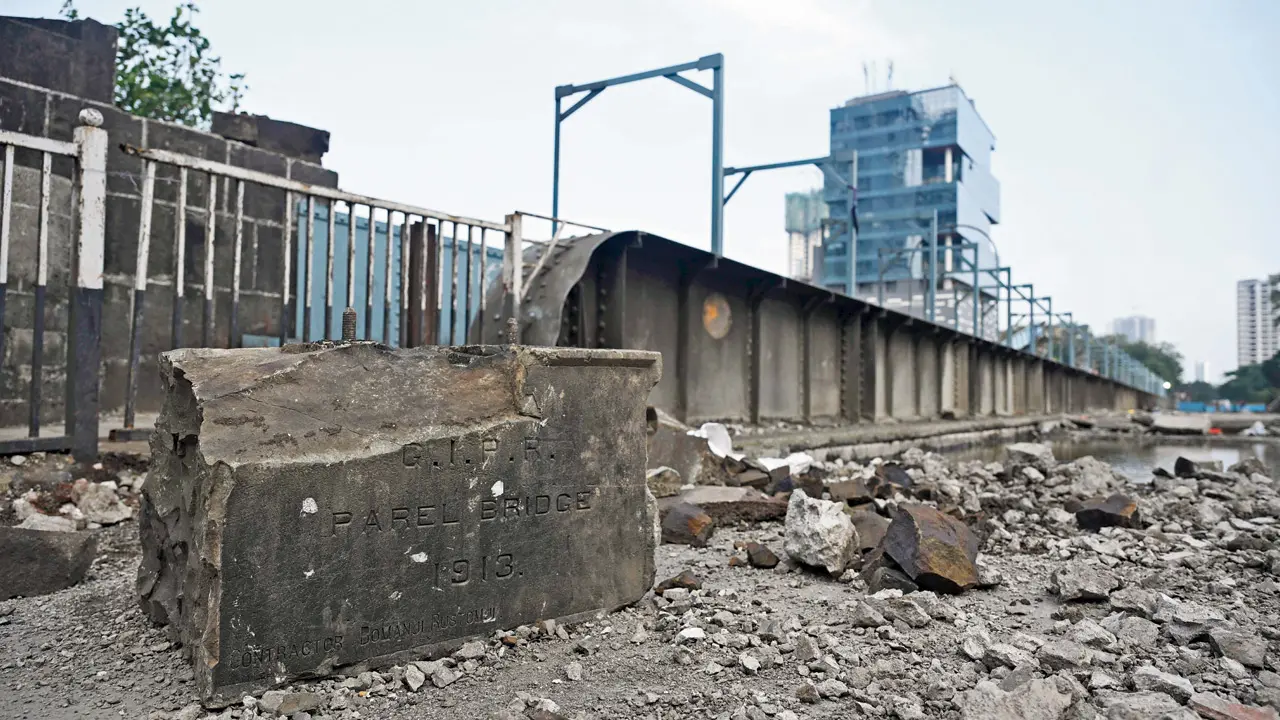
Mumbai’s railway heritage suffered a setback this week after the 1913 cast-iron plaque from the city’s iconic Elphinstone Bridge was damaged during demolition. The plaque — a rare relic inscribed with the names of the Great Indian Peninsula Railway (GIPR), its Scottish fabricators, and the Indian contractor — was destroyed despite earlier assurances that it would be carefully removed and preserved before dismantling began.
According to on-site sources, the century-old marker was accidentally struck by heavy machinery while contractors were clearing the bridge’s stone abutment. The incident has drawn sharp criticism from heritage conservationists and local residents, who described it as an “avoidable loss of industrial history.” Built in 1913 by the GIPR, the Elphinstone Bridge, later known as the Prabhadevi overbridge, was more than just a transport link — it represented a crucial phase in Mumbai’s evolution as an industrial metropolis. The bridge’s twin cast-iron plaques, crafted at the Clutha Works foundry in Glasgow, were among the few surviving artefacts of early 20th-century railway engineering in the city.
An official involved in the demolition process confirmed that safety and preservation instructions had been issued but admitted that the pace of work and the scale of the operation may have led to lapses in handling fragile components. “There was an understanding that significant elements would be documented and stored safely for future display, but the plaque was accidentally hit before removal,” the official said. Heritage experts have long urged authorities to document and conserve remnants of Mumbai’s colonial-era infrastructure before redevelopment projects erase them. “These plaques tell a story of global collaboration — of Indian contractors, British engineers, and Scottish foundries that built the city’s early transport backbone,” noted a conservation architect. “When such artefacts are destroyed, we lose physical evidence of how Mumbai was built.”
The demolition of the Elphinstone Bridge is part of a larger project by the Maharashtra Rail Infrastructure Development Corporation (MRIDC) to construct a new double-deck connector between Parel and Prabhadevi by 2027. The new bridge will feature expanded road capacity and improved commuter safety, aiming to relieve chronic congestion in central Mumbai. However, the incident has revived a recurring question in Mumbai’s urban renewal efforts — can modernisation and heritage coexist? Conservationists argue that preserving even small historical details, such as plaques and nameplates, is vital to maintaining the city’s architectural memory amid rapid redevelopment.
For now, the damaged Elphinstone plaque stands as a cautionary reminder that progress must be measured not only in infrastructure but in care for the past that built it.
Also Read: Mumbai To Replace Elphinstone Bridge With Modern Double Deck Connector
