


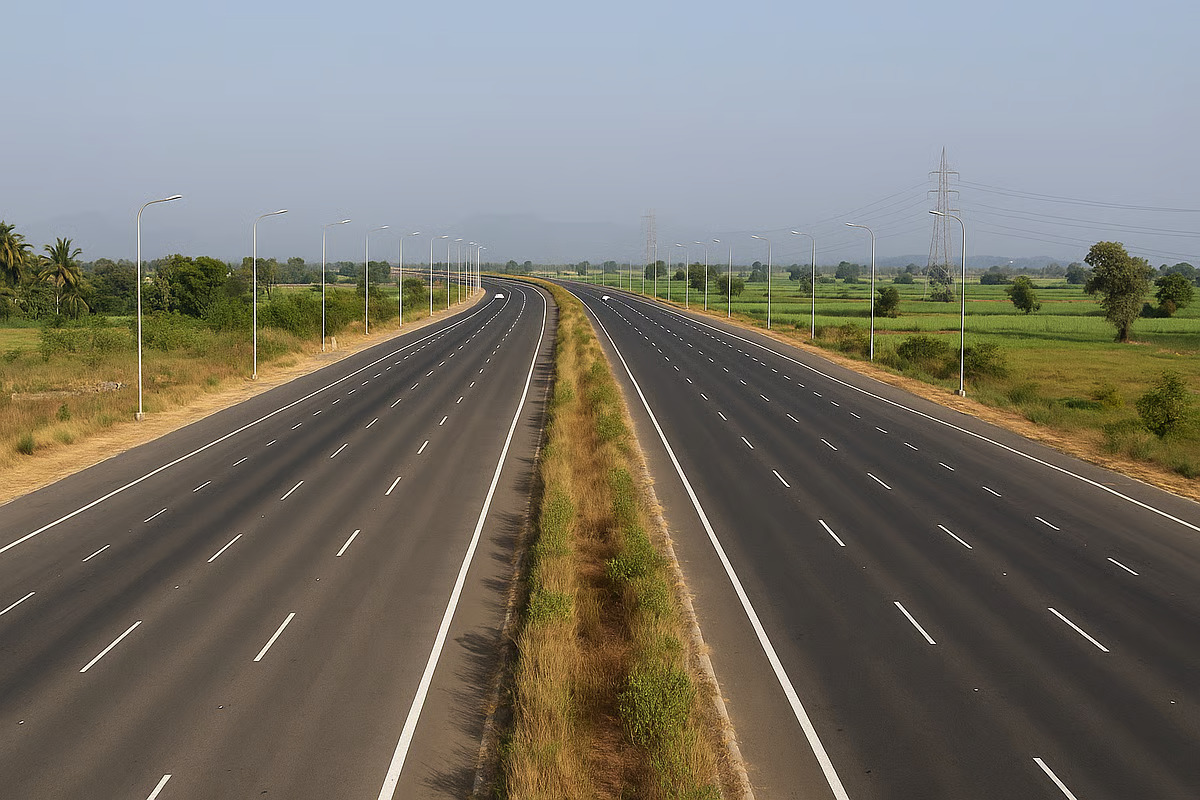
The Delhi–Mumbai Expressway, India’s longest and most ambitious expressway corridor, is inching closer to full operational status, with over 80 per cent of its total length now open to commuters. The 1,386-kilometre, eight-lane expressway, designed to significantly reduce travel time between the national and financial capitals, is progressing rapidly across all major sections in Haryana, Rajasthan, Madhya Pradesh, Gujarat, and Maharashtra.
According to officials from the National Highways Authority of India (NHAI), the Delhi–Vadodara segment — the project’s largest phase comprising 31 packages — has achieved substantial advancement. Of these, 27 packages are fully operational, while a few, including Packages 10 and 15 in Rajasthan and Package 26 in Gujarat, are in the final stages, recording 94, 82, and 74 per cent completion respectively. The section features major infrastructure firms including Larsen & Toubro, GR Infraprojects, HG Infra, APCO Infratech, and GHV India, who have played key roles in executing critical portions of the corridor. Notably, several packages managed by Larsen & Toubro and GR Infra have achieved 100 per cent progress, marking major milestones in the project’s implementation.
In the Vadodara–Virar section, which spans 13 packages, the progress has also been robust. Six packages are already operational, while several others are approaching completion. Package 5, covering a 25 km stretch from Ankleshwar to Kim, developed by Sadbhav Engineering and Gawar Construction, now stands at 86 per cent completion. Meanwhile, projects handled by GR Infra, Ashoka Buildcon, Patel Infrastructure, and Montecarlo continue to show steady momentum, with Package 12 in Maharashtra reporting 85 per cent completion. The DND–Faridabad–KMP spur, which links the Delhi National Capital Region (NCR) to the expressway, is also nearing full readiness. Of its four packages, three are operational, and the Jewar spur — a critical connector to the upcoming Noida International Airport — has achieved 56 per cent progress. Officials stated that this link is vital for decongesting Delhi’s arterial routes and improving logistics movement across NCR’s industrial belts.
Meanwhile, the JNPT spur in Maharashtra, which extends the expressway to the Jawaharlal Nehru Port Trust, is in its final stages. Package 15, handled by Agroh Infrastructure, has reached 86 per cent completion, while other segments under the Maharashtra State Road Development Corporation (MSRDC) and IRCON are progressing between 77 and 82 per cent. Once operational, the JNPT spur will enable seamless cargo movement between the port and northern India, enhancing trade efficiency and reducing logistics costs. The expressway, expected to cut travel time between Delhi and Mumbai from 24 hours to just 12 hours, is also being built with a strong emphasis on sustainability and green infrastructure. The project integrates features such as solar-powered lighting, rainwater harvesting systems, and dedicated wildlife crossings — positioning it as a model for climate-conscious transport infrastructure in India.
Experts view the Delhi–Mumbai Expressway as a transformative project that will not only enhance economic connectivity between industrial hubs but also boost regional development in states along the route. Once completed, it is expected to significantly reduce vehicular emissions by cutting fuel consumption and easing congestion on existing highways.
Also Read: Navi Mumbai Ulwe Coastal Road to Boost Airport Connectivity by 2026
