


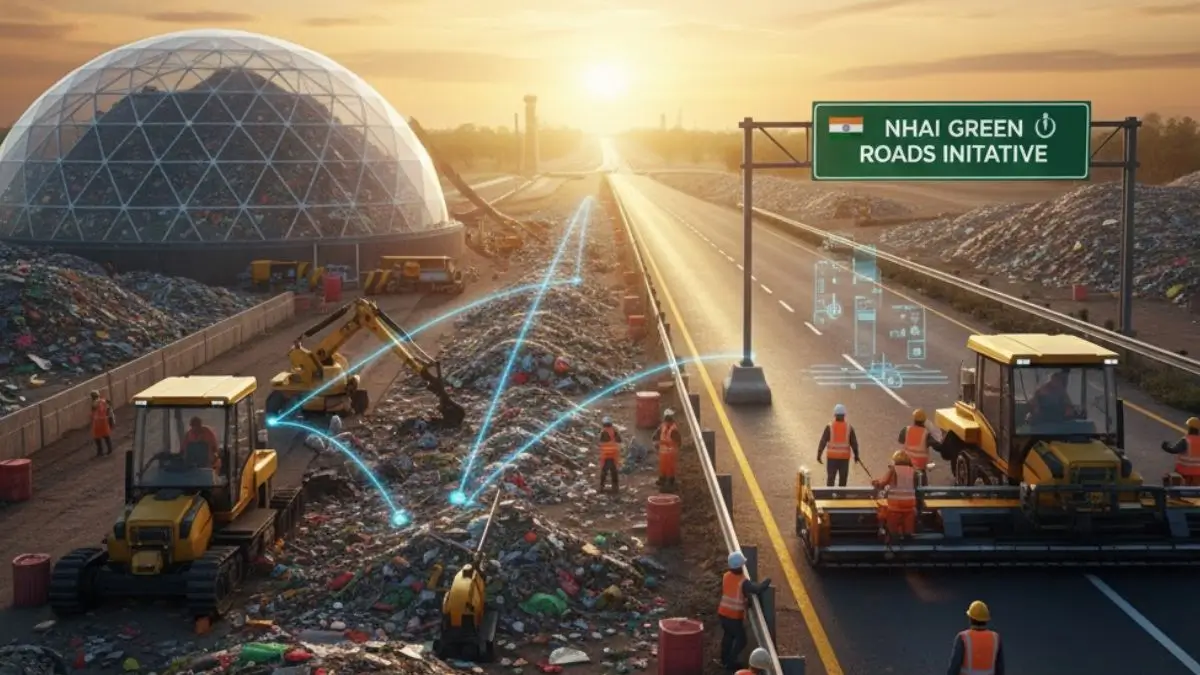
The National Highways Authority of India (NHAI) has unveiled a bold initiative to use municipal waste for national highway construction by 2027, marking a major step towards sustainable infrastructure development. Officials confirmed that the authority aims to channel all municipal waste generated in India into road-building projects, leveraging innovative technologies such as bio bitumen derived from livestock and other organic matter.
Currently, around 80 lakh tonnes of municipal waste have been repurposed for highway construction, including 25 lakh tonnes on the Ahmedabad–Pune stretch and 40 lakh tonnes on the Mumbai–Delhi corridor. Experts say this approach not only reduces environmental burden but also presents a cost-effective alternative to traditional petroleum bitumen, aligning with India’s zero-carbon ambitions. Officials noted that bio bitumen, certified by central research bodies, offers superior performance compared to conventional bitumen. This innovation is part of a broader strategy integrating circular economy principles into national infrastructure. Research is also underway to derive hydrogen and other energy sources from municipal waste, further expanding the sustainability potential of highways.
Transport analysts highlight that incorporating municipal waste into road construction could significantly decrease landfill pressure while simultaneously enhancing road durability. “Waste-based roads represent a dual benefit: reducing urban waste and building resilient highways,” said a senior infrastructure expert. The NHAI initiative also aims to engage young engineers and innovators in sustainable infrastructure development. Officials emphasised that students and industry professionals are encouraged to explore technologies that convert waste into valuable construction materials, creating a model of eco-friendly job creation and innovation.
However, experts caution that long-term success depends on consistent quality control, effective waste collection, and rigorous compliance with environmental standards. Proper segregation, processing, and monitoring will be essential to ensure that municipal waste roads are safe, durable, and truly sustainable. The ambitious plan is expected to transform India’s approach to highway construction, providing a model for other nations grappling with urban waste and infrastructure demands. If fully implemented, municipal waste could become a cornerstone of India’s green infrastructure agenda, reducing reliance on non-renewable resources while fostering environmentally responsible urban development.
With the 2027 target in sight, NHAI’s strategy represents a convergence of technology, sustainability, and civic responsibility—demonstrating how public infrastructure can align with zero-carbon and circular economy principles while delivering long-term societal benefits.
Also Read : Delhi Police Receives 653 Crore Funding For New Stations And Facilities
