


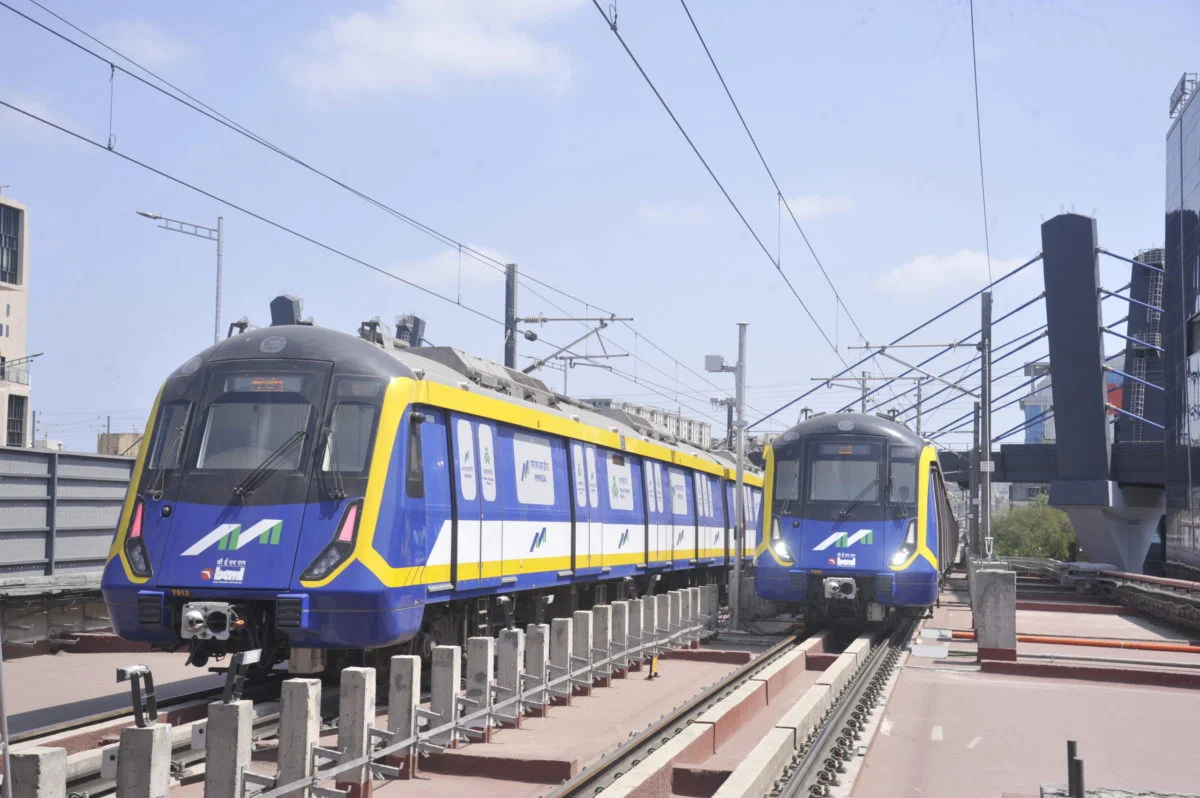
Mumbai is set to take another stride towards sustainable mobility with the overhead electrification of Metro Lines 4 and 4A beginning on August 30. Authorities confirmed that traction wires carrying 25,000 volts of electricity will be activated along a 4.68-kilometre stretch between Dongripada and Gaimukha stations, marking a significant step in the city’s long-delayed project.
The implementing authority has issued a public advisory urging citizens to treat all overhead traction wires as live at all times. Officials have cautioned against unauthorised access to the high-voltage equipment, underscoring that safety remains the foremost priority as Mumbai inches closer to conducting trial runs. Metro Line 4 and its extension, Line 4A, are designed as part of a larger network expansion aimed at decongesting Mumbai’s overburdened roads while offering a low-carbon alternative to daily commuters. The upcoming trial run is expected to cover 10 kilometres and 10 stations, with rolling stock already placed on tracks. Officials said this milestone would accelerate the process towards full-fledged operations.
Infrastructure providers have also moved into advanced phases of deployment. An international consortium has been tasked with supplying 234 metro cars, equivalent to 39 train sets of six cars each, supported by a modern Communications-Based Train Control (CBTC) signalling system. Experts said the advanced signalling will allow safer, more efficient operations while reducing headway between trains, ensuring higher frequency services once commercial operations begin. Spanning 35.3 kilometres with 32 stations, Metro Line 4 will connect Wadala in central Mumbai with Kasarvadavali in Thane. It is projected to be one of the city’s longest elevated corridors and will link commuters directly to major transport touchpoints such as the Eastern Express Highway, the existing Monorail, and other Metro lines under development. Urban transport planners said the line has the potential to shift thousands of commuters away from private vehicles, directly contributing to reduced emissions and easing fuel dependence.
Authorities noted that the corridor is a vital part of the city’s mobility blueprint, envisioned to build a network that prioritises equitable, eco-friendly, and resilient transit solutions. Once operational, the line will also help decentralise urban growth by connecting suburban areas more seamlessly with central Mumbai. While electrification of the first stretch is being celebrated as a breakthrough, experts emphasised that sustained progress will be key to ensuring timelines do not slip further. For Mumbai’s citizens, however, the live wires now signal more than infrastructure—they symbolise the beginning of a transition towards a faster, greener, and more reliable mobility future.
Also Read: Kolkata Metro Services On Garia-Tolly Stretch Suspended This Sunday For Rake Reversal Work
