


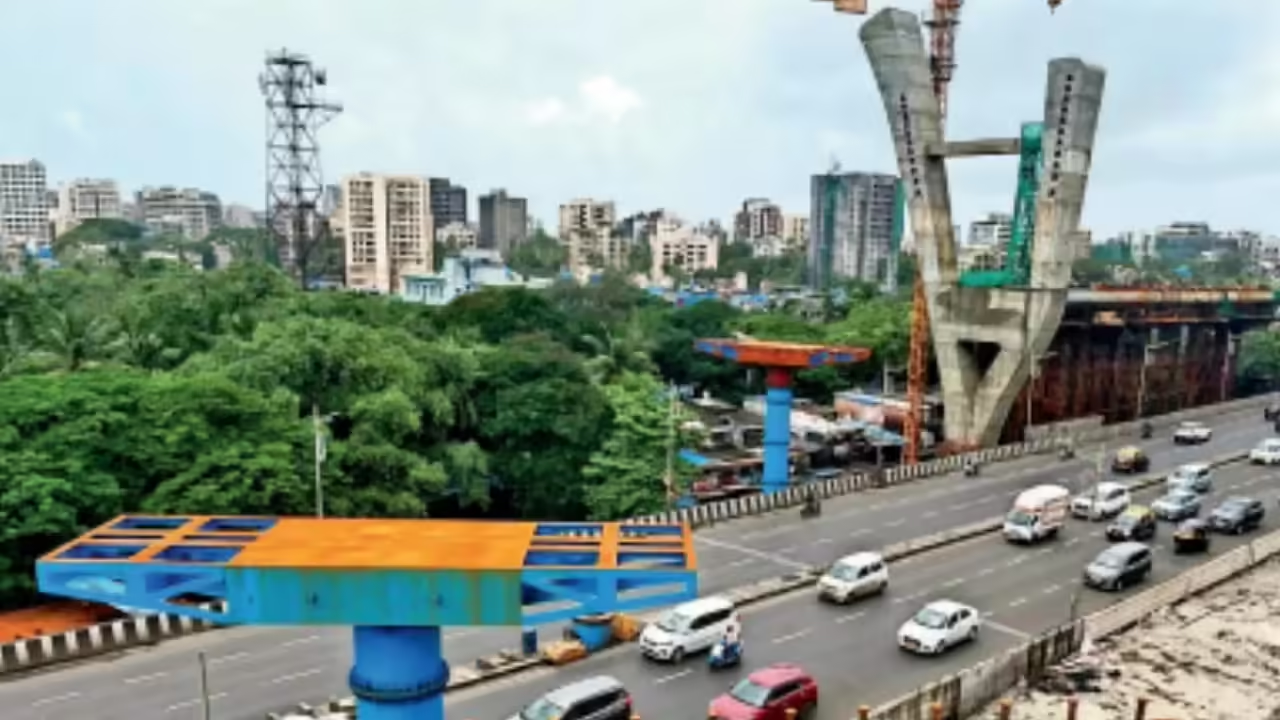
Mumbai’s transport network has taken another significant step towards easing gridlock with the Santacruz–Chembur Link Road (SCLR) extension, an ambitious project officials describe as the result of meticulous inter-agency coordination rather than afterthoughts. Engineers stress that the connector is not only a piece of infrastructure but also an adaptive response to the city’s evolving traffic realities.
Authorities confirm that before the alignment was finalised, extensive traffic impact assessments were carried out in collaboration with the traffic police. On-site inspections revealed that the Vakola junction was already overburdened. A conventional pillar-supported structure would have worsened the bottleneck, leading planners to adopt an unprecedented engineering solution. For the first time in South Asia, a sharp 100-metre radius curved cable-stayed bridge on a Y-pylon was designed, eliminating bulky ground-level supports and facilitating smoother traffic dispersal.
Also Watch: An Exclusive Interview with Sanjeev Jaiswal (IAS), CEO MHADA
In consultation with traffic officials, the landing was extended up to Panbai International School rather than merging directly at Vakola. This adjustment underscored the collaborative nature of the project, balancing engineering innovation with ground-level realities. Experts highlight that such decisions reflect a larger philosophy—transport infrastructure in dense urban centres must remain adaptive, not rigid.
To complement the connector, municipal authorities are widening the Agripada pedestrian subway and expanding a stretch of the Western Express Highway (WEH) from four lanes to five. The two-lane service road has also been reconfigured into a one-way system. These measures, according to officials, were not reactive fixes but were embedded in the planning process from the outset, following joint site inspections by the city’s agencies. Current projections suggest that more than 41,000 vehicles will use the connector daily. With the upgraded five-lane capacity near Agripada, the dispersal of vehicles into the WEH is expected to synchronise more effectively. Even so, real-time monitoring continues. The traffic police and MMRDA teams are assessing flows from the first day of operations to fine-tune dispersal measures.
Delivering the extension was not without hurdles. Authorities had to negotiate the handover of defence land in March 2025, resolve utility conflicts, coordinate with Metro Line 3 construction at Hansbhugra junction, and manage encroachments. Despite these challenges, the bridge has been completed with an emphasis on long-term efficiency. Officials maintain that the project is not an example of execution gaps but a demonstration of adaptive urban planning. By deploying innovative design and strengthening inter-agency coordination, the SCLR extension marks a shift towards sustainable mobility solutions that prioritise fluidity, safety, and long-term adaptability. For a city grappling with rising vehicular pressure, such projects could well form the template for infrastructure planning in the years ahead.
