


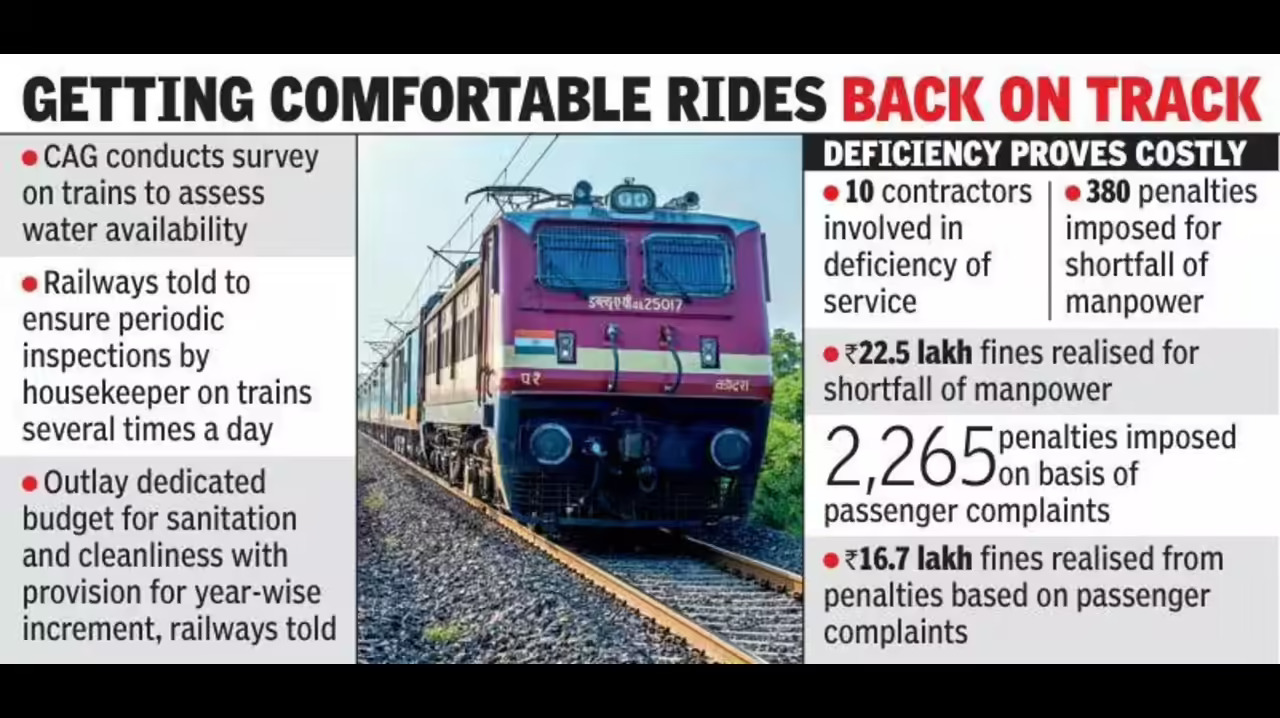
The Comptroller and Auditor General (CAG) has raised serious concerns over the state of sanitation and maintenance of long-distance trains under South Central Railway (SCR), citing systemic deficiencies that directly affect passenger comfort and public health. The audit report, which reviewed water availability, housekeeping, and sanitation infrastructure, underscores a widening gap between policy promises and operational realities.
A major gap highlighted by the CAG is the absence of adequate watering points across several long stretches of the network. Trains running routes such as Katpadi–Vijayawada (559 km) and Renigunta–Vijayawada (450 km) were found without intermediate watering facilities. As a result, coaches frequently face water shortages for toilets and washbasins, leaving passengers stranded with unhygienic conditions until the next major halt. Passenger complaints indicated that these gaps are particularly acute at inter-zonal crossings such as Balharshah–Secunderabad and Gudur–Vijayawada, where coordination failures between railway zones leave trains dry for several hours. Officials admitted that proposals for new watering facilities are under process, but the current dependence on limited stations has left the system vulnerable.
In response, SCR administration highlighted the introduction of Onboard Housekeeping Services (OBHS) on all long-distance trains and the rollout of the Clean Train Station initiative at hubs including Secunderabad, Vijayawada, Renigunta and Guntakal. Expansion to Kacheguda has also been proposed. However, the CAG report makes it clear that these measures remain insufficient to address the scale of the problem. The audit also revealed worrying lapses in manpower and accountability. Contractors hired for sanitation services were found to be operating with significant staff shortages, compromising the quality of work. Penalties amounting to over Rs 38 lakh were levied in response to manpower gaps and passenger complaints. Despite these fines, the persistence of foul-smelling compartments, choked toilets and dirty general coaches points to deeper structural weaknesses in monitoring and service delivery.
Experts argue that cleanliness and reliable water supply are not merely service issues but touch upon sustainable urban mobility. A railway system that fails to ensure basic sanitation undermines the larger public goal of shifting passengers away from road and air travel towards greener mass transit options. For India’s railways to achieve net-zero ambitions, passenger experience and hygiene cannot remain secondary. The CAG has recommended periodic inspections, a dedicated sanitation budget with incremental increases, and better inter-zonal coordination to ensure seamless services. The findings underline that sustainable transport requires not only cleaner energy but also cleaner trains.
As passenger numbers swell during festival seasons and long-distance travel grows, ensuring hygiene on trains will be a test of the railway system’s ability to balance scale with sustainability.
Also Read: Mumbai Railways Launch 300 Special Ganpati Trains Via Central And Konkan Lines
