


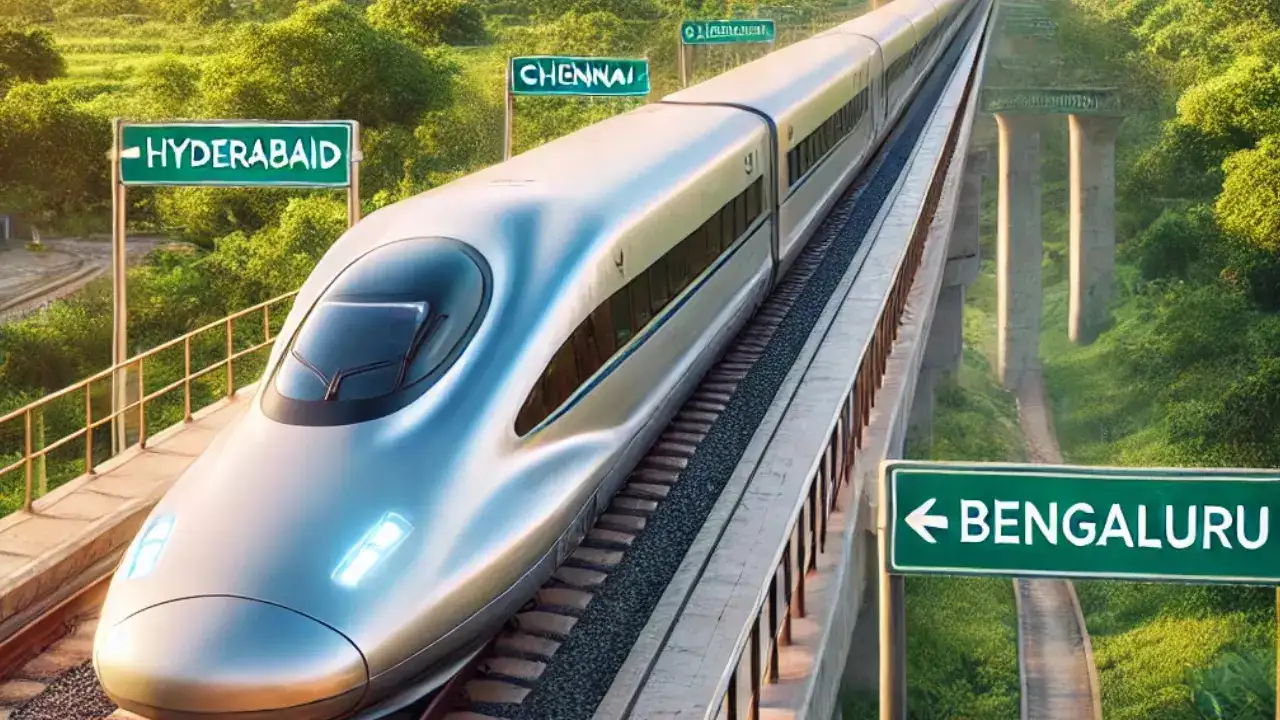
Hyderabad is moving closer to joining India’s expanding high-speed rail network with a feasibility study underway to examine the potential of a bullet train service linking the city to Chennai. Officials have confirmed that the study, being conducted by RITES Limited, will assess technical, financial and environmental aspects of the proposed corridor, which could cut travel time between the two southern metros to just over two hours.
Currently, rail journeys between Hyderabad and Chennai take nearly 12 hours, while road trips are often longer due to congestion. The proposed bullet train is expected to transform connectivity, offering commuters, business travellers and tourists a quicker, safer and more sustainable alternative. The project is part of a wider government agenda to strengthen high-speed rail infrastructure across southern India and integrate regional economies more seamlessly.Officials highlight that beyond faster travel, the project holds significance for its potential environmental benefits. A fully electric high-speed corridor would reduce reliance on road and air traffic, both of which contribute significantly to carbon emissions. Analysts believe that the Hyderabad–Chennai link, if realised, could become a model for sustainable mobility in southern India, promoting zero-carbon urban transport and easing pressure on existing modes of travel.
Also Watch: An Exclusive Interview with Sanjeev Jaiswal (IAS), CEO MHADA
The study is expected to focus on route alignment, land acquisition requirements, passenger demand projections and potential integration with existing transport networks. Experts stress that while the financial investment is likely to be considerable, the long-term gains in terms of economic productivity, tourism inflow, and reduced fossil fuel dependency could outweigh the costs.In recent years, India’s push towards high-speed rail has gathered momentum, with projects such as the Mumbai–Ahmedabad corridor already under development.
If approved, the Hyderabad–Chennai line would mark a major expansion of this vision into southern states, connecting two urban centres that serve as hubs for technology, industry and culture.Transport planners also underline the importance of inclusive design in future bullet train networks. Ensuring accessibility for all passengers, including senior citizens and persons with disabilities, along with gender-sensitive planning, will be crucial in shaping an equitable transport system.While the feasibility study is at an early stage, anticipation is building among industry stakeholders and the travelling public. A successful rollout would not only redefine intercity mobility but also signal Hyderabad and Chennai’s entry into a global league of cities connected by high-speed, sustainable rail infrastructure.
