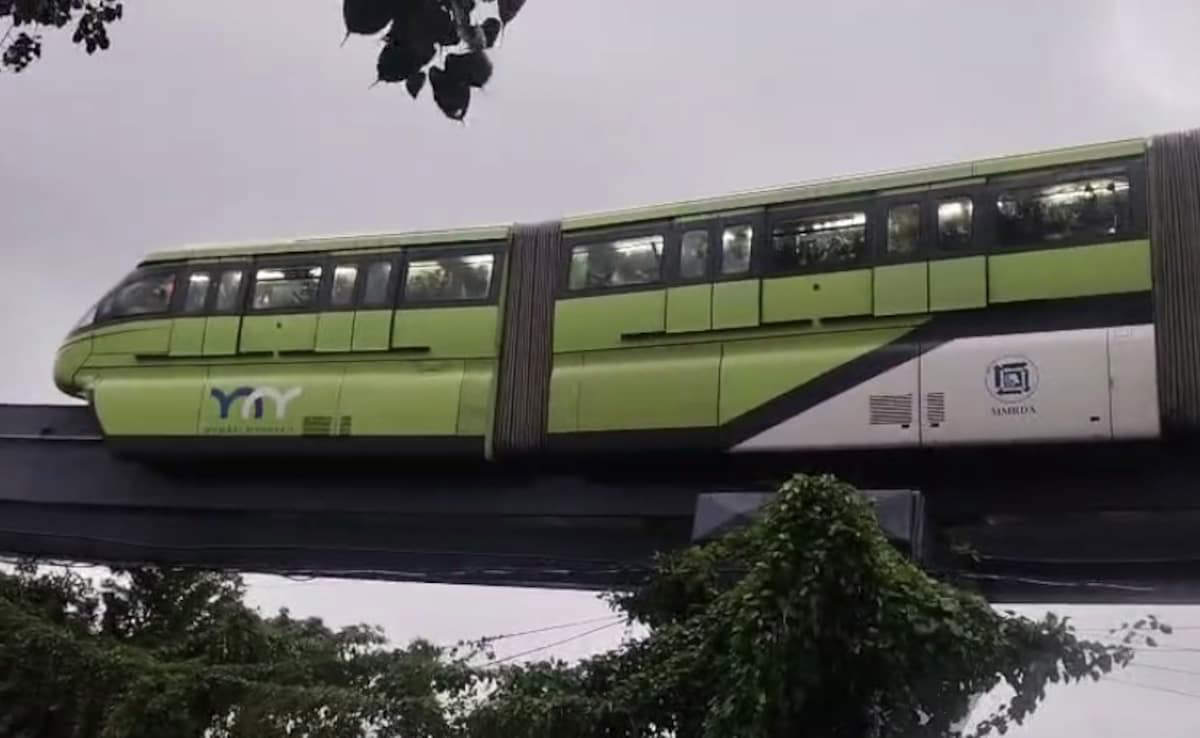
Mumbai’s troubled monorail has once again raised safety concerns after back-to-back breakdowns during torrential rains left over 1,100 commuters stranded between stations, forcing emergency rescue operations. The incident has revived debates on the viability of India’s only operational monorail, which continues to falter despite over a decade of investment and management changes.
According to transport officials, two separate trains stalled on elevated tracks on Tuesday evening due to power failures. One train, stranded near Chembur’s Mysore Colony, lost contact with the power line after coaches tilted beyond permissible limits, while another came to a halt near Antop Hill. Passengers, trapped in humid conditions without ventilation, eventually reached out to the fire brigade for rescue rather than the system’s control centre, exposing lapses in emergency response.
The Mumbai Monorail, launched in 2014 at a cost of ₹2,696 crore, was envisioned as a modern, space-efficient mass transit solution along congested corridors. Yet, more than 11 years later, it remains plagued by breakdowns, technical faults, and financial losses. With just five operational rakes, low frequency of services, and a daily ridership of merely 16,500 passengers, it has failed to integrate into Mumbai’s high-volume transport ecosystem.
Officials admitted that the incident was aggravated by poor crowd management. The system was designed to carry 562 passengers per train, but overcrowding pushed the load marginally higher. While authorities blamed excess passenger weight for the disruption, experts argued that the explanation was inconsistent with the system’s engineering standards, highlighting deeper flaws in the design and upkeep. The monorail has witnessed repeated disruptions over the years, including fires in 2015 and 2017, and multiple service halts between 2019 and 2025. Despite the Mumbai Metropolitan Region Development Authority taking over its operation in 2018 from private contractors, service quality has not improved significantly. Officials admit that procurement of spares remains a chronic challenge, while newly acquired trains await safety certification before entering service.
With losses crossing ₹550 crore annually, and operational costs far outweighing revenues, the monorail has increasingly been described as a financial burden. Experts have suggested repurposing its elevated viaducts for more practical systems, such as an elevated Bus Rapid Transit corridor, or alternative lightweight transport models. International precedents, like Jakarta’s elevated BRT lines, provide templates for how Mumbai’s underperforming monorail infrastructure could be retrofitted for mass use. For now, however, officials are compelled to keep the system alive. The monorail remains a crucial connector between three upcoming metro corridors and cannot yet be abandoned without leaving transport gaps. But the fresh chaos has once again underlined that without strong investment in sustainable, high-capacity, and reliable systems, Mumbai risks continuing to pour money into what many have begun calling a costly white elephant.