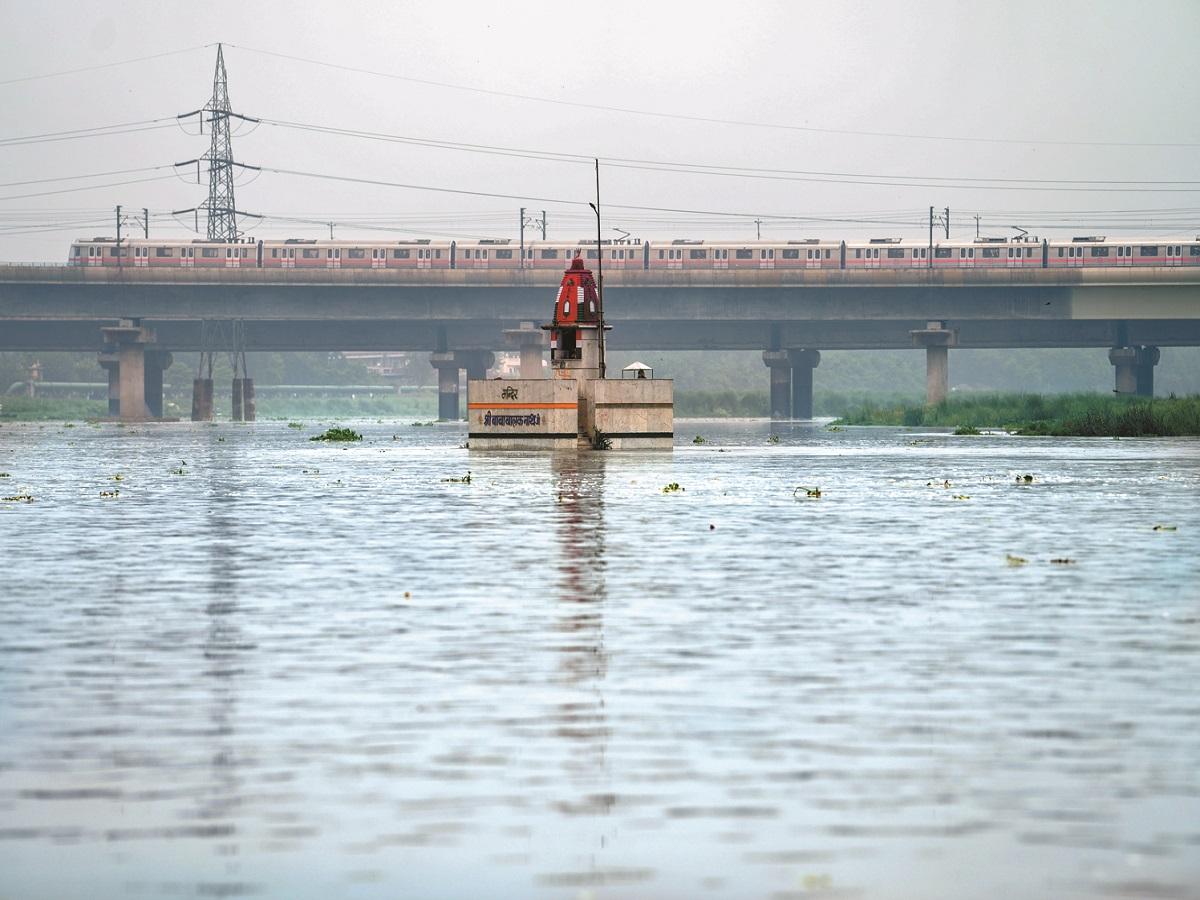
Delhis Yamuna Water Level Nears Warning Mark After Barrage Discharge
In Delhi, the Yamuna River water level is inching closer to its warning mark of 204.5 meters after over 50,000 cusecs of water was discharged from the Hathnikund barrage for the first time this season. Data from the Central Water Commission (CWC) indicated that the discharge peaked at 54,707 cusecs at 1 AM on Tuesday, with the water typically taking 48-50 hours to reach the capital. As of 5 PM on Tuesday, the water level at the Old Railway Bridge, a key benchmark, stood at 202.24 meters, signaling a potential rise in the coming days with more rain expected in the Yamuna’s upper reaches.
The CWC data further specified that the discharge at Hathnikund surpassed 50,000 cusecs at 9 PM on Monday and maintained that level for four hours until 1 AM, before slightly dipping to 48,974 cusecs by 2 AM. Last year, the Yamuna in Delhi did not reach the warning level, with the highest recorded level being 204.38 meters on September 26, 2024. The peak discharge from Hathnikund during the last monsoon was 87,018 cusecs.
In stark contrast, 2023 saw the Yamuna breaching its warning level significantly, reaching 208.66 meters on July 11. During that period, the peak discharge was a massive 359,760 cusecs, with multiple releases exceeding 100,000 cusecs. This led to widespread inundation in various parts of Delhi, including Mayur Vihar, ITO, Salimgarh bypass, and Civil Lines, resulting in the evacuation of over 23,000 people. Crucially, Delhi’s three main water treatment plants at Wazirabad, Chandrawal, and Okhla, which supply approximately 25% of the city’s drinking water, were temporarily shut down, severely impacting water supply.
Delhi designates 204.5 meters as the warning level and 205.33 meters as the danger level. Historical data from the Irrigation and Flood Control (I&FC) department over the past 63 years shows the warning level has been breached in 53 of those years, indicating a common annual occurrence. The river has surpassed the 205-meter mark in 43 years and the 206-meter mark in 14 years. The I&FC department has outlined a clear flood control plan. A first warning will be issued by the Central Flood Control Room if the Hathnikund Barrage discharge exceeds 100,000 cusecs, activating sector control rooms and deploying boats to vulnerable points.
A second warning is triggered at 300,000 cusecs, initiating warnings for residents within river embankments and arranging their relocation to safer areas. Typical arrangements for annual flooding also include placing multiple boats on standby for evacuation and establishing temporary shelters near areas like the Commonwealth Games Village and Hathi Ghat for people from low-lying regions. Flood preparedness was recently reviewed by Delhi’s water minister, who also conducted a boat survey of the river stretch to assess water levels and embankment conditions.